

Glory to Ukraine!
Glory to the defenders of Ukraine and all of modern civilization!
- The House of Representatives voted to pass Bill H.R.2913, the “Ukraine Support Act”: how the bill was passed, what might happen next, and the main provisions of the bill
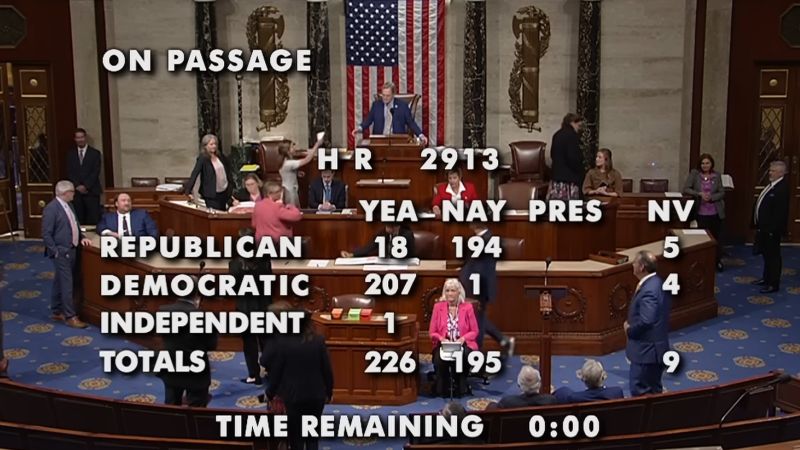
▶ On Thursday evening, the House of Representatives voted to pass Bill H.R.2913, the “Ukraine Support Act.”
226 representatives voted “For” (207 Democrats, 18 Republicans, and 1 Independent who left the Republican Party in March). 195 representatives voted “Against” (194 Republicans and 1 Democrat – the ultra-left Congresswoman Omar). 5 Republicans and 4 Democrats were absent.
This bill, introduced on April 14 by Democratic Congressman Gregory Meeks from New York, was included in the agenda and considered despite Speaker Mike Johnson, who refused to include the bill in the agenda. Congressman Meeks initiated a petition for its consideration. The House rules allow for the bill to be considered contrary to the speaker’s wishes if at least 218 representatives (50% of the constitutional composition of the House plus one) demand it. 218 signatures were collected by mid-May. It took a whole month to find four Republicans willing to sign the petition. Along with all 214 Democrats, the petition was signed by three Republicans and one Independent (former Republican). At this point, in mid-May, there were already 212 Democrats in the House of Representatives, not 214, but the signatures of a deceased representative and another representative who resigned remained valid. The collected 218 signatures allowed the bill to be considered despite the speaker. According to the regulations, it had to be considered within seven session days.
Speaker Johnson sent the House on a 10-day recess. Then he delayed until the last, seventh session day. On Wednesday, he gathered the entire Republican faction and urged his party colleagues to vote against the bill, arguing that the bill complicates negotiations with Russia for the president.
The speaker’s persuasion did not help. 18 Republicans voted against Johnson’s wishes and, of course, against Trump’s wishes. The bill was passed.
This event is a serious political blow to both the president and the speaker. It is a rare instance where part of the majority faction goes against the president representing their party and against the speaker from their own party, giving enough votes together with the minority opposition faction for a bill opposed by both the president and the speaker to be passed.
Before briefly discussing the content of the bill, it is necessary to explain what might happen with this bill next.
For it to become law, it must be passed by the Senate in the same version and signed by the president. If the Senate passes it and the president vetoes the bill, a 2/3 vote in each chamber is required to override the veto.
Each chamber of Congress operates according to its own agenda. The Senate is not formally required to consider bills passed by the House of Representatives, and conversely, the House is not required to consider bills passed by the Senate. If one chamber passes a bill and the other does not consider it, such a bill cannot become law.
According to its rules, the Senate’s agenda is set by the majority leader. Today, it is Republican leader John Thune. He decides which bills to consider and when, and which not to consider. There is no mechanism for collecting signatures to force the consideration of a bill in the Senate against the wish of the majority leader (unlike in the House of Representatives).
Thus, whether this bill will be considered in the Senate depends on whether Republican leader Thune includes it in the agenda. Since Thune became the Republican majority leader in the Senate on January 3, 2025, he hasn’t included any bills in the Senate agenda that Trump did not want to be passed.
Therefore, it’s easy to see that there are three possible scenarios for further developments.
The first (let’s say, the most likely). Thune does not advance the bill because Trump does not want it to pass.
The second (let’s say, significantly less likely). Thune includes the bill in the agenda against Trump’s wishes, and the bill passes if enough Republican votes are found.
The third (practically improbable, but, as they say, never say “never,” even if the probability is close to zero). Trump does not object to the bill being considered, and it is considered and passed.
Is it possible to achieve developments according to the second scenario?
The United States, at least for now, remains an electoral democracy. And in an electoral democracy, members of parliament depend on their constituents. To try to get Thune to include a bill in the agenda, it’s necessary to write to and call Republican senators. If there are many such calls and letters, it works. Especially in an election year, this affects those who are up for reelection. The primaries are ending, and Republicans in Congress, afraid of Trump and the possibility that he will oppose them in the primaries with his supporters if they disobey him, will fear him less. The closer the elections, the more they will have to heed their constituents who can show them the door. Especially considering Trump’s policies have led to Republican candidates receiving 12-15% fewer votes in all elections, regular and special, conducted over the past year, regardless of whether they are in “red” or “blue” states, than in 2024.
Even 3-4 months ago, it was hard to imagine Congress passing bills or resolutions opposed by Trump (there was a single exception—the law on the publication of Epstein files, which, however, was considered through the petition mechanism with signature collection). Now, some Republican members of Congress are forced to consider their constituents. Several more Republican lawmakers will not be able to run for reelection as they lost the primaries to the president’s supporters. Some Republicans themselves declined to run for reelection because they didn’t want to be defeated in the primaries.
The most indicative example of changing sentiments among some Republican lawmakers is the bill to support Ukraine. Only three Republicans initially agreed to sign the petition for its consideration. But three weeks after its signing, 18 Republicans voted in the House of Representatives for this bill. Another example is this week’s vote by four Republicans in the House of Representatives alongside all Democrats for a resolution prohibiting the president from further military actions against Iran without Congress’s consent. And this resolution was passed.
Now about the content of the bill. It is very comprehensive and consists of many sections.
✓ Its key provision is the renewal of the Lend-Lease Act for Ukraine from the moment the law takes effect until September 30, 2028. This gives the president the right to sell weapons and ammunition to Ukraine on credit with appropriate deferred payment contracts for each such sale.
✓ The bill provides $8 billion in loans to Ukraine and NATO allies to purchase American weapons and ammunition.
✓ Annual funding for the Ukraine Security Assistance Initiative is restored—$300 million per year until December 31, 2027. Since 2016, these funds have paid for orders to manufacture new weapons, weapon systems, and ammunition for Ukraine.
✓ The bill requires the administration to continuously provide Ukraine with necessary intelligence information, with a report on the provided information to the intelligence committees of both chambers of Congress.
✓ The bill obliges the president, in the event that 15 days after the law comes into force, Russia continues the war against Ukraine, refuses to engage in real peace negotiations with Ukraine, or violates a possible peace agreement with Ukraine, to impose sanctions:
-
- against the main banks of Russia, including its central bank;
- against the entire oil and gas extraction sector of the Russian economy;
- against the coal mining sector and all mineral extraction in Russia;
- against “Rosatom” and other relevant structures for the seizure and occupation of the Zaporizhzhia NPP;
- The US is obliged to coordinate with G7 countries to maintain a price cap on Russian oil and sanction all discovered ships of the Russian shadow fleet.
- The US is obliged to block all transactions for Russian financial institutions.
Separate sanction packages are provided for the abduction of Ukrainian children by Russia and Russia’s military cooperation with North Korea.
-
- For any import from Russia to the US, the importer must pay a 500% duty.
✓ The bill establishes the full funding and operation (broadcasting) of the Radio Free Europe/Radio Liberty corporation.
✓ A separate section of the bill is dedicated to supporting the Baltic countries.
✓ The bill provides for broad US participation in the post-war reconstruction of Ukraine, with the creation of an appropriate fund by the US government.
✓ A special section of the bill establishes that
“(1) The United States reaffirms its full and unwavering commitment to NATO;
(2) NATO plays a vital role for the national security interests of the United States, and the US maintains full commitment to defending its allies in accordance with Article 5 of the North Atlantic Treaty;
(3) NATO’s ‘open-door’ policy is crucial for European security, and every sovereign state, including Ukraine, has the right to independently determine the mechanisms of ensuring its own security.”
Remember – on Wednesday, Speaker Johnson was persuading his Republican colleagues at a specially convened faction meeting to vote against this bill. For one real reason – to do everything according to Trump’s wishes. But he did not convince 18 members of his faction. What might happen next, we have already analyzed above.
There are 961 days left until the end of the story titled “Fear: Trump in the White House” © (the title of Bob Woodward’s book, published in 2018).
Thank you to everyone who read. Take care of yourself and your loved ones. Take care of each other, help each other. Health to all.
Ultimately, what happens in the world depends on us. Whether we fight evil, do good, remain mere observers, passively wait and believe someone somewhere will decide for us, or fight evil and do everything possible for good to prevail.
We must not allow evil to prevail. The victory of evil would mean the end of the world we live in. We cannot allow this. Especially now.
Ukrainian friends, I embrace and love you all. Please take care of each other.
Ukraine is and will always be.
And evil will be defeated and punished. And that is inevitable.
