

There is a similar problem with the Poles as with Hungary: part of their society is post-imperial, poisoned by phantom pains. Yes, there is a strong pro-Ukrainian movement in Poland. Just as there were fervent Ukrainophiles in the Polish-Lithuanian Commonwealth in the first half of the 17th century. But the anti-Ukrainian current on their historical maps marks territories up to the Dnipro, prides itself on Bolesław the Brave and past greatness, and is offended by the deserved historical defeat received in 1939, when they, together with Hitler, first divided Czechoslovakia and then were divided themselves.
And if this part wins the elections in the country, it means their ideas are popular.
AND WILL BE popular!
All those hopes to “convince” their populists — “if we are good to them” — are as naïve as the hopes to convince Orbán.
These days I have read suggestions that we need to “not aggravate,” “organize joint flower-laying,” “propagate the formula ‘we forgive and ask for forgiveness’.” All of this is correct.
But everyone reflected on Nawrocki’s phrase about their Eagle’s order, yet few noticed another much more important part of his speech: it contained veiled threats to block our entry into the EU over UPA.
Before joining the EU, each country has the right to veto the entry of a candidate country, and therefore each country can theoretically demand some concessions from the candidate. So Nawrocki practically stated directly: “Ukraine will either abandon the memory of UPA, or it has no place in the European family of nations.”
Nawrocki knows perfectly well that the EU doesn’t care about the proud plucked Polish eagle and their grievances towards UPA. But he knows the procedure for EU accession.
That’s all. You can present any arguments to him, be thrice as good and “not escalate,” but the opponent already understands that they can twist your arm. And a realistic view of international politics says: if the other side gets a leverage, it will use it — simply because it can. Just like Orbán did, who didn’t care about all the arguments.
This poses a problem for Ukraine of a different strategic order than hoping that compliance or joint flower-laying will change the logic of political struggle within Poland or Bulgaria.
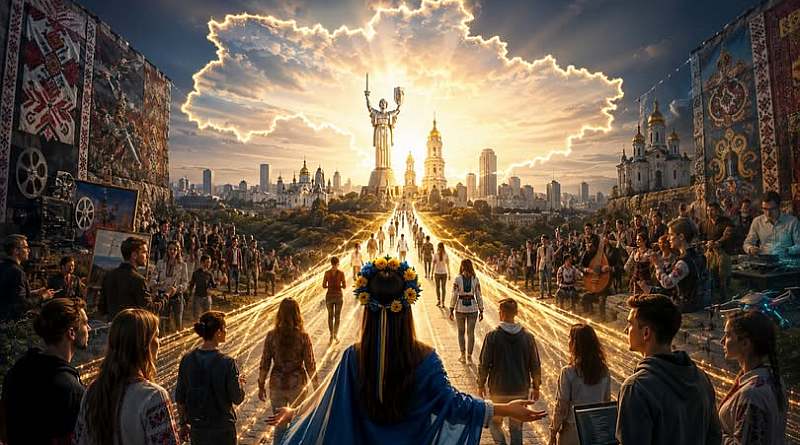
The solution: Ukraine must begin to develop its own soft power strategy among neighbors.
Traditionally, Ukraine has been very weak in working with cultural influence abroad compared even to Poland and Hungary, let alone Russia. Many states have invested for decades in:
• cinema;
• cultural institutes;
• popularization of history;
• educational programs;
• media for a foreign audience.
We need to adopt this strategy as well.
Objective: to create a strong loyal movement in each neighboring country.
The stronger the Ukrainophilia in the neighboring country’s society, the more challenging the environment for anti-Ukrainian populists and idiots will be.
We need to offer a pro-Ukrainian ideology that is interesting to other states.
I have said many times, we need to build sympathy for Ukraine among neighbors based on two simple principles:
1) Culture of strength. The cult of strength is the foundation of all religions and cultures.
Therefore: Armed Forces of Ukraine, heroic resistance, “David vs. Goliath,” celebrate the deeds of heroes, films about our Ukrainian Rambo, our James Bonds. Our culture has survived in conditions where others disappeared. Now its task is to carry Ukraine to the world. We need to create a stylish visual aesthetic, like the horned helmets and tattoos of the Vikings. We must spend money on cultural grants for our artists.
J.K. Rowling — once a single mother, with barely anything in her fridge, finished Harry Potter thanks to state support. Now Harry Potter tells the world’s young generation more about Britain than the British Ministry of Culture.
We too should flood the world with our culture, even like the South Koreans (Hallyu — Korean wave). We have a wealth of material for this. But we need to build a structure that can realize it.
2) Shared history and culture with neighbors.
Everyone in the world seeks their roots. Thus, we should preach: “We have common roots and centuries-old ties.” Ukraine is the Motherland of all Slavic peoples. Like Mecca for Muslims. We need to promote common culture, revive shared traditions, seek common history and origins of Slavic peoples (and even broader — Indo-European). This has potential; it can be filled with meaning.
For example, the support for Israel from US citizens is not entirely based on the AIPAC lobby. Largely, this support is built on millions of evangelical Christians, for whom Jerusalem is their Mecca.
Yes, the idea of their younger brotherhood may provoke negativity among right-wing Poles, as the Polish right discourse (even moderate) has historically been very jealous of its primacy in the region. They even propagated pseudo-historical nonsense about Ukrainians’ origins from Poles in the past century. But modern research has put an end to this. We are unlikely to heal all their grievances of humiliation, but that’s not our job. We need to take the core of right-wing ideology from all neighbors — the part about love for their roots — and give them sympathy for our land.
And through these two points, build a bridge in the consciousness of neighbors to the modern us. You all — Czechs, Bulgarians, Poles, Slovaks — are just as cool and strong as Ukrainians, we are all cool together because we all come from the same roots.
The USA, China, Russia, Poland, and even Hungary would not invest in soft power if it did not work.
Ukraine has for too long built external policy only through states and elites and not enough through societies. We must not only negotiate with governments but also work with:
• students;
• artists;
• ethnographers;
• bloggers and journalists;
• historians;
• local communities.
This is how an environment is gradually formed where anti-Ukrainian rhetoric becomes politically losing.
Without this: a new day – a new Orban. And they will all eternally want something from us.
We must reach a situation where a Czech, Hungarian, or Pole has to question who is closer to them—their own populist who has said something against Ukraine, or a Ukrainian neighbor. And when the neighbor ostracizes their Ukraine-phobes, we have won.
But the third pillar is also important.
History shows that affinities between states are most durable when people see practical benefits from cooperation. Therefore, alongside the heroic image of Ukraine as a motherland, it is worth building the image of the country as a place of:
• talented engineers;
• IT specialists;
• military innovators;
• brave entrepreneurs.
Neighbors should not only see a Ukrainian as the “brave person with a gun” who conveniently protects everyone. Nor even as a “high-quality specialist,” because this turns into a “specialist hired for peanuts,” who can be prodded with a stick.
Ukrainians should be seen as leaders. A Ukrainian is no longer a pushover. A Ukrainian is now the bearer of unique experience, which gives them the right to speak their mind, rather than listen to lectures.
* * *
This is a long game. It will not yield results in 2 or 5 years. But it will yield results in 10-15 years. Future children will thank us, unlike us who consider the previous generation clueless. The life span of one generation can change everything.
When youth in neighboring countries grow up with a positive image of Ukraine, then their Orbans and Navrockis will simply stop winning elections.
