
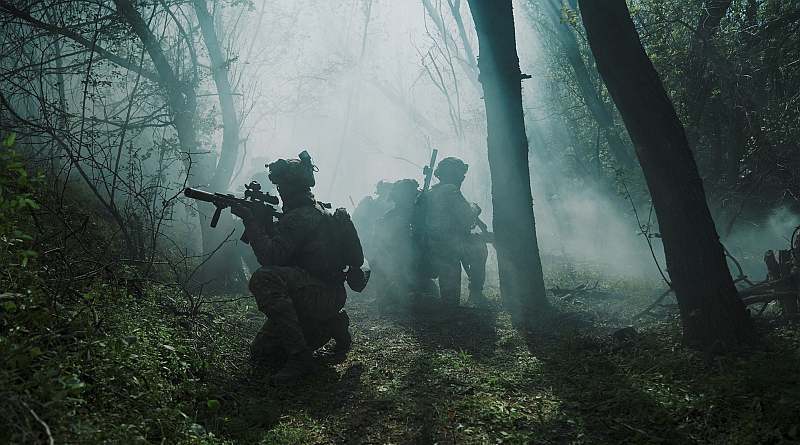

We continue in the format — “briefly, from different directions”
1. Kupiansk direction
The enemy (Russian forces) continues attempts to eliminate the Kupiansk bridgehead of the Armed Forces of Ukraine on the Oskil River, concentrating its main efforts on its northern and eastern parts.
The main grouping of enemy troops tasked with this mission includes units and formations of the 1st Tank Army (TA) from the “West” grouping — the 47th Tank Division (td), the 27th Separate Motorized Rifle Brigade (omrb), and several units of the 4th Tank and 2nd Motorized Rifle Divisions (td/mrd) of the same army.
They are also reinforced by a number of forces and means from the “North” grouping, primarily concerning the 68th Motorized Rifle Division (mrd) of the 6th Combined Arms Army (CAA) and separate parts and units of the 11th Army Corps (AC) of the “North” grouping, operating from their bridgehead on the Oskil River north and northeast of Kupiansk directly in the operational zone of the “West” grouping.
As I understand it, the essence of the plan of the “West” grouping command and the 1st TA, particularly those likely exercising overall (operational) control of this grouping’s actions, was to split the Ukrainian bridgehead with two concentric “blows” from the north and east, break into the eastern part of Kupiansk (the so-called “Zaozkol” area) and the Kupiansk-Vuzlovyi area. Then eliminate its “fragmented” remnants “in turn.”
However, even after persistent but unsuccessful attempts to deblock the remnants of assault groups of the 68th mrd, previously surrounded by the UAF in Kupiansk, and conducting a large-scale regrouping of forces and means in their 1st TA sector, the enemy is, let’s say, still quite far from achieving this result. Although they have been actively trying to capture Kupiansk itself since about the beginning of last autumn.
In the last 1.5-2 months of fighting in the Kupiansk direction, the enemy has managed to achieve only limited tactical results, including:
– He managed to advance in the northern part of the bridgehead towards Vilshana — Petropavlivka approximately 4.5-4.7 km, starting battles for the latter, and finally capturing almost the “sister village” of Mala Tokmachka – the settlement of Synykyivka. At the same time, the Armed Forces of Ukraine confidently continue to hold “Zaoskillia,” Kucheriivka, and part of Petropavlivka. Numerous enemy attacks from Lyman Pershyi, through the forested area northeast of Kupyansk, along the Oskil and the railway leading to the city from the north, did not result in significant success for them. Only individual small Russian infantry (assault) groups were again observed in the area of City Lyceum No. 7 and the Milk Canning Factory area. However, the enemy has not been able to achieve (restore) stable control over even one of the city’s districts within its limits.
– In the eastern part of the bridgehead, Russian troops, who also operated along the railway leading to Kupyansk from Stepova Novoselivka, managed to occupy Pishchane and advance with separate small infantry (assault) groups to Kurylivka (where they occupied several buildings on both banks of the Lozovatka River in the eastern part of the village) and Kivsharivka (entrenching in several shelters on the northeast outskirts of the settlement). Overall, this spring, the enemy’s offensive in the 47th Tank Division’s sector extended in depth on average about 5.4-5.5 km.
Russian troops on the Kupyansk direction still have not managed to capture or take stable control of Kupyansk-Vuzlovyi, Kurylivka, and Kivsharivka, and they still cannot achieve this. Separate Russian servicemen who are in the latter two settlements are currently more concerned with their own survival than continuing active offensive actions towards Kupyansk-Vuzlovyi.
However, all this does not mean that the command of UV “Zapad” and its 1st TA, in particular, have resigned to the existing state of affairs on the Kupyansk direction. The enemy continues, using so-called “small” and “very small” infantry groups, to make quite active and intense attempts to “penetrate” the combat formations of the frontline subdivisions of the Armed Forces of Ukraine in this direction. Specifically:
– Such attempts were recorded between Kucheriivka and Petropavlivka (along Lisova Street and the small Hnylytsia River). In addition, quite fierce battles regularly take place in Petropavlivka and Kucheriivka themselves. The enemy occasionally also attacks from the direction of Lyman Pershyi, trying to break through with larger forces to the northeast part of the city and its eastern outskirts.
– Such attempts also regularly occur towards Pishchane — Kupyansk-Vuzlovyi. Moreover, the enemy clearly seeks not only to “cling” to the latter but also to “spread out,” so to speak, “as widely as possible” to the surrounding villages — from Podoly, Novoosynove to Hlushkivka. Timely detection and further “capture” of these “infiltrators” due to the significant personnel shortage in the frontline subdivisions of the Armed Forces of Ukraine is quite a challenging task.
– Moreover, over the past several “extreme” weeks, Russian units have also become more active in the southern part of the bridgehead. From the area northwest of Tabaivka, their separate small infantry groups are trying to advance generally towards Novoosynove. Thus, there they achieved a “small” tactical success — simultaneously on three sections, they managed to advance on average a distance of 300-500 meters.
2. Borova Region
The Russian 4th Tank Division (TD) of the 1st TA, along with attached forces and means, with the “support” of part of the forces of the 3rd MSD of the 20th ZVA, continues its persistent attempts to “cut off” the Ukrainian salient in the Borova area and reach the Oskil with a broad front.
In fact, both armies of the UW “Zapad,” the units and formations of which are operating in this area—1st TA and 20th ZVA, are likely seeking some “synchronization” of offensive actions on their adjacent flanks to ensure the advance of their forward units to the Oskil with a rather broad front (approximately from Kruglyakivka to Pisky-Radkivski).
However, in my opinion, this rather “bold” operational-tactical aspiration of the UW “Zapad” command is unlikely to have significant chances of successful implementation as of now. At least in the near future. Particularly for several reasons simultaneously:
– It is evident that the main attention of the Russian UW “Zapad” command is currently focused on the flanks of its operational zone—Kupiansk direction (the 1st TA span—its right flank) and Lyman direction (span of the 25th ZVA and the left flank of the 20th ZVA). It is there that the main operational-level reserves of this operational-strategic grouping of enemy forces are concentrated. Therefore, their command can “strengthen the offensive” on Borova with only a limited reserve component, and even then, obviously for a very short time. The situation, of course, could change if the command of UW “Zapad” decides that the breakthrough and reaching Oskil on a wide front is much more important than eliminating the Lyman bridgehead of the Armed Forces of Ukraine or capturing Kupiansk.
– To reach the Oskil River on such a front, the Russian command will have to “on the way” solve, I would say, a series of smaller (tactical) tasks, which in themselves are quite challenging. In particular, it is necessary to eliminate the Ukrainian “mini-bridgehead” in a kind of “triangle” Zahrizove—Nova Kruglyakivka—Bohuslavka, to “capture” Novoplatonivka and Borova, break through south of the Borova—Svatove road (towards Shyykivka and Kopanky), bypass or assault the heights west of the Chornyi Zherebets River (towards Novoyehorivka and northwest of Hrekivka), and finally break through to Pisky-Radkivski through Maliivka. Objectively, it should be noted that each of these tactical tasks in itself will require from the Russian forces more than a week of stubborn fighting (consider, in this respect, the assault and capture of just Borova, for instance) and exertion of all their strength.
– The formal composition of the forces and means of the Russian grouping attempting to advance to Oskil towards Borova looks quite convincing: from the 1st TA—the 4th Tank Division (TD), reinforced by part of the forces of the 2nd MSD of the same army, and from the 20th ZVA—the 3rd MSD, reinforced by separate units of the 144th MSD of the same army. This is quite comparable to what is currently trying to advance, for example, on Kupiansk—the 68th MSD (6th ZVA) and the 47th TD (1st TA) + 27th Marine Brigade.
However, the Russian military grouping advancing on Borova faces a significantly longer line of contact (LoC) than the groupings operating towards Kupiansk or Lyman (in this sense, it is enough to compare the size of the Ukrainian bridgehead in the Kupiansk area with the similar indicator of the Armed Forces of Ukraine’s bridgehead in the Borova area).
Moreover, in terms of its combat and numerous composition, the “Borovskoye” group of Russian troops clearly lags behind them. In other words, it currently cannot ensure the appropriate level of density in its combat formations (operational construction) necessary for successful, and most importantly, SIMULTANEOUS and rapid advancement to the Oskol along its entire line.
This is why the command of the Russian parts and units operating in this direction strives to accomplish the above-mentioned task exclusively step by step, concentrating efforts sequentially on individual sectors and directions.
Currently, it’s the zone of the 4th Tank Division of the 1st Tank Army, and specifically, the enemy has been conducting intensive offensive actions in the following directions:
– Borovskaya Andriivka – Novoplatonivka,
– Borovskaya Andriivka – Borova,
– Zelenyi Hai – Shyikivka,
– Pershotravneve – Kopanky.
Meanwhile, in the zone of the 3rd Motor Rifle Division, the enemy operates less intensively, mostly limiting itself to maintaining its own forward positions, but from time to time still attempting to advance in the tactical zone near Novovodyanoye and Grekivka.
At present, the enemy has managed to reach the highway (R-79) and railway roads running along the Oskol (along its eastern bank) in the section between Novoplatonivka and Boguslavka, and will probably secure there with several separate infantry groups. This, in turn, has significantly complicated the logistics (MTO) of several Ukrainian units, which continue to defend in the areas of Zahryzove, Boguslavka, and Nova Kruhlakivka. Obviously, in the area of Kopanky, Ukrainian units were also forced to retreat southward, where the enemy has probably already managed to engage in a fight to seize this village. However, in key directions (toward Borova and Shyikivka), it has still not achieved a significant (even in a tactical sense) result.
In the next review, we will examine the Lyman direction, where the current situation is changing quite dynamically.
Photo: Command of the Special Operations Forces of the Armed Forces of Ukraine
