
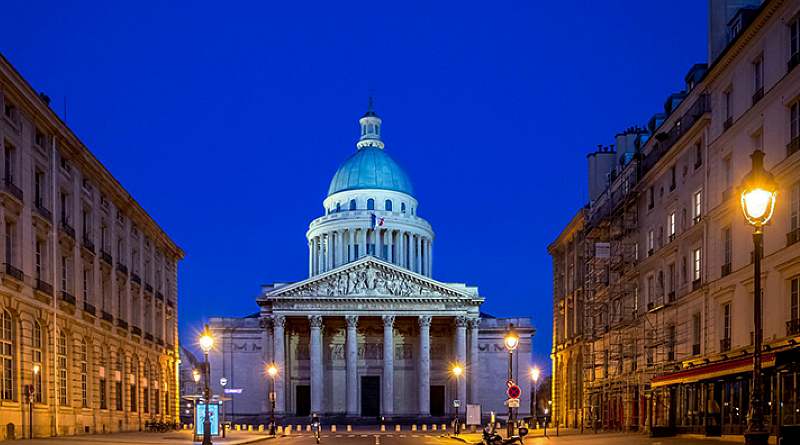
The story of the reburial in France of Emperor Napoleon Bonaparte’s remains—after his defeat at Waterloo, the famous commander and politician was sent by the allies to the island of Saint Helena, where he soon died—is considered one of the best examples of historical reconciliation. Especially since the decision for this reburial was made not during the Republic or even during the short restoration of the Bonaparte dynasty, but when France was ruled by the last of the Bourbons, King Louis-Philippe. But the next question is: where did Napoleon find his final resting place?
Great French figures are usually buried in the Panthéon in the center of Paris (in the photo – Ed.), a majestic building known to every visitor of the French capital. In the Panthéon, you can approach the graves of Voltaire, Mirabeau, Hugo, Zola, Dumas, and others. There are also the graves of well-known politicians, such as Gambetta and Jaurès. And military leaders. Yet, Napoleon’s grave is not here.
The emperor was buried in another pantheon—the pantheon of the Hôtel des Invalides. Here, only military figures are buried, although Bonaparte is buried next to his family members, including his young son Napoleon II, “L’Aiglon,” who, of course, did not have the chance to become a commander. However, this burial alongside marshals and admirals emphasized the military achievements of the emperor—one might judge his political legacy and his rights to the throne differently, but very few in the world would question Napoleon I’s military genius. And it was the acceptance of Bonaparte the military leader that reconciled the French.
This French lesson can help understand how to approach Ukrainian memory. Now, amidst the war, we are witnessing a pantheon of people who advocated for Ukrainian independence and were ready to fight for it—either with weapons or with the pen. It must be understood that during their real lifetimes, not their lives in our memory, these people mostly represented a minority of the Ukrainian people. Even fewer were willing not only to support them but to actively champion their cause—perhaps only in critical historical moments, such as wars and uprisings, could they count on the support of a relative majority. Remember that even after the proclamation of Ukraine’s independence in 1991, the word “nationalist” continued to be used, if not as an insult, then at least as a sign of political marginality in much of the restored state’s territory. And yes, it seems obvious to me that this was and remains a manifestation of national schizophrenia—if the state exists, its heroes should primarily be those who fought for its creation when it wasn’t popular among the majority of their compatriots. I cannot imagine Israel not honoring the founders and leaders of Zionism, such as Herzl or Jabotinsky (also buried in Jerusalem on Mount Herzl, an equivalent of the Pantheon), but instead honoring only those Jews who cared about the development of Jewish culture or were scientists but were not interested in statehood.
But such people also have every right to remain in our grateful memory – hence the “other pantheon.” There are outstanding writers who survived in foreign empires and even served them, but without their words, Ukrainians would likely not remain Ukrainians. There are great singers who performed on Viennese or Moscow stages, yet still remained examples of Ukrainian national genius. There are scientists who developed science in Ukraine or became examples of Ukrainian participation in world science development; after all, Ukrainians still know very little about their diaspora. Religious figures who were hierarchs of foreign Churches in times when there was no Ukrainian Church. There are many such examples, and I will be told that among these figures are people with very ambiguous reputations – that is a fact. Yes, and among the politicians and military figures of the “first” pantheon, there are people with very ambiguous reputations, people who made such fatal mistakes that they literally halted the development of the Ukrainian nation. But the question of evaluating a personality is in the overall contribution and intention, not in the mistake itself. Unfortunately, there are very few unambiguous personalities in history. Unambiguous personalities look at us from icons, and even then…
Well, another important approach is that there cannot be a place in the pantheon of our memory for those who consciously worked to make sure Ukraine did not exist – who were agents of destruction and used positions or talent for that. Let those who betrayed Ukraine and the Ukrainian people be celebrated by the states whose interests these people tied their fates to, but not us! This does not mean, however, that we can simply erase such figures from Ukrainian history and pretend they weren’t there. No, a full-fledged nation, a nation without complexes, does not forget either its heroes or its traitors.
I intentionally do not mention any Ukrainian surnames in this text because any attempt at examples will turn the discussion into hysteria. I want us to think not about graves but about our ability for grateful memory – memory of those who dreamed and fought for an independent Ukraine, and memory of those who dedicated their lives to the Ukrainian people as such at a time when it was not such a popular endeavor, but a matter of choice and even sacrifice, losing the “great” world of empires and their prospects. Of course, the inability to reconcile state and nation in one’s choice was a true Ukrainian – though not exclusively Ukrainian – tragedy. But that is how the history of Ukrainian lands unfolded, which cannot be rewritten to suit contemporary needs.
However, to suit contemporary needs, we can simply try to unite these two different pantheons in national gratitude.
