
Timothy Garton Ash / Translation by iPress
British historian Timothy Garton Ash argues that Putin’s regime, despite signs of internal exhaustion, remains dangerous—and only death or Russia itself can remove him from within. He outlines eight elements of a strategy aimed at containing the Kremlin’s external ambitions: from supporting Ukraine and strengthening sanctions to deterring new aggression and countering populists within Europe. The central idea of the article: democracies do not have to always “do” something—their most important task is to keep their societies strong, prosperous, and attractive, and win through strategic patience. Time is on the side of those who can wait.
No dictator is eternal. Eventually, Putin will leave. Recent reports indicate an increasingly weak Russian economy, social discontent, and a decline in confidence within the regime. However, concluding that the end is near would be imprudent. Only death or Russia itself can overthrow Putin, and no one knows when and how that will happen. What the democracies of Europe and other parts of the world can do is refine a strategy to contain his external ambitions. Below is a non-exhaustive list of eight elements of such a strategy.
1. Have a clear goal. Putin seeks to subjugate Ukraine, restore as much of the Russian empire as possible, undermine trust in NATO, undermine the European Union, and reestablish a Russian sphere of influence over Eastern Europe. Preventing him from achieving these goals means defeating him.
2. Stay the course on Ukraine. On June 11, Russia’s full-scale war against Ukraine will last longer than the First World War. Ukraine’s achievements in confronting a much stronger opponent are impressive. Given the impact zone created at the front by drones, this war is unlikely to be decided on the frontline, but both sides are striking deep into each other’s rear—targeting energy infrastructure, the economy, and morale. President Donald Trump’s withdrawal of support for Ukraine complicated its defense but did not paralyze it. The fall of Viktor Orban in Hungary unlocked 90 billion euros of European economic support, which is to cover the Ukrainian budget until the end of 2027. Various scenarios are possible, but the most likely one is that this war will continue to move slowly for a long time.
3. But it will not end even when it ends. Unlike Victory Day in 1945, we will not know who won at the moment the gunfire stops. The onset of “peace,” most likely in the form of a ceasefire that will turn into a prolonged freezing of hostilities along the current front line, will become another dangerous moment for Ukraine. Inside the country, all the social contradictions and traumas accumulated over years of war may explode during an acute presidential election campaign and extremely polarized subsequent politics. Externally, Europe’s attention may quickly shift elsewhere—just as it turned away from Bosnia after the Dayton Peace Agreement in 1995. Unfortunately, a future is entirely possible in which four-fifths of Ukraine, not occupied by Russia, turn into a depopulated, internally conflict-ridden, failing state. This would be a victory for Putin’s plan “B”—to destroy Ukraine if it cannot be conquered. Only when Ukraine becomes a relatively prosperous, secure, stable, and democratic member of the EU can we say that Putin has been defeated there.
4. Intensify economic pressure on Russia. A paradoxical consequence of the war against Iran chosen by Trump is the rise in Russia’s oil and gas revenues and partial easing of sanctions. To defeat Putin, the opposite must happen. In addition to tightening sanctions and supporting Ukraine’s long-range strikes on Russia’s energy infrastructure, Europe must fight harder against Russia’s “shadow fleet.” Nearly half of Russia’s oil exports pass through the Baltic Sea—often on tankers already under sanctions.
5. Deter a new Russian attack. Significant attention is given to organizing a five-to-ten-year transition from the current US-dependent European security to a state where Europe can defend itself. But the highest risk of Russia attacking NATO and EU territory likely falls in the early years of this transition—especially in 2027-2028. Putin is an old man who lacks time, obsessed with restoring Russia’s greatness, and, as is customary with long-standing dictators, increasingly detached from reality. He has a large, battle-hardened army and a military economy. He faces a Europe that is just beginning to rearm, and a US president who is unlikely to want to uphold the Article 5 NATO commitment to defend an Eastern European ally if attacked. However, Putin can rely on Trump in the White House only until January 20, 2029. So this is his best, and possibly last, chance to demonstrate that NATO is a “paper tiger.” This does not require a massive frontal assault: it is enough to seize a few square kilometers in Estonia, Lithuania, on some Baltic island, or elsewhere on the eastern flank.
Even if the likelihood of such an attack is low, the accompanying risk is so great that strengthening deterrence is extremely necessary. If we could rely on the US president, the current deployment of NATO forces under American command would be sufficient. Since we cannot, we urgently need an alternative strategy whereby European forces (including, notably, the German), currently under NATO commands, along with those operating in regional formats — such as the British-Nordic-Baltic-Dutch Joint Expeditionary Force, could independently deter such an attack. This is exceedingly difficult—and extremely necessary.
6. Not just defending on the hybrid front. A remarkable recent document from the European Council on Foreign Relations argues: given the scale of Russia’s hybrid campaign against Europe, we should not only defend ourselves—we also need to destabilize the enemy and, within clearly defined limits, go on the offensive. (More details —in this document.)
7. Talking to all Russias. Discussions continue on whether to authorize a high-ranking European representative to talk to Putin. But what would such a representative say—even if Putin were listening? Yes, it’s worth keeping channels of communication with the Kremlin open, including secret ones. But the only language Putin truly understands is military and economic power, backed by political will.
More important is talking to the three other Russian audiences: the business, professional, and even bureaucratic elites remaining in the country; the broader Russian society; and the “other Russia”—those currently living mostly outside of Russia and desiring Putin’s defeat more than anyone. Despite the differences in specific messages, they are united by the common thought: “Other relations with Russia are possible, if…” In the short term, this changes little, but it may bear fruit when the moment of change comes.
8. Neutralizing our own nationalists. So far, Putin does not have a full-fledged substitute for Hungarian Orbán as a “veto-player” at the negotiating table in Brussels. Slovak Robert Fico cannot compare. However, anti-liberal, populist, nationalist parties continue setting the tone elsewhere in Europe. Jordan Bardella as President of France in 2027, or even more so “Alternative for Germany” (AfD) as the largest party in the Bundestag in 2029, would give Putin new opportunities to split Europe from within.
Do nothing extra – just hold on. I have spent more years of my life than I would like to remember studying Western policy towards the Soviet Union. One conclusion was obvious: the most important thing we did to win the Cold War was not any particular foreign policy step, but that we kept our own societies safe, strong, prosperous, and attractive—and “just held on.” Likewise now. Significant political changes in Russia could happen tomorrow—or not for another ten years. The hardest task for a diverse community of liberal democracies is at the same time the most important: strategic patience. Achieve it—and time will be on our side.
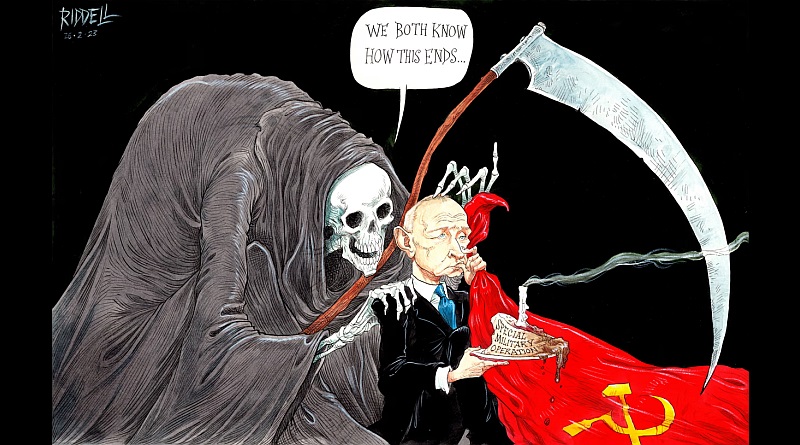
Illustration: Chris Riddell
