

Oleksandr Kovalenko / Obozrevatel
A year ago, the Ukrainian information space discussed the notion of “a thousand ‘Shaheds’ every night,” but now a similar, yet much more realistic threat is being discussed in Russia. The trigger was the drone attack on Moscow on May 17, and today Russian “experts” are concerned about the question of when Ukraine will be able to launch a thousand or more drones.
More about this in the joint project material by OBOZ.UA and the “Information Resistance” group.
It is an undeniable fact that since 2022, Ukraine has improved the capabilities of its drones for strikes on Russia and diversified the modifications. Moreover, Ukraine has not only achieved parity in terms of quantitative use but has also started launching more of these means against the Russian Federation than the ROF against the Ukrainian rear. This fact is even confirmed by Russian Z-military and “experts” who are raising alarms.
However, it is essential to consider the comprehensive factor of the current successes of Ukraine’s Defense Forces in conducting attacks, not just the quantitative, technologically qualitative, and tactical aspects. This comprehensive factor includes the trend of steady degradation of Russian air defense systems, which Russian “experts” can no longer hide or ignore.
Factors of Russian Air Defense Degradation
The massive, combined raid by Ukrainian drones on May 17 in Moscow showed that the Russian air defense is facing serious problems with intercepting multiple small, low-flying, subsonic targets, which have several equivalent explanations.
First – lack of air defense means. Despite forming four rings of layered air defense around Moscow, with the highest concentration of countermeasures in Russia, there were not enough means to intercept all targets. It turned out there were enough gaps and vulnerabilities in the defense for breaching the established rings.
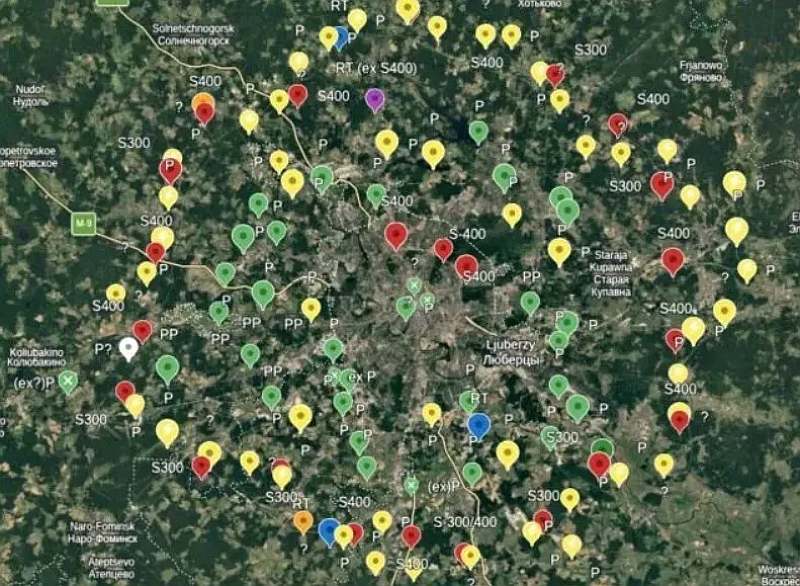
Second – a lack of ammunition. In the fifth year of the full-scale war, Russian air defense systems are beginning to feel an acute shortage of ammunition for missile systems.
The production of anti-aircraft guided missiles at Russian enterprises significantly lags behind Ukraine’s ability to produce attack drones. As a result, even Russian Z-military correspondents are forced to admit that sometimes some air defense systems stand “silently” because they are empty.
Third – technological backwardness. This particularly concerns the quality of some air defense systems, which have problems with fire control systems, guidance, radars, tracking, and destroying targets.
Primarily, this is the defective “Pantsir-S1” air defense missile-gun system, which performs its tasks extremely poorly due to multiple technological problems that cannot be resolved due to sanctions. They try to “work around” this by placing this most common and primary means for combating drones at a short range on towers and rooftops, but the improvement in effectiveness from such measures is minor.
Fourth – the reduction of air defense assets. Ukraine’s drone forces have launched a real hunt for Russian air defense systems, pursuing them both in Ukraine’s temporarily occupied territories and in the rear zones of the Russian Federation.
Currently, Russian occupation forces lose dozens of air defense units every month, while they can only produce a few. Compensation for losses critically lags behind the losses themselves, and every month Russia has fewer and fewer air defense resources.
These are the four main reasons why Ukrainian drone strikes on Russia are becoming increasingly effective. But what about the Russians’ fears that there will soon be a thousand or more UAV raids on Russian territory every day?
The Potential of Ukraine’s Drone Systems
Russian analysts and propagandists regularly complain that Ukraine is systematically increasing raids on Russia, continuously setting quantitative records and raising the success rate of striking multiple targets simultaneously.
Meanwhile, official Ukrainian representatives authorized to make such statements have never provided detailed statistics on the number of attack drones used for raids on Russia. Therefore, to understand the scale, we can only use approximate data based on manipulative reports from the Russian Ministry of Defense.
Let me explain what I mean.
For example, on March 9, the Russian Ministry of Defense reported that Ukraine carried out a record raid at that time, resulting in the interception of 754 Ukrainian drones.
Clearly, these figures shouldn’t be trusted, as the Russian command constantly lies, exaggerating data and inflating their achievements. But any exaggeration is based on initial real data. The question is, what percentage of this is exaggeration?
For instance, according to the Russian Ministry of Defense, Ukraine lost over 28,000 tanks and armored vehicles in the war, whereas collectively we never had such a number of main battle tanks and armored vehicles, even with partner technical supplies. In sum, considering verified information about the Ukrainian armed forces’ losses published by monitoring platforms, the real losses may be exaggerated 3-4 times!
Another example. In the spring of 2025, the Russian Ministry of Defense reported intercepting 524 Ukrainian drones. Thus, from March 2025 to March 2026, the growth in the Ministry of Defense’s reporting was 50%. Therefore, cautiously interpolating this information, one could say that in March, over 250 drones flew over Russia, and a year ago over 170. The daily raid growth of 50% amounted to 80 drones.
But, again, this is a variable assumption.
Overall, if we trace the trend of the Russian Ministry of Defense’s reporting on the interception of Ukrainian drones, their statistics could be assessed as follows:
- On September 1, 2024, the Russian armed forces reported intercepting 158 Ukrainian drones;
- By March 11, 2025, the Russian Ministry of Defense report featured 337 drones;
- On May 7, 2025, there was a sharp rise to 524 drones, and by May 13 – to 572;
- On March 9, 2026, the report included 724 intercepted drones;
- By May 17, 2026, the Russian Ministry of Defense claimed 1,054 intercepted Ukrainian drones.
Even based on these data, it’s clear that over a year and a half, the trend in the number of ‘intercepted’ drones (as Russian Ministry of Defense reports always feature only ‘intercepted’) increased by 6.6 times! And even if one variably assumes that on May 17, over 350 weapons were used against Moscow, then by the end of the year, this figure could systematically reach 1,000.
But the scariest thing for the Russian reality would be to assume that the Russian Ministry of Defense’s reporting is indeed truthful or as close to the truth as possible. Then it means that systemic raids in Russia by Ukrainian drones numbering a thousand and more could occur already this summer.
In any case, with some confidence, we can already state: Ukraine has not only reached a parity level of confrontation with Russia regarding the use of strike drones but is also ahead of it. And the gap in quantitative indicators continues to grow rapidly.
At the same time, if Ukraine, for more than four years, focused on strengthening air defenses and searching for cheap and mass means to counter kamikaze drones, then in Russia, on the contrary, air defense was a category of the most sensitive, difficult-to-compensate losses, which now has led not only to a clear shortage of these means across the country but also to a fatal depletion of ammunition for those still available.
Taking into account all of the above, it can be stated: the concerns of the Russian “experts” are not unfounded. And it is quite likely that those who rejoiced at the blackouts in Ukraine will soon be riding the metro (due to a lack of gasoline at gas stations) and searching around Moscow for a place to charge their phones or power banks.
Photo on cover: Robert Brovdi/Facebook
