
May 20, 2019, was a Monday.
Given the new government’s inclination towards superstitions, the occult, and Soviet film classics, one might have expected them to choose a different date. Because “whatever they do – things don’t work out: it’s clear, they were born on a Monday.”
Participants in the process say that Zelensky’s team did indeed try to schedule the inauguration for another day. But before May 20 there were dates inappropriate for celebration: May 18 – Day of Remembrance of the Victims of the Genocide of the Crimean Tatar People, May 19 – Day of Remembrance of Victims of Political Repressions. Yet, the “Ze Team” did not want to wait another day or two (there was time until May 30); they were eager to get their hands on the reins of power.
The beneficiaries of the campaign, Kolomoisky, Shefir, and Zelensky himself, gave interviews that simply radiated impatience. They wanted to reconcile with Russia, correct the “excesses” of Ukrainization, and deal with opponents… in short, to turn everything back as it was.
So they settled for Monday. Zelensky became President of Ukraine, promising to demonstrate a new quality of politics in one term.
Almost all promises were fulfilled precisely in the opposite way. Much has been written about this:
– instead of peace, a full-scale war;
– instead of fighting corruption, an unprecedented increase even compared to Yanukovych, with about 40% of respondents believing Zelensky participates in it, and about 30% considering him well informed;
– instead of improving life and solving social issues, economic decline by the fall of 2019, even before COVID and the full-scale invasion…
It turned out that “it will get worse.” The harmfulness of electing random people brought to power through media technology was experimentally confirmed, so that “even the grandchildren would have enough,” as the newly appointed “new faces” evaluated their obtained trophy.
The 2019 victors used and amplified the public demand that populists feed on:
• for the “simplicity” of problem-solving;
• for emotional relief after the shock of Russia’s attack;
• for a “non-politician” magician capable of fulfilling desires, because people want miracles, so how can they not be provided with one?
• for avoiding complex answers.
Ukrainians then voted for a carefully sold hope that complex history could be “switched like a TV channel.” But reality always, sooner or later, catches up with political marketing. The only question is the price…
Seven years later, we understand much better: a state cannot be replaced by a TV series. And history cannot be replaced by an audacious script. The media project “Ukraine on Stage” failed miserably. And now we all have to deal with this mess of problems together.
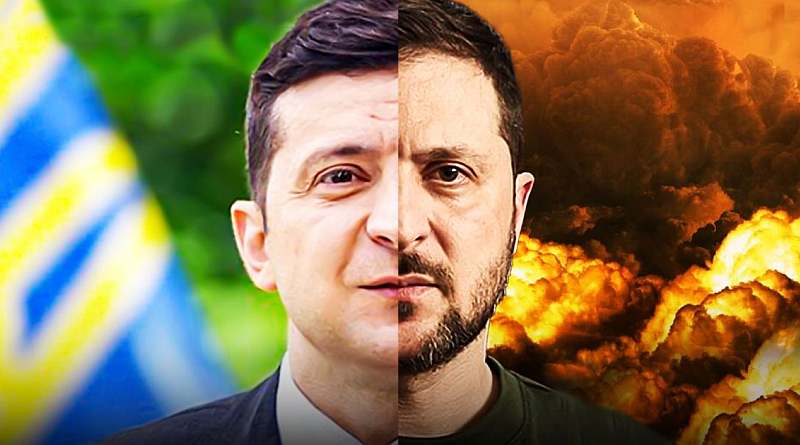
Collage: TSN
