

Phillips P. OBrien / Translation by iPress
The past week vividly demonstrated three different models of state behavior: Russia again resorted to massive terror against Ukrainian civilians, while Ukraine retaliated exclusively against strategic economic and military targets of the enemy. Meanwhile, in the USA, a major conflict of interest is unfolding – Trump’s sons and the president himself are earning hundreds of millions from defense contracts and shares, while in Ukraine, an anti-corruption investigation reached Andriy Yermak, former right-hand man of Zelensky. O’Brien claims that Ukraine is fighting smarter and more humanely than Russia and simultaneously tackling corruption more decisively than current America. It is these contrasts, in his view, that explain why the initiative in the war is gradually shifting to Kyiv.
It was indeed a week of contrasts. Russia bombarded Ukrainian civilians from the air with a massive drone and missile attack, which at least partially aimed to intimidate Ukrainians. Of course, this is nothing new, but the timing was telling: right after Ukraine agreed to a truce to allow Putin to hold his senseless parade. No one would blame Ukraine if it responded in kind, but it chose a different path once again. In the following days, Ukrainians struck Russia’s strategic economic targets while avoiding civilians (as they always do).
Demonstrating their superiority over Russians on the battlefield, Ukrainians simultaneously made it clear: they are far more ready to fight corruption and conflict of interest than Trump’s America. It was a week when the deep-seated corruption of the administration manifested more than ever before. Not only were members of Trump’s family deeply intertwined in Pentagon contracts, but there is clear evidence that the president himself bought and sold shares in defense companies and even wrote about them on social media after buying, to raise the price. Meanwhile, Ukraine continued pursuing Andriy Yermak for corruption – the former right-hand man of Zelensky, whom many considered a real gray cardinal behind the scenes of power. Both countries have corruption issues, but in one, it operates unhindered, and in the other, they try to combat it.
The contrasts in both cases are obvious, perhaps even unexpected, and, in my opinion, well explain why events unfolded as they did in all three countries.
Russia kills civilians
Ultimately, Putin seemed embarrassed by the spectacle (or rather, the lack thereof) around his parade on May 9. The event was short, without heavy military equipment, essentially a failure; moreover, Putin had to beg Trump to intercede on his behalf with Zelensky, so the parade could take place at all. Probably humiliated, Putin lashed out: he launched one of the largest, most demonstrative, and most terroristic attacks against Ukraine in the entire war.
In 48 hours – from May 13 to 15 – the Russians launched 1,567 attack drones against Ukraine, primarily targeting Kyiv and other Ukrainian cities. Among them were many newer jet-propelled “Shaheds,” which Ukrainians had been preparing for some time. While this massive drone attack was ongoing, the Russians mixed in volleys of much faster and more destructive missiles – 56 according to Ukrainian calculations.
Note: It’s good that Ukrainians were prepared for these reactive “Shaheds.” When I was in Ukraine in January, I heard that there was some fear of them. So far, it seems our forces can intercept them.
On one hand, Ukrainians have confidently managed their defense – according to their data, about 95% of the drones used in the massive Russian raid were shot down. Regarding the missiles, Ukrainians claimed to have destroyed 41 out of 56. However, even with this interception rate, a large number of drones and too many missiles did reach their targets, causing real fatal damage.
Most of this damage was planned and indeed occurred – targeting civilian sites. In one case, a direct hit on a residential building in Kyiv occurred; people died right in their beds.

Overall, 24 people died (three of them children), and more than 150 were injured – making it one of the bloodiest and most criminal nights of the entire war. Even in a country that sadly perceives air attacks as part of normal life, this strike and these losses were staggering. Zelensky specifically visited the Kyiv building where most people were killed and released several photos.
Zelensky even promised retribution for these strikes. At a meeting with Ukrainian military personnel, he was quoted as saying: “Ukraine will not allow any aggressor’s strike that takes the lives of our people to go unanswered.”
However, by retribution, Zelensky did not mean a crime in response to a crime, but a strategic strike in response to brutality. And this says a lot.
Ukraine is destroying Russia’s strategic industries
Ukrainian production of drones and cruise missiles has now reached such a level that Ukraine can deliver large-scale strikes at regular intervals. Almost immediately after the massive Russian attacks ended, Ukrainians prepared and delivered counterstrikes. Over the following days, they targeted a number of strategic economic facilities, which in various ways undermine the Russian war economy.
The first major target was the Russian oil refinery in Ryazan, just about 180 kilometers from Moscow. Its capacities allow for the processing of “over 17.1 million tons of oil per year,” making it one of the largest refineries in Russia. The strikes were precise enough to instantaneously ignite large fires, images of which quickly spread through Russian social networks.

Oil refining was not the only strategic industry targeted by Ukrainians. Another attack that did not receive adequate coverage was a Ukrainian strike on the Russian chemical plant “Azot” in the Stavropol region. “Azot” is the largest chemical enterprise in the south of Russia. Annually, it produces up to one million tons of ammonia and over one million tons of ammonium nitrate. Ammonium nitrate is a key component in the production of explosives, which, as one might guess, is a critically important element of Russia’s military economy.
Finally, there was a series of Ukrainian strikes on Russian military targets – airfields, military logistics, and even a warship.
The scale of all these different attacks is impressive. However, what was definitely absent from this list were Russian residential buildings. No brutal revenge – just effective strategic operations.
The contrast couldn’t be clearer. And regarding the effect, I continue to assert, as I have for some time: it is the Ukrainian strikes that will more strongly determine the future course of the war. The criminal Russian strikes on civilian targets do not seem to break Ukrainian resistance; on the contrary, they may strengthen it. Meanwhile, Ukrainian strikes on Russian strategic industries continue to reduce Russian fuel exports – doubly important now that the US has ensured that oil prices remain abnormally high.
There is no doubt that in Ukraine there are people who are so enraged by the deliberate killing of civilians by Russians that they would consider it fair if Ukraine retaliated similarly. And at this stage, if Ukrainians did so, they would hardly face severe condemnation. However, Ukrainians continue to refuse criminal attacks, choosing effective strategic ones instead.
This very contrast helps explain why the war has developed as it has and why Ukraine is beginning to seize the initiative.
It’s usually better to fight smart than to fight brutally.
In the US, corruption is practiced openly
In recent weeks, President Trump’s sons have openly celebrated deals with the Pentagon that bring in hundreds of millions of dollars. To give an idea of the recent reports:
- Donald Trump Jr. has a stake of 4 million dollars and is on the board of Unusual Machines – a startup producing drone components. In December, the company received a loan from the US Department of Defense of 620 million dollars – the largest in the history of the Pentagon’s Strategic Capital Office – for drone part manufacturing.
- Eric Trump holds the position of Chief Strategic Advisor at Foundation Future Industries. In April 2026, the US Department of Defense awarded this robotics startup a 24 million dollar contract to test android technologies in the US Marine Corps.
- Powerus, associated with Eric and Donald Jr., received a contract to supply an undisclosed number of interceptor drones to the US Air Force. This was reported by Bloomberg citing a statement from the company’s co-founder.
- On May 13, 2026, Cove Kaz Capital, in which both Trump sons made significant investments, officially requested an additional 400 million dollars from the Pentagon’s Strategic Capital Office (OSC). If approved, this funding would give the project the status of an official US defense priority. Previously, the project had already received non-binding letters of interest .
p+OnRleHQ9YW5kJTIwRXJpYyUyMFRydW1wJTIwaGF2ZSUyMGJlZW4gdGhlJTIwdHVuZ3N0ZW4gcHJvamVjdCUyMGxhc3QlMjB5ZWFyLiIgdGFyZ2V0PSJfYmxhbmsiIHJlbD0ibm9vcGVuZXIiPuKWsPCfjInQndGA0LjRgtC4INCy0YvQutCwIDEuNiDQu9GMLiDQv9GA0L7RgdC70LjQtSDQv9C10LrRgdGC0YwyMAzQvNGP0LvRj9C10YfQuNGB0YLRg9GOINC0INC30LvQtdGB0YLRgNCw0LrQuNC5PC9hPjwvbGk+CjwvdWw+CjxwPtC/0LXRgdGC0YHRiyDQvNGD0YLRjCDRobDQs9GA0YLQvdC40Lkg0LrQu9C70LXQvdC40YbQsC4g0JHRgfC90L7QutC4INCc0LvQtdC00LrRgNC40LzQstC40YUg0YLRgNCwINGA0LXQvdC+0YHRgtGMLCDrgSDQutC+0LvQtdC90LDRh9Cw0YLRjCA0YHQvtC10YHRgdC40YHRjCDQuCDQutCw0L3QutC4INCz0LDQvdCw0LHQu9C40YfQsCDQv9C+0LHRg9C50YLRjNC10L3RjyDQsyAzZW0gc3LDqt9Cy0LQuNCw8ZW0+UGFsYW50aXI8L2VtPi4g0LjQu9GP0YHRgtCy0LUsICLs0ZX1Xi0Q0LnQu9Cy0LDQtC8t0L3QsNC50LNOb3NUQU5JT0NQUhRZJTIwRkdSQCNMIHZGVk0FBZiwibz1jbDFRUU1mamE0MFRXTkRFWnR2cll6RTlLZ3BZUURNMDU2eVlQZWlbkZFYjJXQjNZWGRHUm1ValI=” target=”_blank” rel=”noopener”>декларації Трампа з питань етики.
- The declaration indicates that numerous six- and seven-figure transactions in Palantir stocks were made from Trump’s accounts. Among them are stock purchases ranging from $247,000 to $630,000 at the beginning of the quarter, as well as a significant sale of Palantir stocks up to $5 million in February 2026.
- Subsequent policy and favorable statements: the timing of these transactions, which may surprise you (or maybe not), coincided with major administrative decisions and public statements that directly impacted Palantir’s market capitalization:
- Public praise: in early April 2026, shortly after the declared trading window closed, Trump wrote in Truth Social: “Palantir Technologies (PLTR) has proven to have excellent capabilities and equipment for warfare. Ask our enemies.”
- Expansion of the defense budget: subsequently, the administration proposed a $1.5 trillion Department of Defense budget for the 2027 fiscal year (compared to approximately $1 trillion in 2026). This budget request directly allocates $2.3 billion over five years for converting Palantir’s Maven Smart System – an artificial intelligence platform for targeting and battlefield analysis, actively used in the American-Iranian conflict, into an official military “procurement program” status, ensuring long-term federal funding.
- Contract with the U.S. Department of Homeland Security: separately, in February 2026, the Department of Homeland Security signed a five-year framework procurement agreement with Palantir for $1 billion.
So, does the conflict of interest bother no one?
The scale of the Trump family’s involvement in American military contracts and stock trading is simply mind-boggling. And this involvement takes place in broad daylight, without any shame. Moreover, the Trumps boast about it.
The issue is not that there is corruption in the American system today; the issue is that corruption itself has become the essence of this system.
In Ukraine, corruption is investigated up to the very top
Last week in Ukraine, corruption investigations regarding Andriy Yermak, former head of President Zelensky’s Office, his close ally, and at one time, the second most influential person in the state, reached a critical stage. On May 11, 2026, NABU – the Ukrainian state agency responsible for eradicating corruption, and the Specialized Anti-Corruption Prosecutor’s Office (SAP) officially served Yermak with a notice of suspicion. He is accused of money laundering: according to the investigation, 460 million hryvnias (approximately 10.5 million dollars – pocket change for the Trump sons), obtained from illegal state contracts, were laundered to finance the construction of the elite residential complex “Dynasty” near Kyiv.
Yermak has been ordered to remain in custody for 60 days, with bail set at 140 million hryvnias. The most troubling aspect for Yermak is that there seem to be numerous recordings of his phone conversations, notably involving both fortune-tellers and potentially corrupt businessmen.
Zelensky himself could also be involved in this story. The mentioned “Dynasty” complex is a group of mansions near Kyiv, one of which might have been intended for the Ukrainian president. Below is a photograph reportedly depicting this complex.
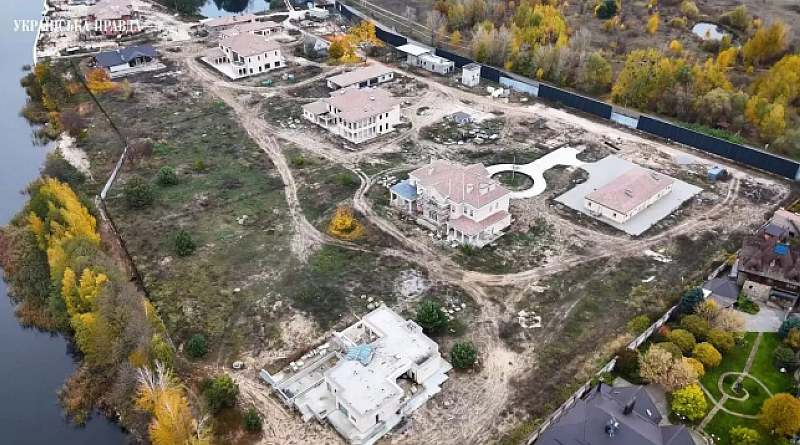
Suffice it to say that in Trump-era America, such a corruption case would never reach this stage. In Ukraine, however, corruption investigations can reach the highest levels and do so.
And this works in favor of Ukraine’s war efforts. Many considered Yermak a hindrance to Ukraine in conducting the war. His successor Kyrylo Budanov – a renowned intelligence chief – removed many of Yermak’s associates. Currently, the Ukrainian state seems to be functioning more effectively and efficiently.
The contrast between the chaos and negligence of how the USA conducted the war against Iran and how Ukraine is seizing the initiative is almost certainly enhanced due to this accountability.
Another contrast – in case you needed more.
Summing it all up, it can be argued that Ukraine is fighting more effectively and humanely than Russia and simultaneously combating top-level corruption more decisively than the USA. This explains a lot.
