
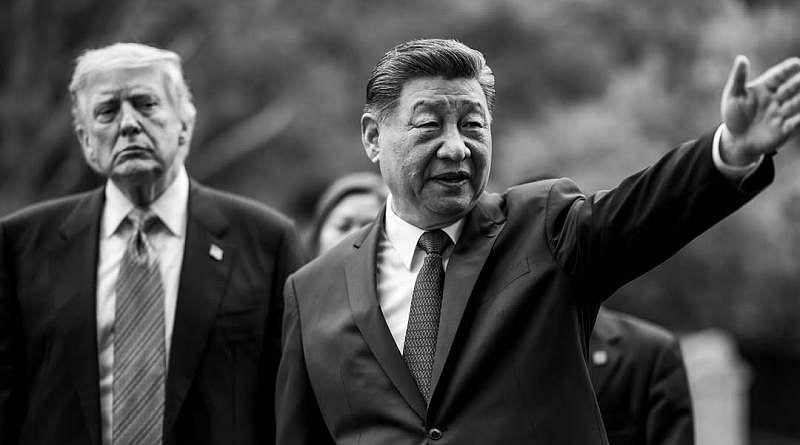
The first visit by an American president to China in nine years ended with what it was intended for: a fragile “peace” between the world’s two leading powers.
Just a day after Trump’s visit concluded, the Kremlin announced that Russian President Vladimir Putin would travel to Beijing, according to the Russian state news agency TASS. The visit is scheduled for May 19-20, and the Russian leader will visit China at the invitation of Chinese President Xi Jinping.
Chinese President Xi Jinping hosted Donald Trump with a lavish reception in Beijing, spoke to him as an equal, and even threatened him.
He did not rush to aid America in its battle with its main adversary — Iran, and as soon as Trump left, Xi began preparing to welcome another US rival — Russian leader Vladimir Putin.
Experts warned that no specifics should be expected from Trump’s visit to China. It was enough that the leaders of the two largest economies and armies on the planet met and parted amicably.
Ultimately, that’s what happened. Trump and Xi exchanged compliments, and their diplomats announced the results of closed-door negotiations.
If read without context, it might seem Trump and Xi spoke without an interpreter and each only heard and understood themselves — so radically different are the accounts of what they discussed in the Chinese and American versions.
The Chinese side claims that Xi discussed with Trump how geopolitics is changing in a shifting world (an intricate Chinese expression of the idea that America is no longer the hegemon and China is its equal), as well as Taiwan.
The Americans insist Trump discussed how China would help the US achieve Trump’s goals. Increase Chinese investments in America, buy more oil and gas from the US, expand access for American companies to the Chinese market and — crucially — convince Iran to lift the blockade of the Strait of Hormuz and abandon the idea of creating a nuclear bomb.
The Americans did not mention Taiwan at all, while Xi made it clear that the issue of the democratic Chinese island is of paramount importance to communist China. Even before his meeting with Trump, Xi raised the stakes and for the first time threatened America with war if things did not go well.
“Xi Jinping emphasized that the Taiwan issue is probably the most crucial topic in the bilateral agenda between China and the US,” stated China’s Ministry of Foreign Affairs. “If approached incorrectly, the two countries could confront each other and even face conflict.”
Trump did not respond to Xi’s threats, while shortly afterwards, Secretary of State Marco Rubio stated that the US position had not changed.
America recognizes the one-China principle and does not support Taiwan’s independence. China has long sought for the US to change the wording from “does not support” to “opposes.”
Not to make peace, but to buy time
Although the summit outcomes as presented by the Chinese and Americans read like accounts of two different meetings, the key point is that neither side contradicts the other or rushes to refute its interpretation of what happened, notes Ryan Hass, former special assistant at the White House for China affairs. He accompanied Barack Obama at several meetings with Xi Jinping in 2014–2016.
“The fact that the parties described the meeting so differently indicates that they consciously allow each other to emphasize their own priorities. Clearly, this is done to strengthen the stability in relations, which both leaders strive for,” writes Hass, now an expert at the American Brookings Institution.
In the same vein, Xi spoke at a banquet with Trump.
“We unanimously agree that Chinese-American relations are the most important bilateral relations in the modern world, they need to be improved, not destroyed. Cooperation benefits China and the USA, while conflict between us will lead to mutual losses, so we must be partners, not rivals,” said the Chinese leader.
China seeks to continue the fragile truce but is in no hurry to agree on specific terms with Trump, as Xi is playing the long game, while Trump, firstly, likes quick results and loud “deals,” secondly, rarely keeps his word. Thirdly, his presidential term will end in less than three years, and he might become a “lame duck” as early as November if the Democrats win the midterm elections to Congress.
“Many in China seem convinced that confrontation with the USA will escalate again after the midterm elections or after Trump leaves. From this perspective, their task is not to reconcile but to buy time: to maintain stability while continuing to strengthen China’s long-term positions,” believes Zoe Liu, a China expert and author of the book “Can BRICS Undermine the Role of the Dollar in the Global Financial System.”
How Putin Agrees with Xi
This strategy is bearing fruit. Chinese propaganda portrays Xi as a leading world leader, to whom the leaders of the main nuclear states are flocking one by one.
First, Trump came to hear a lecture on Taiwan. And right away, Xi called on the red carpet Vladimir Putin – the president of Russia, which has turned into a raw material and technological appendage of China.
Xi will likely use Putin’s visit next week to once again show the world that the USA is no longer in control of China. For this, Xi has specific levers to demonstrate newfound hegemony.
One of them is war. Trump has long been trying to end Russia’s war against Ukraine and his own war with Iran.
China is the main protector and ally of these countries, and without China, nothing is working out for Trump so far.
The second is energy. Trump is trying to make America the oil and gas hegemon in the world and wanted to convince Xi to buy more oil and gas from the USA, rather than where China currently does – in the Middle East and Russia.
China has not taken on any specific commitments.
And as early as next week, Xi could once again demonstrate power to Trump if he signs the long-awaited contract with Putin to build the “Power of Siberia – 2” pipeline, promises to buy more gas from Russia instead of the USA, and at the same time helps Putin compensate for lost export revenues to Europe and fund the war in Ukraine.
All this could upset Trump and, in the coming weeks and months, lead to an escalation in relations between the USA and China, experts warn. Especially since Trump is preparing a new trade war with China – his previous tariffs were declared illegal by his own Supreme Court, and now the White House is trying to introduce new ones, but under a different pretext.
Thus, the truce is more than just temporary and fragile, notes Michael Froman, a former senior White House official who was responsible for foreign trade and relations with the “Group of Seven” and APEC, the association of Asia and America countries, during the Obama administration.
There are many unresolved disputes between the US and China — from trade to Taiwan and the nuclear arms race — which Trump and Xi merely swept under the parade red carpet of the Beijing summit.
“Ignoring most of these issues creates a risk of future conflict,” warns Michael Froman. “There is a difference between measured skepticism and complacency. At some point, the key contradictions in US-China relations will inevitably need resolution.”
Photo: The White House/Instagram
