
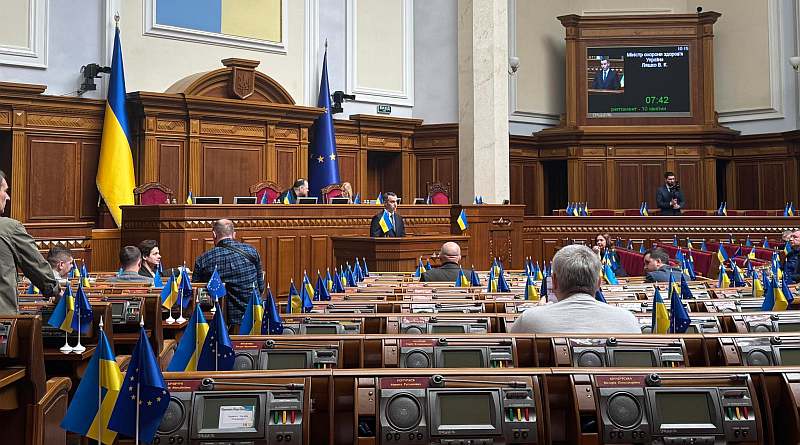
The Minister of Health is on the podium (pictured). The “servants” decided that he is the most relevant to be listened to right now on Government Day. They invited him—and didn’t show up.
A symbolic situation for summarizing another week of government crisis.
The parliamentary week confirmed a trend we have been discussing for a long time. The “servants” and their attendants have no votes for anything.
The only effective votes occurred only with the participation of the opposition. This means fewer foolish decisions will be made. That’s good.
However, it’s bad that neither Zelensky nor his entourage is trying to systematically resolve the crisis. Neither acknowledging the death of the “monomajority” and forming a coalition (Zelensky forbids it), nor at least improving the quality of projects that are not just “for all good against all bad,” considering opposition amendments. European Solidarity in its amendments is working towards clarity and definiteness of regulation, closing corruption loopholes, and preventing the substitution of law with “discretion” of officials. This would benefit both European integration and the overall quality of legislation.
I never tire of reminding that when this principle worked in March 2022, it positively impacted the effectiveness of laws. But then the scare passed, and the “servants” try to pretend that they are still a formidable mono-force. But that’s not the case.
The quality of the “human material” of the current government was very clearly demonstrated by the recent recordings from the Mindich case, the court regarding the preventive measure for the once all-powerful Yermak, and especially the “swindle of the common fund,” which did not allow him to gather bail quickly.
Of course, talking heads and the “thousand positive bloggers” are trying to squeeze a favorable storyline about the prosperity of justice during the Z era out of this, but the situation has definitely affected the morale within the ranks of the authorities. Here, as it is now fashionable to say, you don’t need a fortune teller.
However, they are holding onto their seats with claws, tails, or whatever their zodiac signs suggest. Even those clearly highlighted on the Umierov tapes, Kuleba and Pronin, haven’t been given up yet. But that’s just for now.
The decay and destruction of the system can no longer be stopped, because the people gathered through announcements, without goal or principles, lack motivation.
The pace depends on the actions of anti-corruption bodies, the persistence of Europeans, and societal activity.
The anti-corruption bodies have no way back—devaluation and humiliation experienced by the entire system of the current government will not be forgiven by the latter.
The European Commission will announce the conditions next week for granting 90 billion euros, which the government has already managed to allocate, including for the next populist giveaways. Among the conditions will surely be the reset of the State Bureau of Investigation, one of the main pillars of the house of cards built by Zelensky and Co. They will try to avoid this, but the question of rebooting the Bureau of Economic Security has already shown: “in Zelensky’s camp,” they will stomp their feet, puff out their cheeks, knit their brows, but ultimately they will do what they are forced to do.
This understanding, as in July last year, should show the active part of society: the situation is not hopeless. Ignoramuses are incapable of systematic work and will defend themselves with a small intellectual potential. They can and should be forced towards decisions necessary for Ukraine to stand firm.
But more on this—slightly later.
