
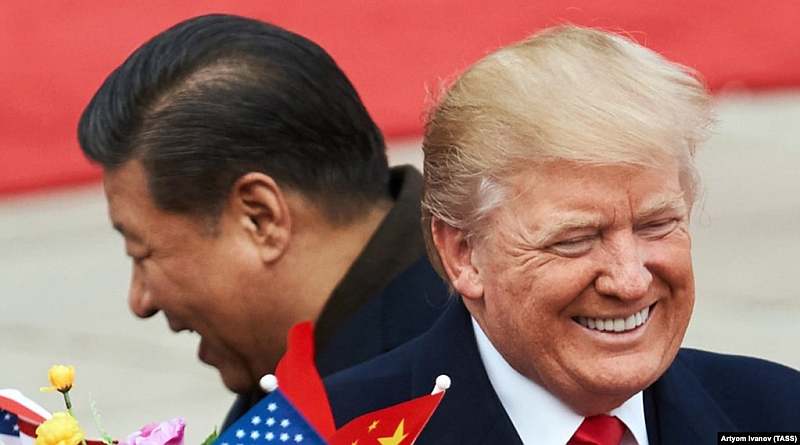

Donald Trump’s current visit to Beijing, similar to the historic state visit in 2017, exposes the fragility and imperfections of Russia’s “pivot to the East.”
The indestructible alliance between Moscow and Beijing fades against the backdrop of the reality of “big deals” between the US and China, which demonstrate that Russia remains not an equal player but merely a tactical piece, whose interests Beijing is ready to neglect for the sake of stabilizing relations with Washington.
One of the most painful consequences of Trump’s rapprochement with Xi Jinping for Russia is direct economic competition. As part of Trump’s course to reduce the US trade deficit, China traditionally agrees to massive purchases of American energy and agricultural products.
Signing multi-billion-dollar contracts for the supply of American liquefied natural gas (LNG) deals a direct blow to the interests of Gazprom and Novatek. For Beijing, American gas is a good way of diversifying energy supplies and a significant lever of pressure on Moscow in negotiations over the price of gas from Power of Siberia-2. Every cubic meter of American fuel in Chinese terminals reduces Russia’s negotiating power, turning it from an “energy superpower” into a supplier forced to sell resources under political discomfort, and therefore with an additional discount.
Trump’s strategy of building direct deals with China revives the concept of the “Big Two” (G2), where global issues are resolved in Washington and Beijing. For Moscow, obsessed with the idea of a “multipolar world,” this means a diplomatic grounding.
When Trump and Xi discuss the security architecture in the Asia-Pacific region, the situation around Iran, or North Korea’s nuclear program, Russia’s role is minimized. Beijing makes it clear that its ties with the American market, worth hundreds of billions of dollars, are incomparably more important than the “boundless friendship” with Russia’s sanctioned economy. As a result, Moscow finds itself in the position of the “odd one out,” whose interests are ignored when concluding global deals on the division of spheres of influence.
Trump’s visit to the Middle Kingdom highlights Russia’s technological dependence. If the US and China can negotiate standards in AI or chip trade, as shown by recent Nvidia deals, Russia remains merely a supplier of raw materials for China’s industry.
The rapprochement between Washington and Beijing based on “pragmatic bargaining” deprives Russia of its status as China’s unique partner. Instead of an alliance against the West, Russia gains the status of a resource appendage, whose loyalty is perceived by Beijing as something taken for granted and not requiring a high price.
For the Kremlin, Trump’s voyage to China is an unpleasant cold shower. It proves that, firstly, China is not Russia’s ally. The PRC is actually a pragmatic hegemon, ready to trade Russia’s interests for access to American technologies and markets.
Secondly, Moscow loses its monopoly on raw material exports. The US successfully pushes Russia out of the Chinese energy market, using Trump’s political tools.
Thirdly, Russia’s geopolitical isolation continues to grow. While Moscow burns resources in conflicts, Washington and Beijing are reshaping the world, leaving Russia as a bystander on the sidelines of history.
Thus, the probable “chemistry” between Trump and Xi Jinping is not just a diplomatic show, but a systemic challenge, which permanently cements Russia’s status as a subordinate “junior partner,” whose fate is decided without its participation.
