
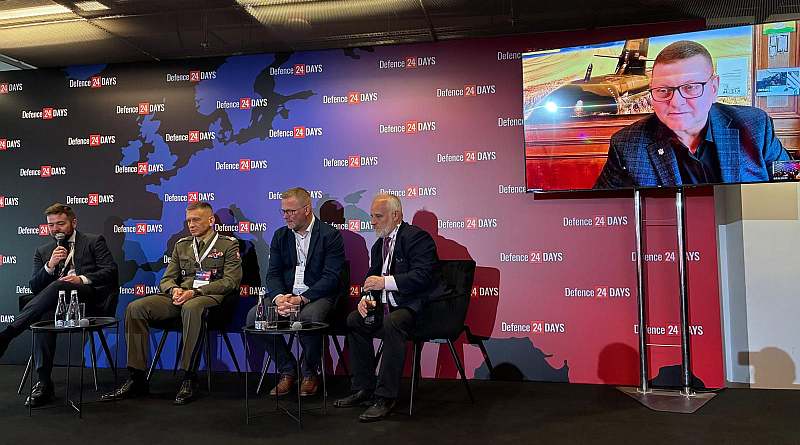
Speech by the Extraordinary and Plenipotentiary Ambassador of Ukraine to the United Kingdom and Northern Ireland, Commander-in-Chief of the Armed Forces of Ukraine (2021-2024) Valerii Zaluzhnyi at the Defence24 Days conference (Warsaw)
Almost three years have passed since I, then Commander-in-Chief of the Armed Forces of Ukraine, announced significant changes on the battlefield in November 2023, which were the result of certain regular processes, and spoke about the beginning of an entirely new war due to the use of new tools and their possible consequences.
At that time, the main consequence of the emergence of such new tools as unmanned systems was the transparency of the battlefield, which led to a so-called deadlock that did not allow for the execution of operational and strategic tasks.
Since that moment, Russia has done considerable work in seeking a way out of this deadlock. Despite a developed technical arsenal and attempts with tactical actions using new technical solutions to get out of the “deadlock,” the result remained obvious – in a war of machines, people can achieve only minor success by old principles of operational art. However, in this way, people become expendable, which, of course, requires replenishment.
Unfortunately, at one time, by conceding the initiative on the battlefield to Russia, Ukraine was forced to respond not only to challenges but also to the systematic work of the enemy across almost all fronts, responding in the same way and, of course, sometimes at a very high cost.
Under such approaches, a certain circle of experts both in Ukraine and abroad, often not understanding the essence, supported the intermediate concept chosen by Russia of inflicting their own losses to cause critical losses to the Armed Forces of Ukraine, which would force society to surrender. This expertise unavoidably led Ukraine and its future into dependence on demographics, and as a result – into inevitable defeat.
Combined with almost continuous tactical advances of the enemy, such a concept allowed Russia to manipulate an improvised negotiation process, where, of course, the main emphasis was on forcing, even through partners, Ukraine to capitulate.
Interestingly, such actions by Russia are accompanied by a parallel large-scale campaign in the informational space aimed at discrediting the very process of mobilization, as a component of restoring and maintaining the combat capability of the Armed Forces of Ukraine. This campaign was quite successful and ultimately revealed another problem for the unconditional resilience of the Ukrainian people in a prolonged war.
The issue of mobilization and the methods of its implementation are increasingly becoming the focus of conflict between the country’s population and the state authorities of Ukraine.
This campaign, by the way, began at the end of the summer of 2023 when we attempted to conduct the so-called reserve mobilization, which was meant to guarantee the replenishment of losses and possibly the formation of a strategic reserve for future operations. However, this is already history that cannot be changed.
We will talk about the future. Perhaps about the most difficult part of our future in a prolonged war, the end of which is becoming less and less obvious to us. About the choice that only we have to make.
Thus, despite questionable methods today of ending the war on one hand, it is clear that for Ukraine, a whole range of opportunities opens up, if not for victory, then to minimize losses and form a long-term defense strategy on the other.
Where does such optimism come from, even when the world we live in does not understand what to do next?
The answer to this question is very simple: we, Ukrainians, know better than anyone else what is happening, and therefore we know the problem and will definitely be able to solve it if we want to. Yes, we are surprised why our partners and neighbors do not understand all of this. However, that is a completely different story and completely different problems.
Because of this, it is difficult to honestly say whether the experience that we, our Armed Forces, and civil society have accumulated in such a tough war, is needed, for example, by NATO member countries? The main thing is that our experience is needed for ourselves, to build a strategy of survival and a strategy of victory. Here it is – the key to our optimism. Our invaluable experience, for which we have paid with the lives of the best sons and daughters of our State.
Therefore, the topic of our conversation today is even not mobilization and demobilization, but a more complex process characteristic of the 13th year of war and the fifth year of full-scale invasion in the absence of a fact of the war ending, large-scale changes in instruments and consequently – the forms and methods of waging war. This is the restoration and maintenance of state combat capability.
In Ukraine, unfortunately, there is often speculation on the topic of demobilization during a full-scale war. If we turn to historical experience, indeed, during wars, the mobilization of both the population and other resources was constantly increased, but it is impossible to find analogies and logic of mass demobilization during the war itself. This is justified very simply.
Mobilization is primarily the creation of the necessary potential in the run-up to war, the creation and preparation of necessary reserves, and the replenishment of evident losses during the war.
Indeed, it was mobilization and its potential, both human and economic, that were the key to success in the test of war.
However, if we speak purely about the filling and maintenance of combat capabilities, which are ensured by human and economic resources, then we will see the dependence of these combat capabilities, first of all, on the level of development of scientific and technological progress and its impact on weapons, and as a result – the forms and methods of its application in the corresponding organizational structures, which are formed from people and this weaponry.
This is, unfortunately, an absolutely unacceptable axiom of the development of armed struggle for civilians.
Scientific and technological progress, or even spontaneous innovations as in our case, create new weapons. Their creation inevitably requires the emergence of entirely new forms and methods of application, and only after that, the creation of new structures. These can be regiments, brigades, corps, or entire branches of the military. But only in that sequence.
All this changes the very method of warfare and, together with the preparation process, funding, supply, and management, combines into an entirely new doctrine. Then the logical question arises: in this case, when it is evident that both now and in the near future, these combat capabilities are based on the use of unmanned and robotic systems, whose application is gradually shifting from remote control to the use of semi-autonomous and autonomous combat systems, should the mobilization system remain at the level of World War I doctrine? Meanwhile, we can also observe the transformation of the functionality of traditional weapons, some of which have already started losing relevance.
Probably, definitely not. Because with the emergence and development of new weapons, the organization of combat operations, for example, on the ground, implies that the frontline almost excludes the physical presence of personnel. On the contrary, World War I and II required maintaining a huge number of people on the frontline. Today, a very limited number of personnel is there, performing tasks at the edge of their capabilities, often without the physical possibility of even being replaced. Being in cover, even behind enemy lines, is safer than moving to the rear of one’s troops.
In the second echelon, teams providing analytical support and technical maintenance and support for the use of combat systems and their security operate.
The launch, coordination, and management centers themselves are located in the operational depth.
And that’s not all. With strategic goals shifted to destroying the economy by targeting infrastructure and reducing the resilience of the population through strikes on civilian objects, there is in fact a complete blurring of the lines between the front and the rear; the entire territory of the state and, unfortunately, the entire population becomes a combat zone. It is true that the distance to the target or object of attack does not and will not matter.
The difference between those in the defense forces and those in the rear is only in the degree of threat to the possibility of being wounded or killed. Thus, the existing mobilization system, based on World War I and II principles, shifts human resources to the zone of maximum threat at the expense, including reducing the potential protection of critical and civilian objects, as well as reducing the overall resilience of society as a whole.
So the question of whether the mobilization system should change due to the replacement of weapons and forms and methods of warfare has an obvious and concise answer. Yes, the mobilization system, which aims to maintain the necessary level of combat capabilities during the war, must change due to changes in the methods of warfare.
Indeed, this is a new and dangerous phenomenon due to its uniqueness and lack of historical examples. However, even through the known history of humanity, robots have come to war for the first time.
There is another misconception that haunts the military leadership: that all problems on the frontline are primarily related to a lack of personnel and the dominance of remote weapons, such as FPV systems. However, whether increasing personnel will lead to increased losses due to the scaling up of, for example, drones is not commonly discussed, although it is obvious. It’s only a matter of time for the scaling of drones on one side and losses on the other.
Until a general military commander understands that modern warfare is drone warfare, that artillery is no longer the god of war, and that tanks are a thing of the past, like horses and sabers, the troops will continue to suffer great personnel losses, and the war will last as long as there are enough people for the old mobilization.
Of course, there is an urgent need to develop technologies for protection against the impacts of unmanned systems, primarily for humans. This is perhaps the only factor preventing the creation of the necessary parity of military power.
Meanwhile, with absolutely natural evolutionary needs to revise the mobilization system, there are also universal reasons for all military conflicts: constant losses in the Armed Forces, which require replenishment; the gradual “war fatigue” of the civilian population, and, as a result, low motivation to serve and fight among a significant portion of those already mobilized.
All this leads to the necessity of introducing so-called smart mobilization, built with consideration of the development of scientific and technological progress and the need for prolonged warfare across the entire country in the face of an obvious demographic crisis.
Without delving into the details of such mobilization, as this would involve a scientific approach in determining its main indicators, under current conditions, such mobilization, considering the technologization of war, will be possible through the following types.
The first type of mobilization is when most of the population does not feel the war in the country and does everything possible to maintain this feeling until the end of hostilities.
A perfect example of such smart mobilization is the gradual transfer of war functions, for instance, to private military companies, or financial incentives for those who voluntarily engage in war. Incidentally, transferring training functions, including for officers, may be the first step in testing such capability.
The second type of mobilization is nationwide mobilization with clear definition of volumes and, importantly, deadlines for all categories of citizens.
The feature of such mobilization will be high demands on personnel in terms of their intellectualization and a maximally open process. This process will be accompanied by absolutely clear timelines for both training and service itself, and will represent a continuous process of preparation and rotations.
In the final stage of this process, the state begins to function under entirely new conditions, without risks of destabilization due to, for example, injustice, and the functioning of the state is brought to a mode similar to Israel.
When the very fact of the state’s constant readiness to ensure its security becomes the main factor of stable and predictable life. The most vulnerable issue in this case is the age requirement, where preference is given to younger and more qualified recruits.
However, most importantly, without reforming the Armed Forces, the system of preparing the mobilization reserve, and the entire combat training system, without a radical reform of the military-industrial complex and an urgent transition to the production of weapons necessary to reduce human losses, such a prudent approach will be impossible. A completely new smart doctrine is needed.
Then, probably, there is a third type of mobilization, as a temporary measure – this is the partial transfer of certain functions to private companies and the continued improvement of the existing system through open dialogue with society, especially the youth, about the new service system, clear preparation terms, and clear service terms and future prospects. This will require complex work from both military leadership and legislative bodies and the government.
Then demobilization itself becomes possible, but only as a result of the measures taken, not as an end in itself.
Currently, Ukraine is fighting a war for survival with an enemy that has superior population numbers and resources. Therefore, in the current Ukrainian realities, all calls to demobilize the military are nothing but political populism with no real sense.
Maintaining the combat capability of the country during the war is a key factor not only for survival but also for achieving necessary goals. This combat capability will be based on a clear strategy that includes maintaining an adequate level of societal resistance capability and the desire to continue the fight.
The unfolding events have made it clear that mobilization and the order of service are the bases of any option for continuing the war. Only by resolving these issues in the context of a demographic and economic crisis can more ambitious goals be pursued in the future. However, solving this complex issue is possible not by declaring goals, but only as a result of a complex process of determining necessary steps and developing a detailed step-by-step implementation plan.
Such a strategy involving society can also become an important factor in uniting society around common goals and interests, achieving which can again bring society confidence and hope.
All photos: Facebook/Valeriy Zaluzhny
