
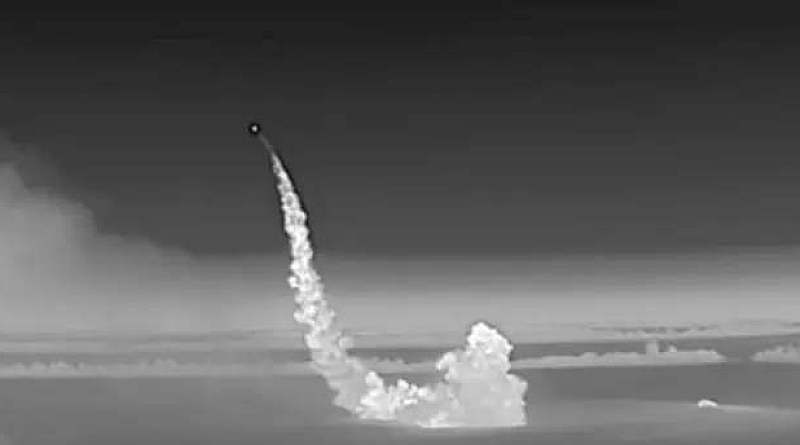
While additional air defense systems are moving through the streets of Moscow for television coverage, a real firework occurred in Cheboksary.
The logic is quite straightforward: what happened 70 years ago in grandfathers’ time does not impact the current situation on the front at all. And if the Kremlin opts for parade showmanship, we are interested in continuing to target their military-industrial complex.
This is already the fifth wave of attacks since the summer of 2025 on the JSC “VNDIR-Progress” enterprise, but this time “Flamingo” cruise missiles were used, whereas previously only drones were deployed.
Blocking the “long arm”
The fifth strike on a strategically important enterprise that produces “Kometa” navigation modules and satellite signal receivers is a direct blocking of scaling the enemy’s “long arm”.
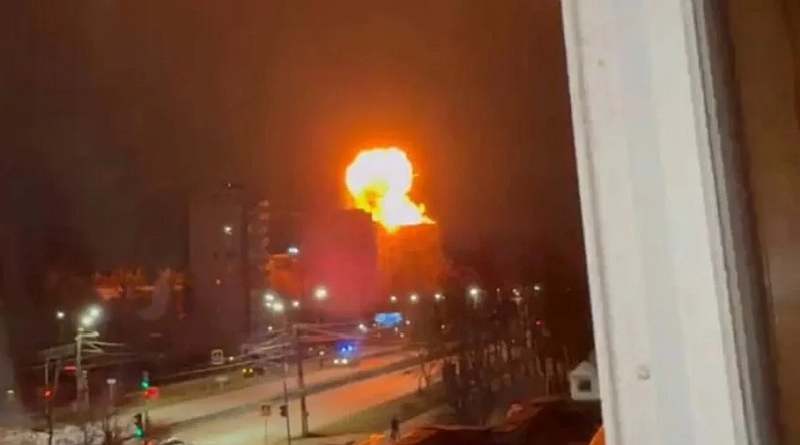
The video clearly shows the administrative building burning, and a powerful explosion occurred directly in the area of the “Kometa” adaptive grid workshop. These boards enable Russian products (from “Shaheds” to UAPK) to ignore and counter our electronic warfare.
I think that communications, pipes, delicate electricity, microelectronics machines, and cranes within a 150-meter zone were severely damaged.
Anyone who doubts the density of the strike can see what the explosive wave did to the facade of the giant “MTV Center” shopping mall opposite the plant.
Amusing stories about “just one hit” by “Flamingo” that some are spreading on Facebook mean only one thing: the enemy is in critical pain, and an internal war over budgets and orders surrounds these missiles.
Let’s dismiss the illusions: neither the extended “Neptune” nor our other serial delivery means can currently reach Cheboksary (1,000 km away) or the “Iskanders” assembly workshops. And the ballistics still need to progress beyond pre-serial test batches.
This is not quick, even with EU money and resources – the first European countries are still increasing annual production of the same Storm Shadows, which they have mastered since the 2000s, by 30-40% and not by hundreds of units.
“Flamingo”: Geography and Damage Figures
To date, we have at least seven successful and confirmed uses of this product.
- FSB Border Outpost near Armansk: Direct hit on the headquarters and hovercraft station. Communication hub, control antenna group destroyed and vessels damaged. Losses of millions of dollars and temporary loss of coordination in the area.
- Kapustin Yar Range (Astrakhan Region): Struck workshop No. 28 (missile assembly and testing base) and facility No. 105 boiler room. Disruption of the testing schedule of new missile systems.
- GRAU Arsenal (Kotluban): Precise breach of a reinforced concrete bunker with an area of 1200 m². Massive detonation evaporated thousands of tons of ammunition. This is tens of millions of dollars in direct damage in the form of shells that did not reach the enemy’s artillery at the front.
- Votkinsk Plant (Udmurtia): Strike on a strategic enterprise producing strategic ballistics. Hit workshop No. 22 (galvanic and stamping production). Result: direct slowing of the conveyor for the release of new Iskanders.
- Promsintez Chemical Plant (Chapayevsk): Two “gingerbread” landed right outside workshop No. 3. Production of industrial explosives and components for ammunition paralyzed.
- Skif Plant (Belgorod): Direct hit on the production site. According to satellite data, the roof and spans are still not repaired.
- VNIIRe “Progress” (Cheboksary): Minus the navigation workshop.
Of course, not all 100% of what is produced is applied immediately – there are also reserves.
But anyone who considers two warheads (equivalent to FAB-500) near workshop No. 3 in Chapayevsk by twenty meters or hitting the FSB headquarters as a miss should recall the zone of complete destruction of a ton head.
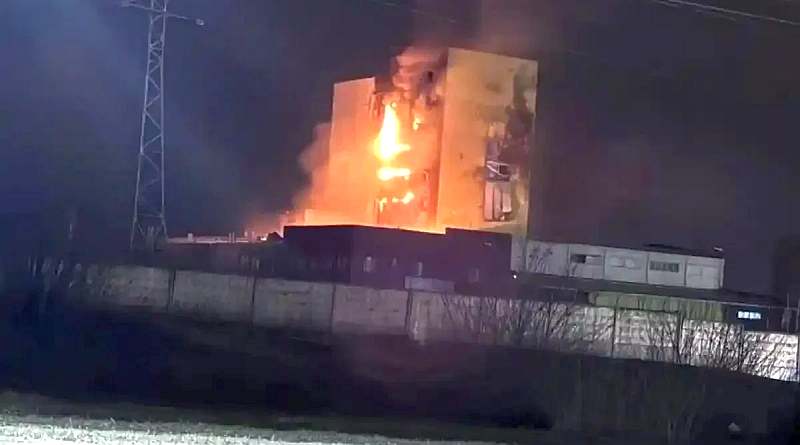
After this, it is enough to open the job sites in Samara region: the “Promsintez” plant is now frantically looking for welders, repair fitters, and electricians. They decided to weld some synthesis pipes and paint walls after the strike.
Maybe then something will be comprehended by the missile specialists online, but that’s not certain.
Fire in the Baltic: Strike on KINEF
Simultaneously, reports emerged about strikes on the KINEF oil refinery in the Leningrad region on May 5, 2026. It’s too early to talk about the final damages, but according to the thermal anomaly maps (FIRMS), a huge red-orange fire spot is located right in the heart of the plant’s technological zone.
This is the area of primary oil processing installations (such as ELOU-AVT), cracking, and complex technological columns. They didn’t hit the fuel oil tanks, which can be quickly extinguished, but the most expensive “hardware.” We’ll see precisely when there’s a clear satellite and normal weather over the facility, but preliminarily – they hit very effectively. A continuously intensifying fire in such a zone always indicates a disruption of the technological cycle.

Hysteria in Response: Syrian Tactics
The enemy responded massively: 11 Iskander-M ballistic missiles on Cherkasy, Zaporizhzhia, Vyshhorod district of Kyiv region, Poltava region, and Kharkiv. Some missed, some struck painfully. The targets were industrial enterprises, gas extraction, warehouses.
In the Poltava region, the Russians used the Syrian double-tap tactic again – a ballistic strike on the object, and when the State Emergency Service arrives to extinguish, they hit with cluster munitions in return. This happened recently in Dnipro as well. We have killed and wounded rescuers.
I think they fired at another bank of targets they had at this time: at 2:58 AM it hit Cheboksary, at 3:15 – Cherkasy. It’s likely just another battery was fired. This wasn’t a carefully planned missile strike – it’s more like a hysterical reaction, as 164 UAVs don’t look like a planned large-scale attack.
And this doesn’t mean we shouldn’t operate on Cheboksary, it means we need to be ready for a response, engage in shelters and dispersion.
So far, the situation before the parade in Moscow is clear: if the Russians want to hold it peacefully, without drones joyfully flying into houses on Mosfilm Street under REB action, they will adhere to our informal silence regime.
If not – it would be ideal to direct as many false targets, decoys, and imitation drones towards Moscow as possible to exhaust the air defense missiles, while continuing to work on military chemical plants, oil refineries, and defense industry factories. Let there be intrigue for the Russian air defense: where to rush and what to defend – the oil in Tuapse, electronics in Cheboksary or the dachas in Rublyovka.
In the past year, Russian insurance agencies estimate losses in the oil and gas sector alone at a trillion rubles. A good figure, and most importantly – stable. One trillion – the loss of the oil sector, yet another trillion – forced payments for new contracts of cannon fodder, three and a half trillion – new regional debts.
The Russian economy is falling and burning out much faster than Maly Tokmachka is captured, and this math is becoming obvious even to the last recruit. Ahead are tough decisions and redistribution of the pie in favor of military Keynesianism, I don’t think, later than autumn.
On the cover: Zelensky showed the launches of “Flamingo” at Cheboksary. Photo: 19th Missile Brigade “Saint Barbara”
