
Emily Ferris, RUSI / Translation by iPress
Senior Research Fellow at the Royal United Services Institute, Emily Ferris, believes that the Iran-Israel war has exposed a previously unnoticed yet significant vulnerability of Russia – its distant supply chains in the Caspian Sea. Israeli strikes in March hit the Russian-Iranian trade route for the first time, which since 2022 has been used to transport weapons, oil, and components for the production of Shahed drones. More painful for Moscow is that damage to Iranian infrastructure and political instability threaten Russia’s key strategic project – the International North-South Transport Corridor, intended to open routes bypassing both Europe and China. The ultimate success of this corridor depends on regional stability, which Russia cannot guarantee, making the Iran-Israel war a strategic problem for the Kremlin.
The discussion of the significant practical consequences of the Iran-Israel war has understandably focused on the closure of the Strait of Hormuz. However, for Russia, there are other vulnerabilities along its supply routes exposed by the war in the Middle East.
As previously noted, Russia’s role in the war has been limited due to practical constraints of its own military resources, as well as diplomatic caution regarding still-new relations with the USA. However, this has not protected the Kremlin from the side effects of the conflict. And although rising oil prices gave a short-term economic boost to a state dependent on the extraction and export of hydrocarbons, this war exposed the ongoing vulnerability of Russia’s distant supply chains in the Caspian Sea – a region Russia does not fully control.
Supply Chains Under Attack
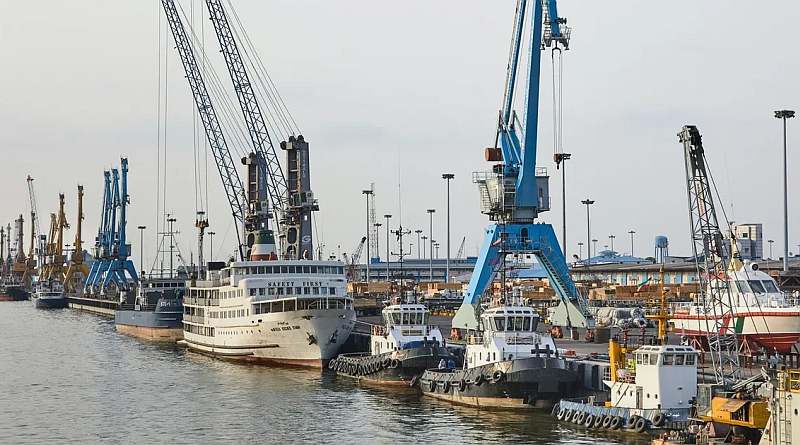
Although outside Israel it attracted little media attention at the time, the Israeli Air Force strike at the end of March targeted a well-known trade route between Russia and Iran in the Caspian Sea. On this route, Russian and Iranian ships transfer cargo between the Iranian ports of Bandar Anzali and Amirabad and the Russian ports of Astrakhan, Olya, and Makhachkala. The port of Bandar Anzali is one of the central hubs in Russia’s broader plans for the International North-South Transport Corridor, a long-term infrastructure project repeatedly stalled by diplomatic and practical challenges. Since 2022, this Caspian supply route has become increasingly important for Russia, facilitating the exchange of weapons and oil between Russia and Iran and serving as a key hub in the transportation of Iranian Shahed drones until Russia managed to localize their production.
This supply and technology and arms transfer chain between Iran and Russia was no secret – the US imposed sanctions in 2024 on Russian shipping companies that transported drone technologies and ammunition via this route. Ukrainians have made several attempts to restrict Russia’s operational capabilities on the Caspian Sea: in November 2024, Ukrainian forces struck a Russian naval base in the port of Kaspiysk in Dagestan, damaging two ships, and in August 2025 hit a Russian cargo ship carrying equipment and ammunition from Iran. Attacks on Russian assets in the enclosed Caspian Sea present practical and diplomatic challenges for the Caspian coastal states – Turkmenistan, Kazakhstan, and Azerbaijan, which have built relatively positive relations with both Russia and Europe.
However, this was the first instance of the Israeli Air Force attacking the Russian supply chain in this manner, and the reaction was telling. In response, Russia outright denied that the strikes occurred – partly to maintain strategic distance and not acknowledge its role in illegal arms trade, and partly to prevent a diplomatic crisis with Israel. Following the attack, Kremlin spokesman Dmitry Peskov stated that the Kremlin had no information about ships transporting Russian weapons in the Caspian. However, with almost unveiled warning, he added that Russia would perceive any potential spread of an Iran-Israel war to the Caspian region “extremely negatively.”
This does not mean the Caspian could become a new theater of military operations. But it does highlight a key vulnerability in one of the most important arteries of Russia’s arms trade.
Russian Control Over Supply Chains Abroad
The International North-South Transport Corridor (INSTC) is an important tool through which Russia implements part of its foreign policy, continues the war in Ukraine, and extends its influence abroad.
For Moscow, the development of the INSTC is a strategic priority. It would open supply chains from north to south bypassing both Europe and China. This 7,200-kilometer land-sea infrastructure project aims to connect Iran, Russia, Central Asia, and India with Europe. It has been discussed since the early 2000s. The project was revived with new urgency following Russia’s invasion of Ukraine, as Russia needed new supply routes. Although the project has long faced other political, practical, and financial challenges – such as Iran’s own economic difficulties and disagreements with Central Asian countries over transit through their territories – the ultimate success of INSTC depends on regional stability, which Russia cannot guarantee.
Israel’s strikes on the leadership of the Islamic Revolutionary Guard Corps (IRGC) create a problem for Moscow’s plans. Although Russia’s interaction with lower-level Iranian regional officials will likely remain unchanged, the assassination of Iran’s Secretary of the National Security Council, Ali Larijani, in March 2026 is likely to have a noticeable impact on the project. Larijani often met with Russian officials to discuss the INSTC, most recently in December 2025. Even without a regime change in Iran, which seems increasingly unlikely, political instability in Iran, damaged infrastructure, and uncertainty about investments in the country risk derailing many Russian infrastructure projects.
During the war, Russian officials cautiously spoke about the future of the INSTC but tried not to remove it from the agenda. Senior Assistant to the President and Chairman of the Maritime Board, Nikolai Patrushev, is closely involved in the project, indicating its importance. In mid-March, he gave a long interview with “Kommersant,” downplaying the impact of the war on Russian infrastructure and hinting that Russia has many ways to secure its maritime projects in the future. Dmitry Peskov generally seemed pessimistic about the prospects of INSTC. However, by the end of March 2026, Transport Minister Andrey Nikitin stated that Russia still intends to continue construction once the region stabilizes.
Amid ongoing diplomatic negotiations between Iran and Israel regarding a ceasefire a few days ago, Patrushev held a rather optimistic meeting in the southern Astrakhan region dedicated to the future of the INSTC. It discussed the prospects of investing in Russian ports and partnerships with Gulf countries to modernize logistics hubs. Although the advancement of the INSTC depends on geopolitical factors beyond Moscow’s control, this meeting was convened personally on Putin’s orders. This increases the likelihood that the project will receive more publicity and that if it fails, the stakes will be higher.
In the image: The port of Bandar Anzali in Iran is a key trade and logistics hub for trade between Russia and Iran. Photo from open sources
