

The cracks and disagreements within the power vertical are rapidly increasing, heightening the unprecedented paranoia of the Russian leader. Kremlin apologists are still working on creating an appearance of stability, but leading global media and intelligence agencies are painting a picture of a regime that has begun to devour itself. The elite pact itself has come into question.
The point of no return was the arrest of Ruslan Tsalikov, which took place on March 5, 2026. For the Russian political system, this event was like a bomb exploding. Tsalikov is not just an ordinary official; he has been the “right hand” and trusted confidant of Sergey Shoigu for the past 30 years. His accusation of organizing a criminal community and embezzlement sent a clear signal: no one is untouchable anymore.
As analysts from the Financial Times emphasize, Putin arbitrarily and officially terminated the unwritten social contract with the elites. For decades, loyalty was exchanged for safety and the right to corruption.
Now that the “special military operation” has reached a dead end, and the economy is crumbling, the aging dictator is searching for culprits among his own. Weakening Shoigu’s position by destroying his close circle puts the Security Council secretary himself under direct attack, depriving him of resources and protection.
Based on the said report by European intelligence services, which came into the possession of CNN, the likelihood of a coup d’état in Russia has reached its highest in recent decades. EU intelligence indicates that Shoigu, despite his formal demotion, still maintains immense influence in the military circle and among security forces unhappy with being turned into “scapegoats.”
Western publications such as Le Monde and Germany’s Spiegel note that Putin no longer trusts even his closest entourage. This is confirmed by security measures that resemble a dystopian scenario.
A system of total control has been established by the FSO. Security service employees now even check Putin’s cooks and photographers, who are prohibited from using public transport.
Russia is reeling from measures for digital isolation. Massive internet outages in Moscow, recorded in March-April, are linked to Kremlin attempts to thwart plotters’ coordination.
Putin himself seems to have fled to the dungeons and has almost stopped appearing in Moscow, preferring deeply modernized bunkers in the Krasnodar region.
The tragedy of Putin’s regime is that his attempts to protect himself are only hastening a grim conclusion. By increasing repression against his own generalship, Putin is pushing the elites to the only logical solution: the physical removal of the source of the threat. As German commentators write, “Putin’s fear of drones on May 9 is just the tip of the iceberg; in reality, he fears a knife in the back from the person standing with him on the podium today.”
The arrest of Tsalikov and the persecution of Shoigu’s team have created a situation where the military leadership has virtually no choice left. They must either become the next ones on the lists for arrest or attempt to seize power. European intelligence directly warns: the purge of the “Shoigu clan” has deprived the system of balance.
In anticipation of May 9, 2026, Russia stands as a country where the president fears his own parade. Putin’s paranoia has turned the Kremlin into a besieged fortress, where each ally, in the dictator’s eyes, is a potential traitor, and every offer of “truce” resembles desperate attempts by an underground dictator to buy himself a little more time. History teaches that regimes built on total distrust collapse precisely when their creator begins to believe that he has outplayed everyone.
Looking at windows broken by a Ukrainian drone on Mosfilmovskaya Street and reinforced FSO patrols, it becomes evident that the final act of the coup play has already been written. Only one question remains: who among Putin’s entourage will dare to lead the long-overdue uprising?
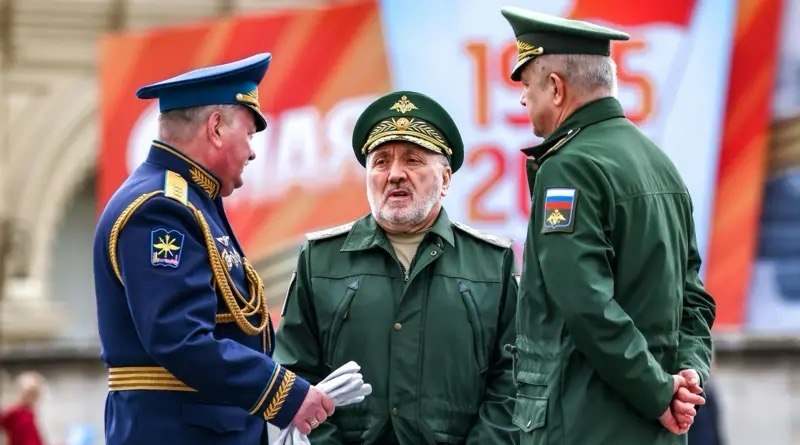
In the image: Tsalikov (center) worked with Shoigu for 30 years. Photo: Occupiers’ media
