The Ministry of Digital Development of Russia is developing a set of measures aimed at transforming the Russian segment of the Internet into a fully state-controlled infrastructure. This is reported by the Foreign Intelligence Service of Ukraine.
Instead of obvious blockades – a slow economic and licensing suppression that the average user will feel gradually: through increased bills, poor connection, and lack of alternatives.
The central initiative is to introduce charges for the use of international internet traffic for mobile subscribers. The estimated rate is about $2 per gigabyte. Officially, this is presented as a change in the tariff model, but the real goal is to make the constant use of VPNs financially unbearable. An average active user consumes 25–30 GB per month, and if the VPN is constantly on, all this traffic can be classified as international, even if the person is just reading Russian news or watching series. The mobile operators themselves turned out to be technically unprepared for such a transition and requested a postponement at least until September 1.
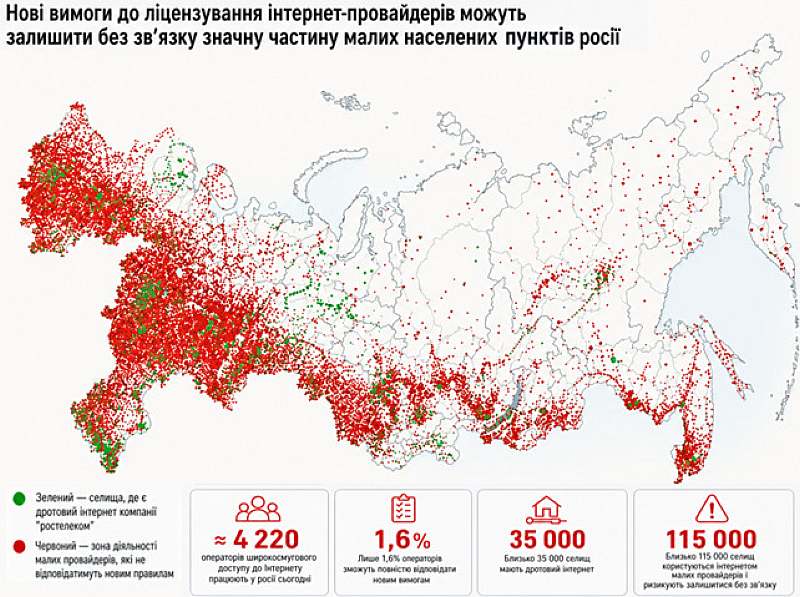
Simultaneously, the Russian Ministry of Digital Development is promoting a radical licensing reform. The current 17 types of licenses are planned to be reduced to three, while sharply increasing the financial entry thresholds to the market. A basic license will require capital of at least $66,000, a universal one – about $400,000, a general one – over $1.3 million. The current minimum statutory capital for a telecommunications operator in Russia is approximately $134.
The consequences for the market will be devastating. Of more than 4,200 existing broadband operators, only a small fraction will be able to meet the new requirements. Over 90% of small providers – internet companies, cable TV, regional operators – will face the threat of liquidation or absorption. The market will consolidate around several large federal structures, which de facto means its transition to direct state control.
Separately, a ban on providing communication services by individual entrepreneurs and companies that have not installed SORM – the system of operational-search measures that provides the FSB with direct access to traffic and subscriber data – is being discussed. Previously, the implementation of SORM was given up to two years; new rules may significantly shorten this term.
The Ministry of Digital Development also seeks to resume planned inspections of operators, despite the moratorium in effect until 2030.