
Today’s format will be somewhat unusual.
Information has begun to flow from the front about the enemy’s (Russian forces’) preparation for active, more or less large-scale offensive actions in several directions simultaneously. Therefore, it is probably worth trying to answer the question – where, how, and why?
Part One
1. First, a few general observations regarding the hypothetical Russian general (strategic) offensive within their summer-autumn campaign of 2026. In other words, we will try to understand why the Kremlin needs a large-scale offensive operation (at least in 1-2 operational directions), and specifically in the summer of this year.
– The first and main reason is the overall strategic situation in the current Russian-Ukrainian war. It is evident that the Kremlin has ALREADY realized that it cannot exit the war on terms acceptable to them (i.e., forcing Ukraine to accept the military-political conditions it had previously formulated). At least in the short to medium term.
Moreover, as it turned out, they cannot achieve this either through foreign policy efforts or through the intensified activities of Russian special services (including in the informational-psychological sphere), neither on the external stage nor within Ukraine itself. Additionally, the impossibility of “crushing” Ukraine financially, economically, or at the resource and technological level has also become evident.
Its ability to conduct armed struggle, though not significantly increasing, is at least not substantially decreasing. Ukraine as a state, and particularly its Armed Forces, continue to quite effectively resist external armed aggression even in the format of a “great war,” and evidently, they will be able to do so in the quite long term as well.
– Moreover, the further “continuation” of large-scale, and most importantly, very intense combat actions (and hence very costly and resource-intensive), has quite a negative impact (in some areas even critically) on the very apparatus. Furthermore, in many parameters (for example, in budgetary and industrial spheres, etc.), the REAL indicators of the apparatus are ALREADY reaching, let’s say, rather “borderline” values, even considering its military status. Also, this spring it became apparent that Ukraine itself is gradually, albeit not very quickly, increasing its capabilities for direct (or, as it is currently fashionable to say, “kinetic”) impact on these apparatus indicators. Particularly in sectors that remain quite sensitive to the overall course of the war (military-industrial and export components). This, in turn, poses quite a serious question on the implementation of the strategic concept of a “war of attrition,” which, evidently, the Kremlin has chosen for its current war conduction. In other words, it simply cannot afford to further prolong the “great war of attrition.” After all, it begins to intensely “exhaust” itself without having visible strategic results.
– Therefore, the only “hypothetically effective” and relatively quick way to force Ukraine to accept the Kremlin’s terms “under duress” remains exclusively military.
Simply put, it needs a significant military victory with a strategic impact. That is, in the near future, the relevant level of Russian military command needs to plan, organize, and conduct a successful operational-strategic offensive operation (at least in the form of several interconnected offensive operations of operational scale), which would create REAL prerequisites for the defeat of 1-2 operational-tactical groups (corps) of the Armed Forces of Ukraine (or one of their operational-strategic groups), thereby radically affecting the overall (strategic) ability of the Armed Forces of Ukraine to conduct further combat actions. Accordingly, this would force the military-political leadership of Ukraine to accept the terms proposed by the Kremlin. Moreover, this should occur in the shortest possible terms and pace (meaning in a strategic sense).
2. Where?
In answering this question, several factors should be considered, which have varying operational and strategic significance. First, in the context of determining the overall results of the war, second, regarding its possible further continuation. In my opinion, there are several such factors:
– The first determines the degree of alignment of a specific possible (hypothetical) Russian offensive operation with the strategic level goals and tasks set by the military-political leadership of the apparatus for its military command. Moreover, not so much in a declarative-political sense (for example, whether it will help “liberate the whole Donbas”), but specifically in a military sense — how it will truly affect Ukraine and its Armed Forces overall in terms of their ability to continue to conduct a full-scale, intense, and wide-ranging war?
That is, even BEFORE drawing specific arrows on maps in certain directions, the Russian military “planners” should honestly and realistically answer this question themselves — how exactly will this operation, even if successfully executed, affect the overall (strategic) situation in the war? Will it help “take” Ukraine out of the war or not so much? Is this specific “skin” worth this “tan” at all?
For example, will the Ukrainian Armed Forces critically lose their operational capabilities if several of their army corps are crushed and exhausted in the Sloviansk-Kramatorsk direction or not?
How would a hypothetical advance of Russian troops from the south and southeast by the forces of 1-2 combined-arms armies to the immediate approaches to Zaporizhzhia affect the overall readiness and ability of the Ukrainian Armed Forces to hold the front and continue fighting?
– The second factor specifically answers the question — where exactly can the desired result be achieved the fastest and with more or less acceptable resource costs (including all types — from human to financial)?
Currently, there are two such operational directions — the Sloviansk-Kramatorsk and the so-called “great Zaporizhzhia.” During the winter campaign, Russian troops were able to occupy a tactically advantageous (i.e., enveloping) position in relation to the Ukrainian Armed Forces groups defending there.
Moreover, considering this factor, the Russian command is likely to consider a number of nuances related to the selection of a specific operational direction(s) during its planning. I will not list them all now, but any operational officer can quickly and completely formulate them at the first opportunity.
For instance, the assessment of the condition of both their own and enemy forces, the availability and combat readiness of various levels of reserves, the state of routes and communications in a certain direction, the degree of equipment in potential concentration and deployment areas of specific strike groups, and the ability to provide comprehensive coverage for their operational deployment, etc., play a significant role in making a specific decision.
– There is another factor influencing the choice of location (direction) for the main (strategic) efforts of the Russian military command during their summer campaign in 2026, which is directly related to the previous two. If formulated as simply and concisely as possible, it involves answering the question — do we (meaning the Russian armed forces) have enough forces this summer for this?
Are there enough for a deep (operational) offensive and achieving decisive goals at this level and in this specific direction? Perhaps it is worth postponing this “decisive” offensive, if not by “location,” then by “time” (or at least extending its timeline)? For example, to conduct the next phase of mobilization deployment and gather the necessary forces for it. In this case, it might be worth limiting the scope and scale of the planned offensive and delaying the “final victory” to next year?
In this context, it is worth noting the rather obvious “strategic narrowing” of the choice for the Russian military command, mainly due to, as I mentioned above, their inability to significantly “prolong the war” further.
Simply put, the “decisive blow” must be dealt NOW (i.e., during the current year) and precisely in the optimal direction(s). And these, in my opinion, according to the most adequate assessment, are the Sloviansk-Kramatorsk and “great Zaporizhzhia” directions.
We will specifically consider each of the above directions regarding the arguments “for” and “against” in the next part of our review.
And finally, a little about “fractures,” “twists,” and other “dislocations.”
The fact that currently the main groups of Russian troops are content with, let’s say, very modest (in a tactical sense) results, which are already prone to “narrowing,” does not at all indicate that the Russian command plans to abandon, at least in the near future, conducting any significant (that is, larger-scale) offensive actions. This, in turn, will require them to take sufficiently active actions in the tactical zone (especially in the directions of future offensives). This means they will be forced to try at any cost to continue to maintain initiative at the respective (tactical) level.
They will attack or, more precisely, try to do so very persistently and regularly (and most likely, in the short term), striving to significantly scale their offensive at the first opportunity. It’s worth preparing for this very thoroughly and comprehensively.
Accordingly, the so-called “initiative,” including at the tactical level, is unlikely to soon pass to the Armed Forces of Ukraine, not to mention the operational or strategic level. Although such a temporary transition (or “breakthrough,” if you will) is possible in certain directions and on certain sections of the front line. But, again, exclusively within the framework of the Strategic Defensive Operation of the Armed Forces of Ukraine, which is far from complete at the moment.
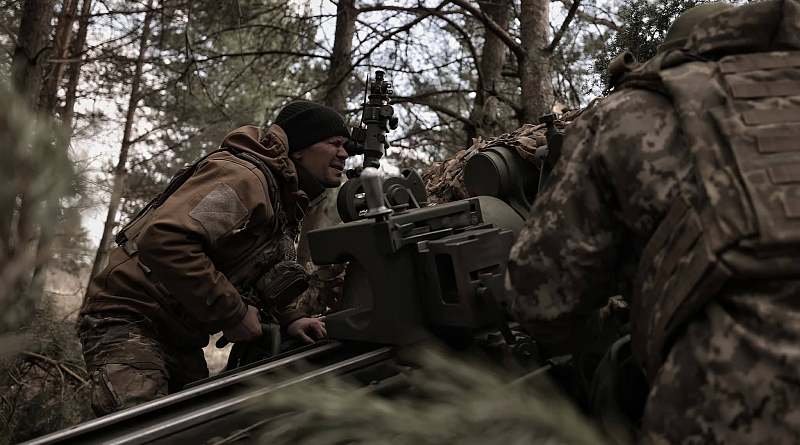
Photo: artillery division of the 33rd Separate Assault Regiment of the Ground Forces
