

Information on the current losses of Russia due to sanctions as of 02.05.2026.
1. Confirmed damage to Russian military aviation at a deep rear airfield.
– According to the General Staff of the Armed Forces of Ukraine, on April 25, Drone Systems Forces struck the Shagol airfield in the Chelyabinsk region — approximately 1700 km from the Ukrainian border.
– The target was several aircraft, including Su-57 and Su-34. The extent of the damage is being clarified.
– Commander of the Drone Systems Forces Robert Brovdi stated that four aircraft were hit: two Su-57s, one Su-34, and another aircraft of the “Su” family of an unspecified modification. According to him, satellite images capture the aftermath of the strike.
– If the information is confirmed, this would be one of the deepest attacks on Russian aviation infrastructure. The impact on even a limited number of modern aircraft, especially the Su-57, has a disproportionate effect due to their small number and the complexity of recovery.
2. Pro-Kremlin economists have downgraded their assessments of the Russian economy, acknowledging the direct impact of strikes on oil and gas infrastructure.
– According to CEMACP, the GDP growth forecast for 2026 has been nearly halved — to 0.5–0.7% against the previous 0.9–1.3%. Medium-term expectations have also worsened: growth for 2027 is now forecast at only 1–1.2%.
– The primary reason is the risk of reduced oil production and export due to strikes on ports and refineries. Damage to facilities in the Baltic and Black Sea directions has disrupted logistics: excess oil is being directed to the Transneft system, which is already facing overflow. This forces companies to limit production.
– Additional risks are associated with potential disruptions in transit through the “Druzhba” pipeline, new sanctions, and high interest rates.
– Collectively, this forms a stable trend: investments are shrinking, inflation is slowing down slowly, and the economy is effectively entering a state of stagnation. Considering that approximately 23% of Russia’s budget revenues are provided by oil and gas receipts, problems with export and processing directly undermine the state’s financial stability.
– Even analysts close to the Kremlin are forced to admit: strikes on energy infrastructure are already transforming from a tactical factor into a systemic economic risk.
3. Gazprom’s financial results for the last year show a formal profit increase, which is not supported by actual operational dynamics.
– The net profit amounted to 1.35 trillion rubles (+2%), however, basic indicators deteriorated. Revenue decreased by 9% to 9.77 trillion rubles, reflecting a decline in oil and gas sales revenue.
– Simultaneously, net debt exceeded 6.1 trillion rubles, meaning the company is selling less but increasing its debt load.
– The key factor for “profitability” is the reduction of tax pressure. Total tax payments decreased by 33% to 2.51 trillion rubles. The mineral extraction tax was almost halved: from 3.06 trillion to 1.79 trillion rubles.
– Thus, the positive financial result was achieved not through efficiency, but through direct loss of budget revenue.
4. There’s a boom in microcredits in Russia, but it’s a bad signal for the economy.
– By the end of the year, Russians borrowed a record 2.1 trillion rubles from microfinance organizations — 35% more than the previous year. Approximately 514 billion rubles were issued quarterly, indicating a mass shift of the population to expensive short-term loans.
– The reason was a sharp tightening of bank credit policies. Due to falling incomes, increasing “gray” payments, and unstable cash flows, banks are much stricter in assessing borrowers.
– As a result, even clients previously considered reliable are losing access to relatively cheap loans and are forced to turn to the microfinance sector with much higher rates.
– However, this segment cannot long compensate for systemic issues. It’s expected that by 2026, lending volumes will decrease by about 5%, and profitability will fall by 10%. The share of risky borrowers is increasing, undermining the stability of the business model.
5. Danish FLSmidth is investigating a possible violation of sanctions against Russia after discovering the transfer of tender materials to affiliated parties in RF.
– The matter concerns documents at the pre-contract stage related to a limited number of potential projects in Kazakhstan. The company confirmed it has suspended participation in these tenders and is conducting an internal review.
– FLSmidth noted that activities taking place before 2026 could fall under the sanction regime and contradict the company’s internal policies.
– The situation highlights a typical scheme of bypassing restrictions through third countries, particularly through Kazakhstan, where Russia is trying to maintain access to technology and equipment.
– Even indirect contacts at the tender documentation level can constitute a violation, indicating increased control over sanctions compliance and rising risks for international businesses interacting with Russian counterparties.
6. Japan partially resumed imports of Russian oil after almost a year-long pause.
– Taiyo Oil’s refinery has purchased a batch of Sakhalin Blend crude oil — for the first time since June last year. The delivery is being carried out by the tanker Voyager, which is headed to the port of Kikuma.
– The volumes of the current purchase are not disclosed, but previously it was about 600,000 barrels. Formally, this grade is not subject to sanctions, allowing Japan to maintain limited cooperation with Russia.
– For Tokyo, this is a pragmatic decision: the country relies on energy imports by approximately 95% and is attempting to diversify its supply sources.
– At the same time, such a purchase is situational in nature. The company emphasizes that no decision has yet been made on further imports of Russian oil. This indicates caution: even with exceptions, Japanese businesses avoid long-term commitments due to sanction and reputational risks.
– In a broader context, this is another example of how Russia maintains targeted sales channels but is unable to return to stable pre-war export volumes.
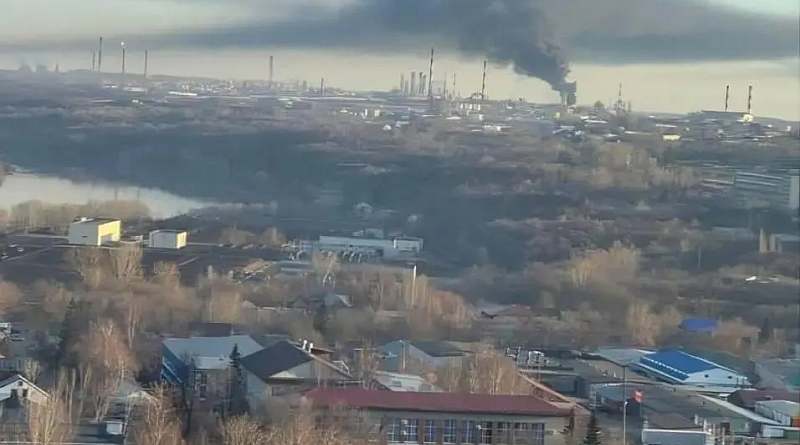
On the cover: Attack on the Bashneft-Novuil oil refinery, April 2026. Photo: Telegram channel Exilenova+
