
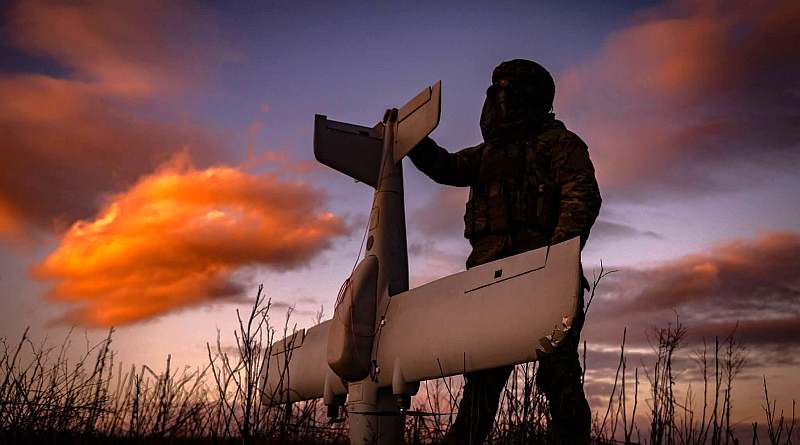
While Z-bloggers frantically calculate what percentage of Patriot missiles the USA used in the war with Iran, a severe crisis is brewing at home. The famous layered defense turned out to be a sparse dotted line around the grandfather’s cottage. Three main signs that the Russian air defense is exhausted.
Repeat attacks on key targets are the main marker
There are factories that have been hit by five waves of UAVs or missiles. The oil depot in Feodosia was attacked four times. The headquarters in Sevastopol — I’ve lost count (more than ten episodes). The terminal in Primorsk three times. Repeatedly the oil refinery in Tuapse, where it is still burning, and there are rains of fuel oil. Twice the fiber optic plant, twice the “Molniya” production workshops with “Neptunes” (with 150 kg warheads). Slowly, with planning — strikes on the theater of war up to 2000 km in-depth, reconnaissance, return visits.
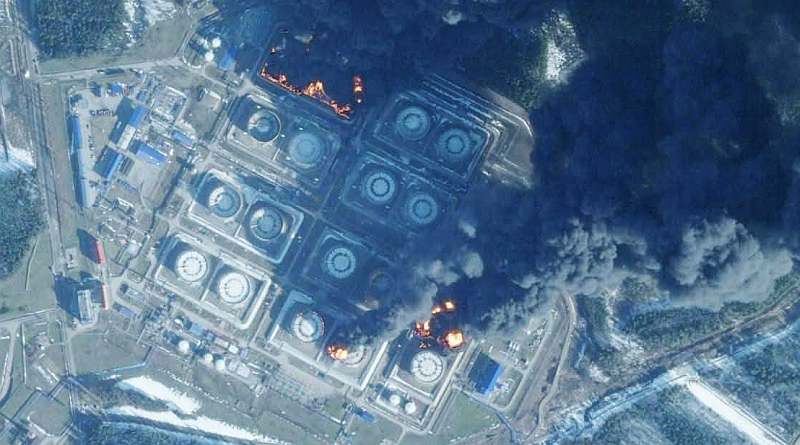
This is not only due to the increasing number of medium and long-range UAVs, but also because the enemy has fewer and fewer air defense missiles. This applies not only to the S-300, whose production cycle is 7–8 months, but also to the “Pantsirs”.
The EU, represented by Belgium, found 15 decommissioned “Gepards” for Ukraine, restored them, painted them, and sent them to the Israelis from Elbit Systems — voilà, plus 15 self-propelled units with a firing rate of 1100 rounds per minute. They depend on ammunition supplies from Rheinmetall, undergo maintenance in the EU if necessary. In the RF, the partner is Iran, which somehow cannot resolve its air defense issues on its own (lost its own S-300), while North Korea hasn’t succeeded with radar systems and inexpensive anti-aircraft artillery — it has 10-12 thousand infantry, 170 mm “Koksans”, and millions of shells for rice and gold.
The summary of this situation is simple: 17 million square kilometers of Russian Federation territory suddenly found themselves in a situation where the sky is completely porous. To cover at least the European part (almost 4 million square kilometers) from a swarm of UAVs, hundreds of short-range systems are needed (at least 300–400 units), which are physically unavailable. The production of one illumination and guidance radar (RPN) for the S-400 faces a shortage of microelectronics, which are imported through grey schemes by the teaspoon per month. The missiles for the “Pantsir” systems (specifically 57E6 costing from $100,000) are being used up much faster than they can be produced by the Tula KBP. In addition, the “Kremny EL” plant in Bryansk, which produced electronics for the “Pantsir”, was struck.
When a flock of “Lyutyi” (range 1000+ km) or new FP-2 priced at $50–100 thousand per unit targets an oil refinery, Russian air defense is forced to spend interceptors priced from $300 thousand to $1–2 million.
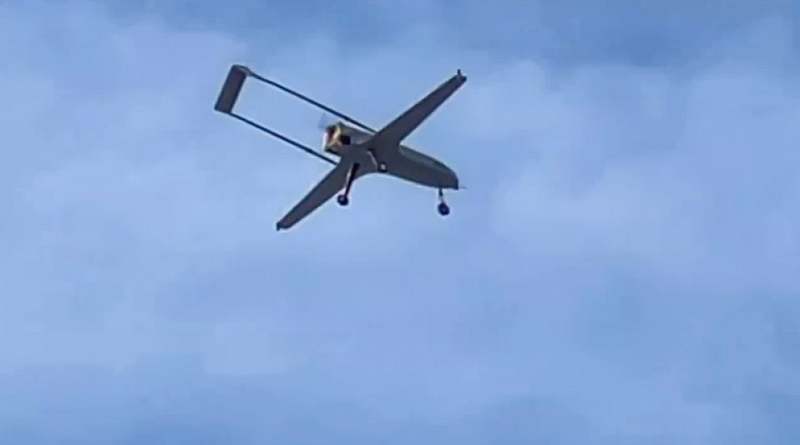
The system is frantically trying to stretch a short blanket: they are pulling SAMs from the Far East (more than 30% removed), exposing Kaliningrad, the Arctic, and even front line areas to cover at least the oil “cash cows”. But a cracking rectification column is not a tank in the field. It is huge (30–50 meters high), costs hundreds of millions of dollars, and Western components now take years to arrive due to sanctions (delivery time increased to 18–24 months). To neutralize it for half a year, it’s enough to let one drone with 50–70 kg of explosives through.
Hello, agency. Inability to cover important locations from slow drones
The strike on Donetsk in broad daylight — on the FSB building on Universitetskaya Street — was carried out by a shortened 200 km radius version of FP-2, carrying 105 kg of explosives. It took out a floor, burned servers, equipment, killed and injured over 27 people (12 officers irreversibly) of the operational staff and management.
Judging by the time of the attack, it hit during the traditional briefing at 08:00 for such agencies. A heavy slap in the face to those accustomed to sending armored “Urals” to addresses, shooting with machine guns, and torturing people with pliers.
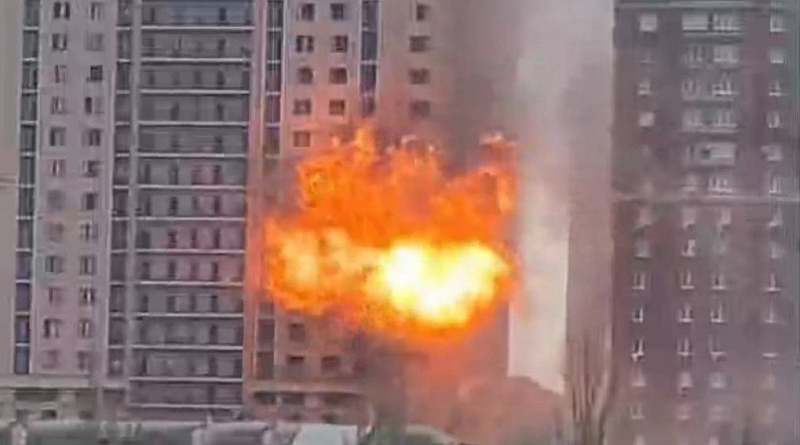
And this is an absolute, standard marker of air defense paralysis. Donetsk is not a remote province beyond the Urals; it’s a major city, which since 2014 (already 12 years!) has been reinforced with layered air defense. Theoretically, it should have a complete radar dome. Yet here flies a massive object, loaded with over a hundred kilograms of explosives. It flies high (at an altitude of 500-1000 meters), boldly, in broad daylight, without terrain masking, not hiding in the area’s folds, and not relying on night stealth. On any working radar (“Pantsir”, “Tor” or S-300), such a flight profile lights up like a Christmas tree, from 30-50 kilometers away. It’s an ideal, contrasting target, with a large effective reflective surface area.
And if this craft calmly reaches Universitetskaya and enters a window for a morning meeting, then it’s one of two things:
— there are blind spots: the radars have been knocked out by previous attacks, leaving 10-kilometer gaps over the city where heavy drones can be brought in like on a highway;
— air defense ammunition famine: operators see the target on their monitors, but firing is pointless — launch containers are empty because missiles were used up on false targets, and the Tula factories can’t supply new ones fast enough.
This is a crisis because the system has reached the stage of a patched-up cloak. To cover the burning oil at the Tuapse refinery (which generated export revenue) or strategic bombers in Engels, the air defense umbrella was pulled there, exposing the headquarters of their own counterintelligence. The elite caste, accustomed to feeling like immortal beneficiaries of human lives in the deep rear, suddenly discovered that the sky above them is open, and their own army can no longer protect them. The system simply ran out of resources to cover “important people.”
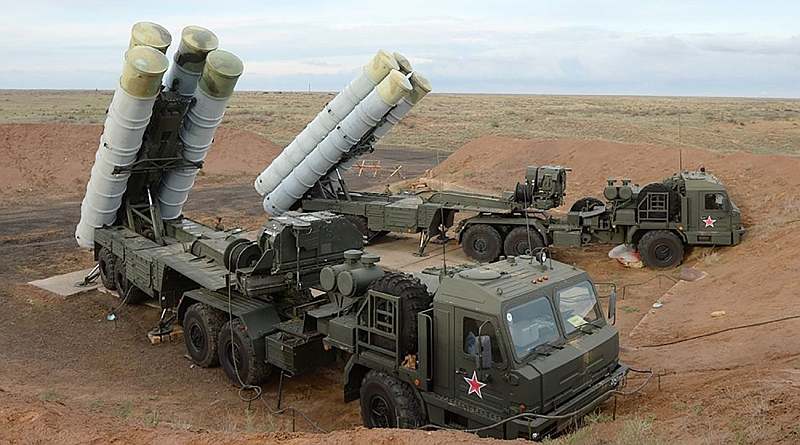
The Suicide of “No Analogues” (S-400 burnout)
Crimea and frontline zones have shown the main paradox: a system created to close the sky cannot even protect itself. S-400 “Triumf” and S-300 divisions worth from half a billion to a billion dollars are systematically burned by cluster ATACMS (with hundreds of submunitions), “Storms,” and not just by swarms of drones but also by a few missile strikes. When air defense cannot shoot down a ballistic missile from the 1990s flying directly into the RPN — it’s a diagnosis. And these divisions can’t be quickly restored: the production cycle of one radar takes 6–8 months, and the component base is under heavy sanctions.
As a result, they lose “umbrellas” faster than they are assembled. The list of radars destroyed and damaged weekly in Crimea by GUR and SBU (all those “Podlyot” and “Nebo-M”) is the size of Ramesses’ scrolls.
Strikes on strategic aviation airfields (like “Olenya” beyond the Polar Circle, 1800 km away) and factories in Tatarstan (1200 km) are just for dessert.
Because it’s an embarrassment unparalleled in military history. Drones the size of light aircraft (based on A-22 or “Lyuti” with a wingspan of up to seven meters) fly for 12–15 hours over the territory of the Russian Federation. Fifteen hundred kilometers. At a speed of 150–200 km/h. They buzz like lawnmowers. They cross dozens of regions, fly over bases, cities, roads. Loads of video — and nobody can do anything.
For contrast: last week there was a raid on Dnipro — air defense was working, though two drones out of two dozen broke through and hit residential buildings. They have absolute emptiness.
This proves what was long kept silent: the Russian Federation does not have a continuous radar field. It is patchy. Complexes are placed around Moscow, palaces, and a few bases (covering a maximum of 10–15% of the territory), and between them are hundreds of kilometers of blind zones, where entire squadrons can be guided. The famous layered defense turned out to be a sparse dotted line around Grandpa’s dacha.
“How are you there, descendants?” — asks Mathias Rust.
“Everything just as you liked it during the USSR,” — the Russians reply.
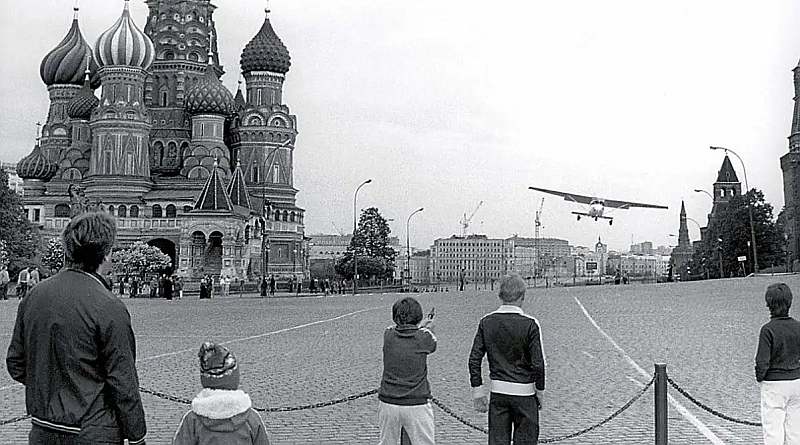
All this comes together into a single clear puzzle: the Russian air defense has turned into a sieve. The more they try to plug these holes, the more it tears in other places of the patched cloak. While they transition to drone interceptors with their corrupt Ministry of Defense and procurements (which will take months), we are charging them a heavy price. Just as Rurik often did with the Pechenegs.
Cover photo: 22nd Separate Mechanized Brigade
