
Oleksandr Shulman, Oleh Hebura / Texts
Sleepless nights and the groans of Russians like “why us?!” are becoming a system for many regions of the Russian Federation. Strikes on Russian oil terminals indicate a transition to a new phase of the campaign — a systematic impact on export infrastructure. Key ports in the Baltic and Black Sea are targeted, and their simultaneous hits create a “bottleneck” effect for the entire supply system. Ultimately, it’s not just about damaging individual objects but about deliberately limiting Russia’s ability to export oil, and thus, receive resources for waging war.
We downloaded and analyzed messages from the Russian telegram channel “Radar across Russia” (@radarrussiia), which reports on air alarms, to see how the war is returning to the aggressor’s territory. There is no official centralized resource for announcing air alarms in Russia, so the real numbers and duration of threats could be even greater, but even these data clearly demonstrate: calm nights for many Russians are a thing of the past.
It can be said that thanks to the work of the Ukrainian defense industry and the help of partners, the years 2025–2026 have turned the strikes on Russia’s energy and oil sector into a systematic campaign with a clear geography and equally clear logic. The main directions of the strikes are the border regions, the central part of the Russian Federation, as well as the deep rear with critical and industrial infrastructure.
Russia is not sleeping
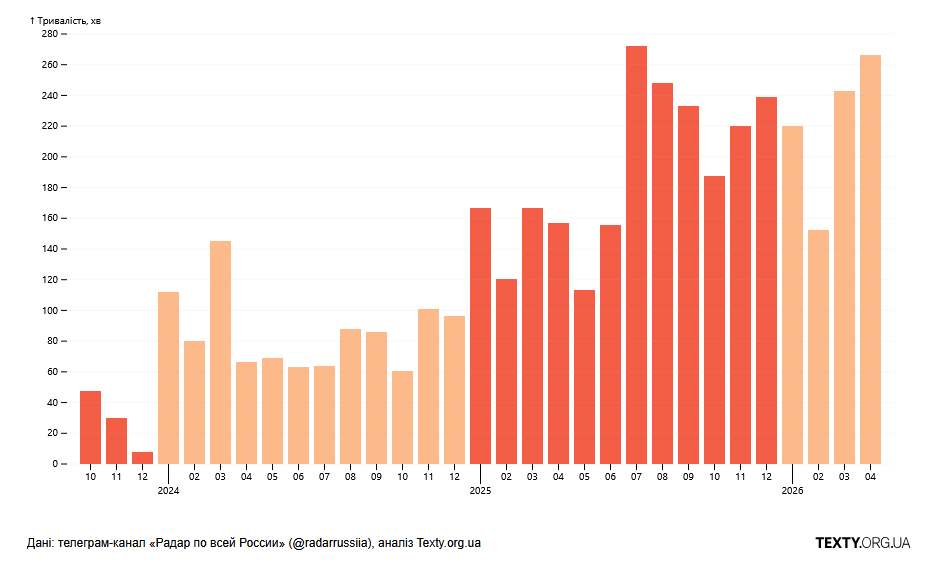
There are not just more alarms — the attacks are working to exhaust. The danger is mostly announced closer to midnight, lasting until 5 or 6 a.m. If in the autumn of 2023 alarms lasted an average of 40 minutes, now, in 2026, they last three to four hours a day.
Air Alarms in Russia
The more saturated the color, the greater the number of regions where air alarms were announced

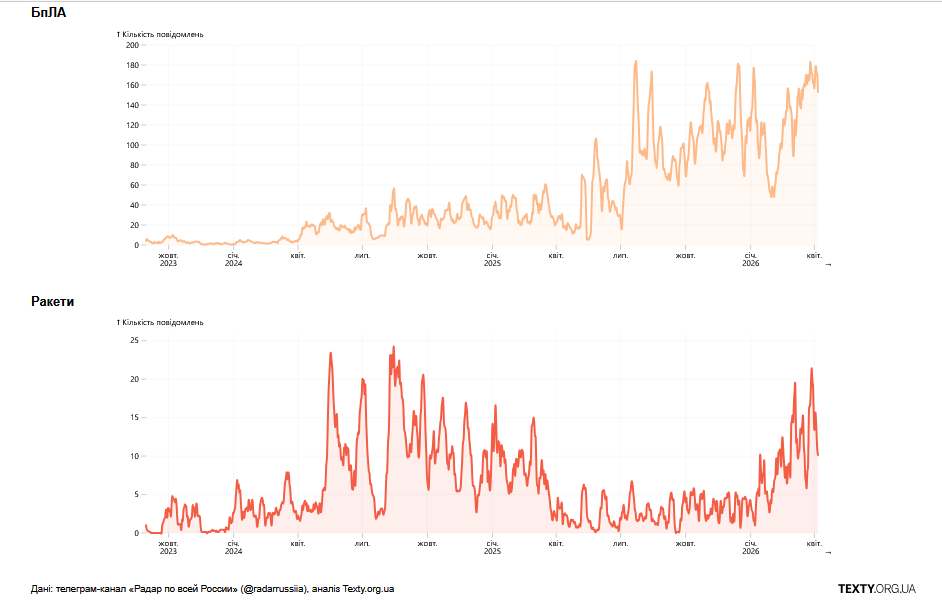
The number of attacks has also increased. In the spring of 2026, the number of reports about drone attacks sharply increased and can reach 150 per day.
Number of reports about air alarms by types of threats
Dynamics of attack warnings in Russian regions by months
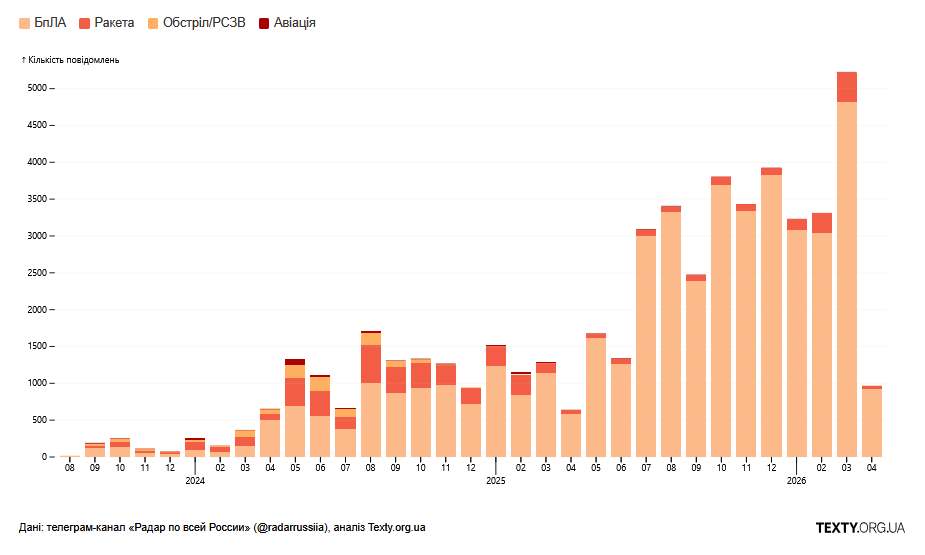
However, missile attacks have significantly decreased after the beginning of 2025 — shortly after Donald Trump’s inauguration. Interestingly, during this time, Russia increased the number of strikes on Ukraine (read more about this in our article here).
Number of attack alerts
Average number of UAV and missile warnings (seven-day moving average)
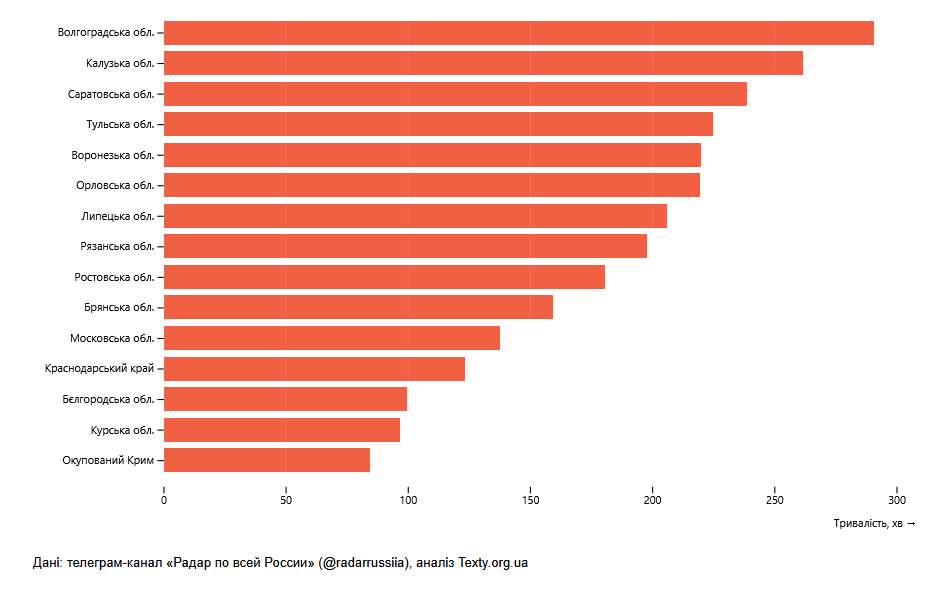
Alerts are most frequently announced in the Volgograd, Kaluga, and Saratov regions. There they average over four hours. For example, in the Moscow region, the average duration of alerts is over two hours.
Border areas: zone of tactical influence
Ukrainian drones are most intensively operating in regions directly bordering Ukraine: Belgorod, Kursk, and Bryansk. Recently, Voronezh and Rostov regions, as well as the Krasnodar territory, have been added (drone launchers operate from there, air bases housing enemy aircraft are located there, and oil depots and ammo depots are concentrated there).
This is quite evident: minimal distance — maximum frequency, less time to intercept our means of destruction — missiles and drones. Here we strike regularly, affecting the tactical and partly operational capabilities of the aggressor. Targets include ammunition depots, air defense positions, logistics hubs, and facilities supplying troops near the front. Essentially, this is the transfer of hostilities into the depths of Russian territory and, one might say, the expansion of the kill zone.
Average duration of air alerts by region
15 regions with the longest alerts
Center of Russia: Demonstrating Vulnerability
The second important direction of attacks is the central regions, particularly Moscow and the Moscow region. Kaluga, Tula, Tver, and Smolensk regions are also under attack.
Previously, attacks on the capital of Russia were more symbolic, akin to strikes on Berlin in the summer of 1941, but recently they have become regular. The goal is not so much to physically destroy targets as to create systemic pressure, such as disrupting airport operations with endless “carpets,” when no plane is flying anywhere, leading to millions in losses, strain on forces, and expenditure of air defense ammunition.
Another very important factor is the psychological impact on what sensible people call brains. Russians see that even the most protected areas are vulnerable.
Deep Rear: Economic Strikes
A separate and strategically most important direction is strikes on industrial regions deep within Russia. This includes the Ryazan, Nizhny Novgorod, Samara, Saratov, Volgograd regions, and Tatarstan.
These regions contain key oil refineries, chemical plants, and energy facilities. Strikes on them have a long-term goal: reducing the production of fuel, raw materials for gunpowder, and gunpowder itself, explosives, complicating logistics, and creating economic pressure on the military machine of Russia and the economy in general.
However, it should be noted that Russians restore oil refineries quite quickly and build protective elements on them. Therefore, news about refinery damage has recently disappeared.
It is noteworthy that many such facilities are attacked more than once or twice. This indicates the systematic and priority nature of this direction, as well as the inability of the Russians to protect them.
Export Restrictions
Another direction of attacks with gradually critical consequences is strikes on oil terminals, affecting the export capacity of Russian oil.
In addition to the refineries themselves, important elements of the infrastructure for transportation and export of oil have come under Ukrainian drone attacks: oil depots, transshipment hubs, pumping stations, and facilities related to main oil pipelines. Even if damage to such hubs does not completely paralyze the system, the strikes significantly reduce throughput and force a redistribution of export flows.
This has several consequences: stable export through ports becomes more complicated, logistics and restoration costs increase, delays in the supply of raw materials and petroleum products occur, and the overall efficiency of the energy sector decreases.
As a result, even without the complete destruction of large facilities, a systemic effect is achieved—a partial limitation of export potential, directly affecting Russia’s foreign exchange earnings.
South and the Caucasus: Infrastructure and Ports
Less intensive but regular attacks are also recorded in the southern regions, including the Krasnodar region, Astrakhan region, and the North Caucasus. Here the focus is on oil depots, transport infrastructure, and facilities related to resource exports. Occasionally, military targets, including airfields, become targets.
Distant Strikes: Reach Effect
Periodically, Ukrainian drones reach much more distant regions—from the Leningrad region to areas near the Caspian Sea. Such attacks occur less frequently but have an important effect.
The focus is on demonstrating the range and capability to strike targets at great depth. These are often unique or particularly important targets, such as large oil and gas facilities or military-industrial complexes.
Campaign Logic
Despite a wide geographical spread, the strikes are not chaotic. A clear structure of priorities is observed:
- border areas — to influence the course of hostilities;
- fuel and energy infrastructure — to economically exhaust;
- export logistics — to reduce foreign currency inflows;
- military objects (airfields, air defense) — to reduce combat capabilities;
- Moscow — as a political and psychological target.
Attacks on Russian Oil Terminals: UAVs Target Exports, Not Just Objects
Recent strikes by Ukrainian drones on Russian territory show a fundamentally new logic of the campaign. Previously, the focus was mainly on military targets or border infrastructure, but now oil terminals and other key nodes where the aggressor profits by exporting energy resources are in the spotlight.
This involves a series of coordinated strikes on several critically important ports, primarily in the Baltic and Black seas.
The Baltic direction has become one of the main focuses. At the end of March and the beginning of April, drones repeatedly attacked the port of Ust-Luga — one of Russia’s largest oil hubs. The strikes were accompanied by fires at terminal sites and damage to tanks and transfer infrastructure. Simultaneously, another key Baltic port, Primorsk, through which crude oil is exported, came under attack.
The consequences of such strikes extend far beyond local damage. Even partial disabling of tanks or loading nodes immediately reduces shipping volumes. Delays occur, routes change, limitations accumulate, resulting in an overall drop in exports. Essentially, it is enough to strike a few key points for the entire system to start operating less efficiently.
Thus, after a strike on the Black Sea export direction, Russians encountered many problems. In early April, our drones repeatedly attacked the “Sheskharis” oil terminal in Novorossiysk. This is one of Russia’s key ports on the Black Sea, where remnants of the Black Sea Fleet, which fled from the “city of Russian glory” Sevastopol, are hiding. Damage to the port infrastructure, disruptions in pumping systems’ operations, and fires led to temporary limitations in the terminal’s functionality. Given its role in export, even short-term disruptions immediately affect overall supply volumes.
What is important is not only where strikes are directed but also how they are combined. The Baltic and Black Sea directions came under attack simultaneously, with strikes on Ust-Luga, Primorsk, and Novorossiysk occurring almost synchronously, creating a synergistic pressure effect on the entire export system. This sharply narrowed the maneuvering possibilities.
As a result, the problem is no longer with individual damaged objects but with the reduced throughput of the entire system.
Average Duration of Air Alarms by Month
This is where the main change in the tactic of drone strikes lies—they are less and less aimed at “spectacular” destructions and increasingly at creating systemic economic pressure. Oil terminals in this sense are an ideal target, as they combine logistics, export, and financial income. Unlike oil refineries or fields, marine terminals have a critical feature—they are the endpoint of the entire system. It is here that oil turns from a resource into money.
If a plant can be partially bypassed and the flows redirected, the situation with ports is much more complex: there are few of them, each with its own specialization and capacity, each being unique.
This means that even local damage creates an effect that is difficult to compensate for. Other ports quickly become overloaded, logistics become complicated, resulting in “floating” export schedules, and shadow tankers are increasingly intercepted by allies. A characteristic feature of the latest attacks is not the complete destruction of objects. It’s enough to put one or two tanks out of action, create a fire, damage a pumping station, or power system—and the terminal already operates in a limited mode or stops for a certain time. This “economics of the strike” makes the campaign effective: relatively small means achieve a disproportionately large result.
