
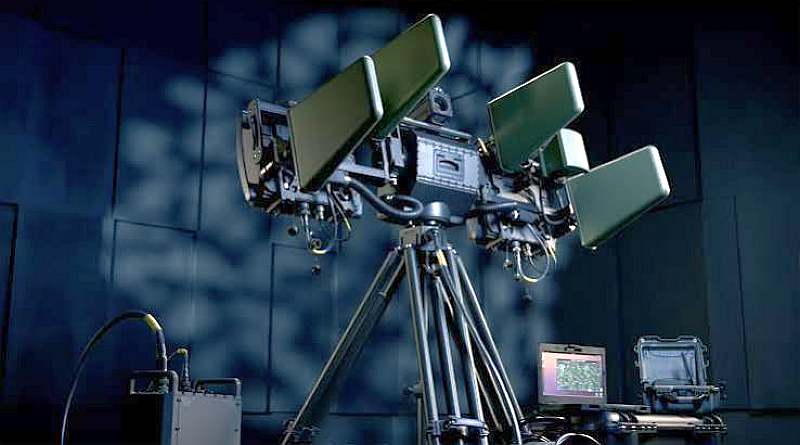
I am watching a simulation of an air battle from the conditional Kyiv and Odesa. My interlocutor is a special forces officer who was at the origins of the development of the PDT air-defense complex “Ai-Petri.” Previously, they already had hundreds of unique operations at the line of contact. Now — they are trying to solve the problem of how to prevent the Russians from shooting at civilians like in a shooting gallery.
I see missiles coming out from Crimea and Shaheds flying in from the North. The positions with the complexes light up — this means they can see and recognize the target, track it, and try to suppress it. Calculating what exactly is flying and where takes programmers literally seconds. In the following seconds, this information reaches the interceptors and other air defense means.
“Skif” — that’s the call sign of my interlocutor — explains “with hands” who and how conducts the air battle, and why Kyiv, Odesa, Dnipro, despite all efforts, let the strikes pass, one after another. There are several reasons.
The first is the most obvious: a lack of means of destruction and trained crews.
The second — to fully suppress one “Komet” navigation system, on which Shaheds operate, several “Ai-Petri” complexes are needed, located in a certain combination. Testing has confirmed its effectiveness. But now hundreds of such wings fly at civilians every day. Accordingly, thousands of complexes are needed.

Unfortunately, they do not physically exist in such numbers. Moreover, new UAVs are trained by artificial intelligence to recognize targets via video links. Therefore, when it comes to large or visually recognizable objects — factory, warehouse, gas station — even without GPS, this scoundrel finds the target with electronic “eyes.” “Ai-Petri” can blind enemy birds, but we return to the beginning — there is a critical shortage of complexes.
However, the state apparatus is in no hurry to change the traditional system of state orders and manual lobbying of certain means. Thus, money defeats efficiency.
Why a person physically does not keep up
During a massive attack, the command post must solve the resource distribution problem in real-time: hundreds of targets, hundreds of means, each of which has a limited range and limited ammunition. A distribution error is costly in the literal sense. For example, when several interceptors work simultaneously on one target, another target is left without coverage at all.
According to “Skyf,” a person physically can’t make these decisions within seconds, regardless of their qualifications: the operator gets tired and loses concentration after just 15–20 minutes of continuous work, whereas a massive attack can last for hours.
“To properly influence a drone, you need to quickly understand what signal it uses. It can take a person minutes, but sometimes we don’t even have seconds. Therefore, artificial intelligence is needed for recognizing signatures and automatically choosing actions.”
At the same time, simply increasing the number of equipped positions and adding more REB or PDT complexes without automating management might not improve but worsen the situation.
“A bad REB might not harm the enemy. An unmanaged REB will also interfere with our own. Thus, the means must work not each on its own but in a single circuit.”
The reality is this: the airwaves are cluttered, and all possible means operate blindly, often interfering with their own. Several crews try to coordinate actions by voice or manually at the same time.

Skyf observes the results of this fiasco on the air battle map daily. “Shaheds” reach their targets one after another. According to the statistics mentioned in the conversation, intercepting one strike UAV of the “Shahed” type averages about ten interceptor sorties. The reason is not only the quality of the drones themselves but also that target designation and distribution among crews often occur without a unified algorithm.
What technically already solves the problem
Skyf explains that the “Ai-Petri” software specifically addresses the task of automated combat control, not target destruction. This is a fundamental difference: the system doesn’t replace firepower but manages its network—allocating targets among available means, designating frequency corridors for REB operations to avoid “jamming” their own interceptors, and reallocating resources in real-time depending on which target is downed and which just appeared.
The key point: the class of “situational awareness” systems, which simply display the battle scene on the screen for a commander, is not the same as combat control systems that directly make decisions and issue commands to the means. Many of the former are being developed in Ukraine, but far fewer of the latter, and according to the developer, they are critically lacking.
This system is already operating in experimental mode in several cities — Kyiv, Odesa, Zaporizhzhia, and now it is being launched in Dnipro. However, the coverage scale remains limited: in Kyiv itself, only a portion of the available facilities are under unified automated control, while the rest continue to operate separately.
The Battle of Means: Is Efficiency Measured by Classic EW Metrics?
At defense exhibitions, any complex is inevitably perceived primarily as a set of visible items: antennas, masts, equipment cabinets, operator workstations. This is what can be photographed, put on a stand, and compared with competitors’ products. However, in the case of “Ai-Petri,” such optics are misleading. What the visitor sees on the site is only the physical part of a much larger system.

The main advantage of “Ai-Petri” lies not in a single antenna, a specific machine, or even in a separate electronic warfare means. It is about a hardware-software complex capable of integrating reconnaissance, EW, optical, and other surveillance channels, as well as means of physical damage, into a single automated circuit. Its key product is manageability: the ability to remotely coordinate a large number of dispersed means, automatically find targets, prioritize, and allocate resources during an attack.
This is a fundamentally different approach to countering drones. It’s not about buying as many separate boxes as possible but building a network where each box becomes an executing element of the common system. Part of such an architecture has already been implemented in “Ai-Petri.”
The “hardware” creates a physical effect, while the software level determines when, where, on which target, and in coordination with which other means this effect should be applied.
This is where the boundary lies between a separate product and a complex. A separate EW can create interference in a given range. The complex must first receive information about the air situation, distinguish a real threat from a false mark, determine the type of target, choose the optimal influence, ensure it doesn’t interfere with its own systems, and monitor the result. If the threat doesn’t disappear, immediately connect another means.
“Here, we need to ask about building a system, not endlessly argue which individual complex is better or worse.”
The more complexes added without automation, the more people are needed at the controls. However, increasing the number of operators does not solve the coordination issue. It’s necessary to know who has targeted what, which frequencies are occupied, where our own electronic warfare can block our own interceptor, and where to redirect resources after the first strike. At some point, the system grows faster than people’s ability to manage it.
Therefore, Skif’s position is harsh but logical: remove humans from the routine part of the loop. This doesn’t mean giving the decision entirely to machines. The operator and commander remain responsible, understand the system’s logic, and can intervene. But finding the optimal executor, target distribution, frequency planning, and continuous recalculation of priorities should occur automatically.
Software Core “Ai-Petri”
In “Ai-Petri,” this role is performed by its own software loop. Simply put, it’s a network management system: it collects data from various sources, forms a shared picture, distributes tasks among available complexes, and constantly recalculates solutions. It’s not about a remote control for a single installation, but an architecture designed for simultaneous control of a large number of dispersed means — potentially hundreds.

In this model, the operator does not manually switch each transmitter. The system determines which complex is optimally located, which frequencies need to be suppressed, where to leave a free corridor, and where electronic influence is insufficient, requiring transmission of the target to a physical strike asset.
“This is the software that controls the ‘Ai-Petri’ network of means. It can manage not just ‘Ai-Petri’ but other compatible means. The idea is to gather everything into one fist and properly allocate resources during an attack.”
This is the fundamental difference from the traditional approach, where each calculation sees only its sector and operates according to local information. In the network model, all elements receive a common picture and specific tasks. Once a target is neutralized, the means are automatically freed for another. If a more dangerous threat appears, the system rearranges priorities.
Importantly, the software layer is not tied to just one type of equipment. With compatible protocols, means from other manufacturers can be connected to it. That’s why “Ai-Petri” should be seen not just as a specific product, but as the foundation of a broader ecosystem for countering UAVs.
This explains why the value of “Ai-Petri” cannot be measured only by the number of transmitters or the power of a single complex. What’s important is how many means the system can integrate, how quickly it distributes targets, whether it can connect interceptors and other hard-kill solutions, and how many operators are needed for the entire network to function.
Ai-Petri is already doing what others still need to build
In the Ukrainian discussion about countering drones, there is often talk about a future “system of systems” — a digital platform that will gather sensors, electronic warfare, and strike capabilities into a single loop. For “Ai-Petri,” this is not just a concept. The software loop is already operational: it encompasses a large network of means, part of the processes are automated, and the architecture allows for the integration of third-party complexes.
Thus, the main question is no longer whether it is technically possible to remotely control a large number of distributed means. It is possible. Not whether the system can automatically distribute frequencies and targets. It can. And not whether electronic impact can be combined with interceptors and other strike means. The loop is created precisely for this.

The problem is in scale. The number of “Ai-Petri” complexes that can realistically form a dense managed network around critical objects and large cities does not yet match the scale of the attacks. At the same time, a significant part of other available means remains outside a unified management. The country may have many electronic warfare systems, but far fewer elements that work as one system.
“We need, to begin with, not just to increase the number of complexes. We must learn to effectively use everything that is already there, bringing it into one loop. Then it will become clear how much more the network needs to be expanded. Currently, its capabilities are critically insufficient for the scale of the threat.”
What is needed for scaling
First — increase the number of “Ai-Petri” complexes where they need to create a dense managed network. The software loop does not eliminate the need for physical means: automation can optimally distribute existing resources but will not create an effect where there is no executing element.
Second — connect compatible means from other manufacturers to the “Ai-Petri” software. For this, the state should implement mandatory exchange protocols: if a new electronic warfare system, sensor, or interceptor is up for procurement, it must be able to operate within a unified loop. Otherwise, each new model increases the fleet but does not increase manageability.
Third — evaluate procurements not by the number of adopted names. The real measure is how many targets the system can detect, correctly allocate, and neutralize simultaneously; how many people are required for this; what the cost of one successful interception is; and whether the system’s own means interfere with each other.
Fourth — develop automatic recognition and integration with hard-kill means. Reactive strike drones reduce reaction time so much that manual targeting becomes inadequate. From detection to the launch of an interceptor or other means should take seconds, not minutes.
And — importantly — both developers and military strategists often overlook an important factor: the economics of war itself has changed. When missiles costing hundreds of thousands of dollars are forced to shoot down drones costing forty to eighty thousand dollars, which are produced in tens of thousands, it literally drains the economy. However, neither the military nor the arms manufacturers can fundamentally solve this issue. The state must pave the way — from financing risky and early developments to ensuring the logistics of supplying a sufficient number of components.
But the key aspect is the strategic decision to focus on planning, unifying requirements, and forecasting risks instead of just managing budgets and cloning nomenclatures.
In the spotlight: The “Ai-Petri” complex. Photo: Oleksandr Volchansky
