
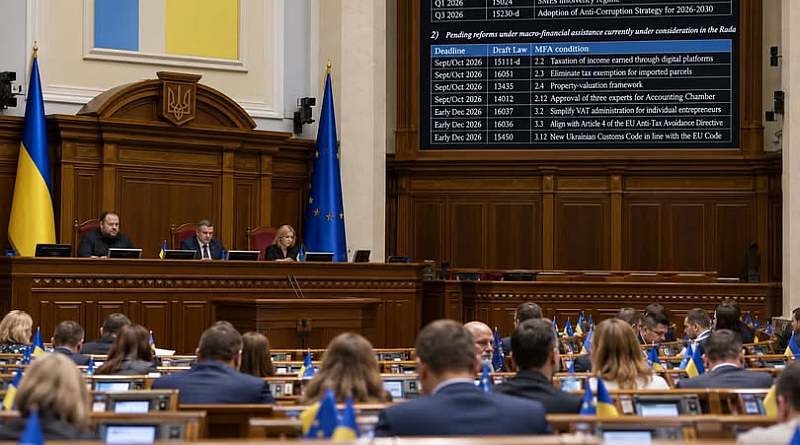
Three things people avoid explaining: how politics are made, what sausages are made of, and what is needed for us to receive another over 20 billion euros in aid from the European Union this year.
Let’s give the last one due attention and delve into the details.
Does the European Union want something extraordinary from us? Something aimed at depriving Ukraine of competitive advantages or making the lives of Ukrainians worse? These questions linger because the answers are not very convenient for those to whom they are addressed.
Let’s take the letter from the European commissioners, sent to the Verkhovna Rada in mid-September at the beginning of the last plenary session, as a basis. The list of laws mentioned there can be conditionally divided into three equally important categories for Ukrainians: fighting corruption, efficiency of state bodies, and welfare.
The Anti-corruption Strategy 2026-30 – the name speaks for itself. It talks about how the anti-corruption infrastructure should be developed. It has been awaiting consideration in the Verkhovna Rada since May.
Competitions for entry into the civil service are about fighting feudal tendencies and nepotism. Preparation has been ongoing in the Verkhovna Rada since April for the second reading.
The approval of the bankruptcy procedure is about creating a legal framework for small and medium-sized businesses to exit crises and improve the efficiency of state property management. The project was in the Verkhovna Rada from February to September 2026 and is only now being prepared for the second reading.
The law on property assessment translates it to international standards and, among other things, allows adequate compensation for damages. It lay in the Verkhovna Rada for over a year before the first reading and is now being prepared for the second.
International experts selecting for the Accounting Chamber will not be interested in which party a candidate belongs to, an organization that audits how our taxes and international loans are spent—particularly on defense, medicines, and reconstruction. In September, the Rada failed to vote, and the committee resubmitted.
The new Customs Code brings Ukrainian customs in line with EU rules, which will serve as safeguards against customs abuses. Submitted to the Verkhovna Rada this summer, it is now only being prepared for the second reading.
And this is just regarding what’s directly tied to money, there are also obligations Ukraine must fulfill to join the EU. This includes judicial reform, State Bureau of Investigation reform, independent expertise for the National Anti-corruption Bureau. All these laws aim to strengthen the rule of law in Ukraine.
As of October 6, delays have already cost Ukraine €5 billion under the Ukraine Facility plan. Here’s what for:
- Fighting corruption, ~€1.7 billion: anti-corruption strategy, transparent selection of prosecutors, disciplinary accountability of prosecutors, strengthening anti-money laundering measures, cryptocurrency transfers transparency.
- Efficiency of public administration, ~€1.6 billion: amendments to the civil service law, a modern civil service vacancies portal, independent supervisory boards and corporatization of state enterprises, independent status of the energy regulator (NERC), reinstatement of the state aid law.
- Citizen welfare, ~€1.8 billion: simplified bankruptcy for small and medium-sized businesses, human rights protection strategy, protection against payment card fraud, road map for gas and electricity market liberalization, energy efficiency requirements for buildings.
I’ve already written about how to galvanize the process of passing laws in parliament.
Moreover, the Koretsky government stated that by the end of September, 17 of the 42 planned decisions had already been executed. The remaining 25 were promised to be completed by October 15, that is, in 9 days.
And the question is not how negatively Brussels perceives Ukraine’s delay in adopting the promised legislative projects. It’s about how we ourselves approach this. After all, it’s not just about money. Each of the aforementioned laws will help create proper legal frameworks, eliminate abuses, and reduce corruption. This in itself will improve the business climate and ensure that money doesn’t disappear in bags.
