

Most foreigners find it very difficult to understand many important nuances of our culture. This is absolutely normal, as understanding subtleties requires being inside the culture.
However, there are a few enormous layers of concepts that, in the case of Ukraine, unquestionably impress with their scale of influence. Among them is intellectual orphanhood, into which the Russian Empire has driven us over the last one and a half centuries.
Of course, our culture is not lacking in great names – Skovoroda, Potebnia, Hrushevsky, Dontsov, Krymsky, Zerov, Kurbas. But perhaps it lacks the most important thing. The mechanism of meaning transmission at almost all levels of its development – from teacher to student, from generation to generation. This mechanism was systematically destroyed. We do not know our intellectual parents. And those who could have become our teachers lie in Sandarmokh, Bykivnia, on the Solovetsky Islands.
I want to remind myself and all of us of those three huge ruptures that didn’t just “happen”, but were purposefully made by the decisions of imperialists with a clear aim: to destroy Ukrainian identity as a separate phenomenon that forms the Ukrainian political nation. Whatever synonyms exist for each of these three ruptures (of course, this is my subjective point of view, I am not a historian, but I share my open vision):
The first rupture
Year 1863. The Valuev Circular: “there never was, nor is, nor can there be any separate Little Russian language.”
Yurii Shevelov, the greatest Ukrainian linguist of the 20th century, in his foundational work “The Ukrainian Language in the First Half of the Twentieth Century” showed the mechanism: when Ukrainian was pushed out of education, science, public administration, it was then that the organic connection of the language with its prior written tradition was broken. Only oral forms of everyday communication remained. A peasant language without an intellectual vocabulary. And now in 2026, we know that it’s not just linguistics. When the higher register of a language is destroyed, the tool for transmitting complex ideas is also destroyed. Philosophy, law, science require terminology. It had to be recreated half a century later and had to be lost again.
The second rupture
1930s. The Executed Renaissance.
Timothy Snyder in “Bloodlands” documents: Stalin took measures to destroy the Ukrainian peasantry and the Ukrainian intellectual and cultural elite to prevent their aspirations for independence. The Holodomor and the Great Terror were not accidents but a system. The figures of intellectual elite destruction are terrifying: in 1930, works by 259 Ukrainian writers were published. By 1938, only 36 remained. The rest were executed, exiled, disappeared, or had committed suicide.
October 27 — November 4, 1937, in the Sandarmokh ravine, the NKVD executed 1,111 people, among them 287 Ukrainians. Director Les Kurbas, writers Mykola Kulish and Valerian Pidmohylny, poets Marko Voronyi and Mykola Zerov. A whole generation of intellectuals in just one week. Jerzy Giedroyc, a Polish intellectual and publisher, called it the “Executed Renaissance.”
But it’s not just about the talented people who perished. The issue is what they didn’t have time to pass on. They didn’t have time to create schools, mentor students, or establish traditions. For me personally, it was heartbreaking to discover dozens of these names as an adult, after having my mind filled during childhood with the “great” Russian culture, and realizing how much these talented (and often unexpectedly young) people left unwritten.
Third Rupture
The 1960s-70s. The Sixtiers (Stus, Symonenko, Kostenko, Chornovil) consciously tried to become the heirs of the Executed Renaissance.
They admired Kurbas and Pidmohylny, studied the banned legacy, and tried to restore the broken network of meanings. The Soviet authorities responded with repressions. Active participants in the movement of the late 1960s — early 1970s were imprisoned or sent to camps. Their supporters, including students and postgraduates, were dismissed from educational and research institutions. The fight against “Ukrainian bourgeois nationalism” continued until the late 1980s. Yes, the system was already much weaker, but the same mechanism of cultural genocide was at work again — each generation trying to restore tradition had to be “cut down to the root.”
Serhii Plokhy, a Harvard historian and author of “The Gates of Europe,” describes how Ukrainian politicians, intellectuals, military, and religious leaders navigated conflicting claims to their land and people over the centuries. But these elites were systematically destroyed, and we had to start over each time.
Therefore, I want to highlight 5 indicators of this condition today.
And these are not just “pebbles in the shoes,” but such a state of affairs in our society is a consequence of the systemic work of imperial, Soviet, and later Russian special services, no matter how such explanations may seem more grounded and understandable to you:
- The cult of the self-taught. “I figured it all out myself” is not a virtue, but a symptom of trauma. When there is no one to learn from, you are left with reinventing the wheel. Each generation starts from scratch.
- “Guru” instead of school. When there is no tradition, there is a cult of personality. We look for a messiah instead of developing agency and building institutions. One charismatic person gathers an audience but does not create a line of transmission. After them, there is emptiness (and I’m not even mentioning the lack of resistance to Instagram marketing gurus of any kind and direction).
- Intellectual smuggling. We import foreign frameworks without “customs clearance,” if you’d like another metaphor 😉. Without critical analysis, adaptation, or rooting. Agile, design thinking, systems thinking, MBA—these are all words without their own schools behind them. We know the terms but do not have a tradition of their application. More importantly, we don’t understand where they originated from, what primary sources their authors drew from. We are tourists in foreign intellectual cultures.
- The university as a place where thinking doesn’t happen. Ukrainian higher education produces diplomas, not thinkers. It’s a certification institution, not a knowledge institution. The lecturer reads a lecture, and the student takes notes. Where is the transfer of ways of thinking? Where is the school? 3-4 universities in the entire country trying to make their first steps in this direction are certainly not the scale we need today.
- Three generations not talking. Soviet, transitional, “independence” generation. Each has its own vocabulary, traumas, and worldview. We don’t argue; mostly, we just don’t hear each other. Because there is no common language. That’s how it was at least until 2022.
The Vienna Circle, the Frankfurt School, the Chicago School of Economics, the Japanese School of Management. These are all remarkable phenomena on a global scale. They have produced hundreds of world-class intellectuals. What do they have in common?
– Each has its own common vocabulary—a set of concepts everyone understands the same way.
– Each has its own line of transmission—from teacher to student, generation after generation.
– Each has its own institutional memory—texts everyone has read, discussions everyone remembers.
– Each values the right to make mistakes within the tradition—you can argue, but there is a common foundation.
We don’t have this. Every reformer, every minister, every “thought leader” starts with a blank slate. We don’t accumulate, we lose. Again and again.
The Paradox of War
From Snyder’s interview in 2023, we can take one of the main thoughts: Russia’s invasion is reminiscent of Stalin’s destruction of Ukraine’s cultural and intellectual elite in the 1930s. Russia continues what began a century ago.
But there is another side. As I wrote in a previous post about the toxicity of aid in a certain dimension, the war brings us to the brink of choice.
In inhuman conditions, under existential threat, we go against the system and decide to act on our own behalf. The war did something that decades of peace could not accomplish: it created a shared experience, a shared vocabulary, a common point of reference. The army is the first Ukrainian institution where real transfer of knowledge occurs from the experienced to the newcomers. Not perfectly, with gaps and mistakes. But it works. There, mistakes cost lives, and therefore they are analyzed and not suppressed. In the army, tradition is formed in real time. At least in its best units (I do not wish to write here about the problems and challenges our defense forces face — that’s a topic for another post).
Such schools cannot be “created” by order or grant. In this context, a school is not a project, but a process.
But conditions can be created:
- Long comprehensive programs. Not two-day trainings, but systems for years. Time for forming “teacher-student” relationships. Including in existing institutions — in Ukrainian schools and universities. Our educational project ecosystem “Keys of Generation” is precisely about this. For us at the Foundation “From Country to Ukraine,” long-term educational programs are now a priority because they will help us break the cycle of orphanhood.
- Shared texts. A canon not as dogma, but as a common basis for discussion. What have we all read? What do we reference? Arrays of translations, schools of translators, support for young researcher-intellectuals, work with young philosophers. It is still difficult to understand how important the work my teachers do from the ThinkCamp initiative is, also the unique activities conducted by “Between the Ears” of Pavlo Haidai, “SowoGuru” of Andrii Melnyk, and other institutions emerging in this direction.
- Institutions of memory. Not museums of the past, but living archives of experience. Documenting what works.
- Bridges between generations. Conscious efforts for dialogue among those who do not speak.
800 years ago, Maimonides said that the highest form of charity is what makes a person independent.
Then it can now be said that the highest form of education is what creates not graduates, but teachers. Not consumers of knowledge, but creators of tradition, creators of values.
We are a nation that lost its intellectual parents. But we are not doomed to remain orphans. We can become those who start new lines of transmission, not waiting for the next catastrophe to force us to start over.
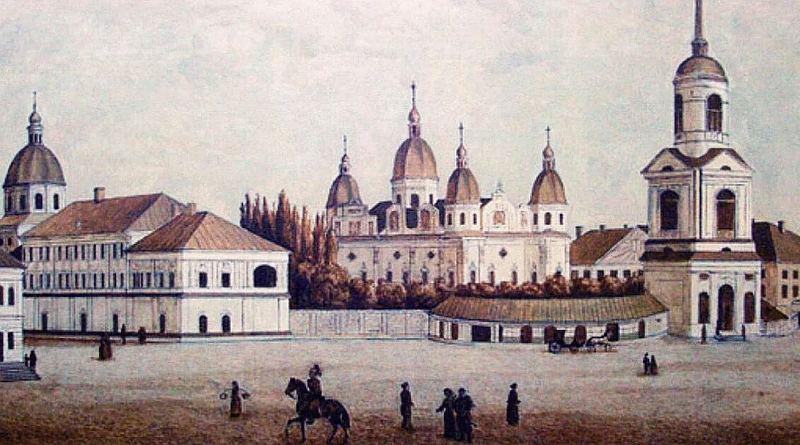
On the cover: Kyiv-Mohyla Collegium
