
Chels Michta, CEPA / Translation iPress
US Army Captain, military intelligence officer, and non-resident fellow of the Democratic Resilience Program at the Center for European Policy Analysis Chels Michta believes that despite Russia’s increasing economic and political dependence on China since the start of the full-scale war, Beijing also has significant reasons to support Moscow. Russia diverts US resources in Europe, maintains valuable military technologies, and expands ties with North Korea and Iran – all of which enhance its importance to China. Therefore, the current asymmetry does not imply that Moscow has become a disposable partner for Beijing: both states share a common interest in dismantling the international order established by the US and its allies.
Russia is increasingly dependent on China, but this does not make their relations unilateral. Moscow still holds assets that Beijing cannot afford to lose.
During a four-hour meeting in Brussels in July 2025, China’s Foreign Minister Wang Yi reportedly told the European Union’s chief diplomat Kaja Kallas that China cannot afford a defeat of Russia in Ukraine.
This was a straightforward power calculation: if Russia lost, the United States could focus all its attention on Beijing. This statement came more than three years after Presidents Xi and Putin declared a “partnership without limits” between China and Russia ahead of the full-scale Russian invasion of Ukraine in 2022. The conversation, first reported by the South China Morning Post but not mentioned in the official Chinese government statement about the meeting, demonstrated how Beijing truly views the war. China has long positioned itself as a neutral party interested in peace. However, in private conversation, its foreign minister effectively acknowledged that maintaining Russia as a militarily capable state aligns with China’s global interests.
Beijing’s support for Moscow is not limited to rhetoric and goes beyond mass purchases of Russian energy resources. China has largely replaced Europe as the primary market for Russian hydrocarbons. Until 2022, Russia’s energy infrastructure and commercial ties were predominantly oriented toward Europe. Western sanctions and European import diversification forced Moscow to redirect vast volumes eastward, and China absorbed a significant portion, often purchasing Russian oil at a discount.
Since February 2022, mineral fuels have averaged about 70% of the value of China’s imports from Russia. This has resulted in a complementary trade structure: Russia sells raw materials, primarily energy resources, and China supplies industrial goods.
This trade has become essential for Russia to continue the war. China is not the only major purchaser of Russian raw materials: India is also critical for the export of Russian oil. However, Chinese purchases are broader, encompassing oil, pipeline gas, liquefied natural gas (LNG), and coal. China also supplies technologies and components that Russia needs for modernizing its weaponry and mass production; the US-China Economic and Security Review Commission reports controlled dual-use goods exports to Russia valued at 10.3 billion dollars since 2022, and Chinese purchases of Russian fossil fuels amounting to 372 billion dollars since the invasion began.
Since Putin launched the full-scale invasion, the economic balance in the relationship has shifted sharply in favor of Beijing: China buys oil and gas that previously went to the West, supplies machinery and components that Moscow finds difficult to obtain elsewhere, and provides political cover amid the near-total collapse of Russia’s relations with Europe. Beijing has also shown it knows how to leverage this advantage.
In September 2025, both governments approved the “Power of Siberia-2” pipeline project in principle, but since then, it has stalled due to price disagreements. Reports indicate China insists on a price close to the subsidized domestic Russian rate, while Russia demands several times more. Moscow has few alternatives. Beijing has pipelines from Central Asia, LNG from the Persian Gulf countries and Australia, and is increasing its own production.
However, Beijing’s advantage in the energy sector does not extend to all aspects of the partnership. The Chinese industrial base is orders of magnitude more powerful than Russia’s, yet Russia still leads China in several military technologies where Beijing is only beginning to build its competencies.
Over the past three decades, Moscow has made significant progress in creating propulsion systems for nuclear multipurpose submarines, hypersonic technologies, and more recently, in designing unmanned aerial systems. All these technologies are necessary for China to become almost an equal competitor to the United States.
This provides Russia with real leverage in its relations with Beijing and simultaneously creates an obvious threat to the West if Moscow decides to integrate its most advanced technologies into Chinese systems and shorten China’s development cycle.
After 2022, the military cooperation between the two countries deepened. Their armed forces now regularly conduct exercises and patrols, including anti-submarine and anti-aircraft drills in the Sea of Japan, and as of April, the US-China Economic and Security Review Commission reported at least 119 joint exercises. In the August review, the commission also referenced reports about collaboration on a missile defense system that would surpass the Russian S-500, as well as on the next-generation Chinese Type 096 ballistic missile submarine. Open sources do not allow for the identification of exactly what Russia has already transferred to China, but Putin’s ongoing dependence on Xi has opened the door for Beijing to seek access to technologies that Moscow previously guarded carefully. Data suggests that this process may have already started.
Today, Russia is the weaker of the two states, but even weak states can possess valuable assets. After military technologies, Russia’s most obvious advantage is its ability to keep the United States engaged in European affairs. As long as the war in Ukraine continues, Beijing benefits from the fact that American military planning and defense industrial potential are required to operate simultaneously in the Atlantic and Pacific theaters.
Therefore, the current status quo in Ukraine suits Beijing more than either of the two extreme scenarios. The collapse of Russia is an outcome China cannot accept, yet a complete Russian victory would create its own problems, as it would remove the urgent need for Moscow to cooperate with Beijing and make bilateral relations more equal.
The war also allowed Russia to establish significantly closer military relations with North Korea. Pyongyang supplied ammunition, and later manpower, for Putin’s campaign, while Russia provided political protection and, according to South Korea’s defense minister, likely technical assistance to North Korea’s submarine program.
Moscow’s relations with Iran have developed along a similar pattern: Tehran supplied drones, and in September, Financial Times reported that Russian specialists were helping Iran develop hypersonic cruise missile technologies that could be used against American aircraft carriers and other targets. As these ties deepen, Moscow gains clients in two regions where Beijing has long been the main external patron.
Now Russia is able to exert pressure not only in Europe but also in the Middle East and the Korean Peninsula. Its ability to stretch American resources across multiple theaters strengthens Putin’s position in relations with Xi. Moscow does not operate under Beijing’s directive and doesn’t have to: their interests intersect even where the policies of the two states differ.
No war lasts forever, so the real question is whether this partnership will survive the advent of peace. It has often been considered a situational alliance that will ultimately not withstand the weight of historical grievances and the increasing gap in national power once the immediate need for cooperation has disappeared.
This interpretation now seems overly reassuring. Russia’s transition to a war economy has created interest groups invested in continuing the confrontation, and the “Eurasian” ideology has gained enough weight in Moscow to portray relations with the West as structurally hostile rather than temporarily tense.
Both Russia and China are seeking the dismantling of the international order built by the United States and its allies. This is why Western attempts to separate these two states using some version of a “reverse Kissinger” are unlikely to succeed: the original U.S. rapprochement with China was made possible by the already existing Sino-Soviet split, and today no such split exists.
Russia may be the junior partner, but “junior” does not mean “disposable,” and Beijing shows no sign of treating it as such.
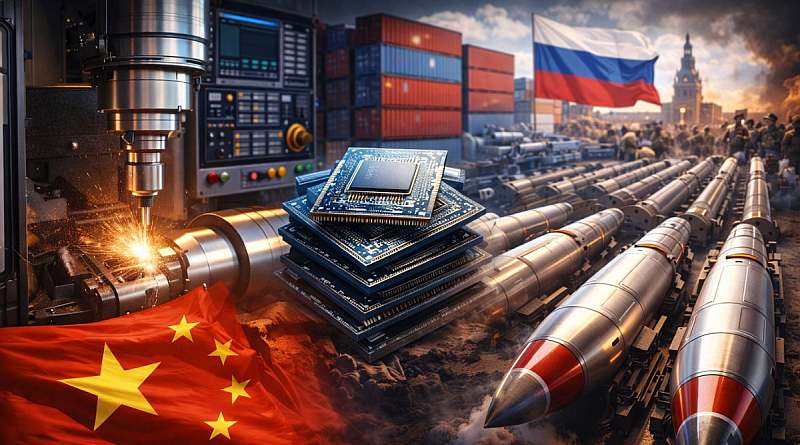
Illustration generated by AI
