
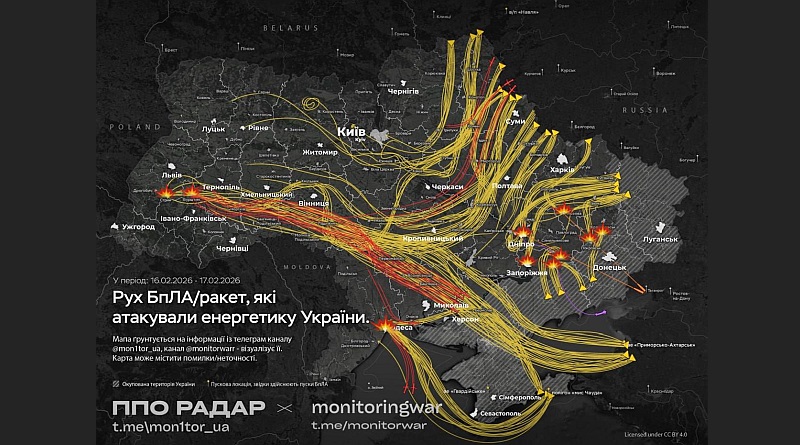

A brief analysis of the incomplete attack on February 17. I didn’t write about the previous ones last week because they can hardly even be called incomplete attacks.
First, the fanfare. Our air defense forces have once again set a new benchmark for effectiveness today. THEY SHOT DOWN ALL THE “CRUISES” that flew over Ukraine. 20/20, 4/4, 1/1, but more details later.
Now for the analysis.
Today’s main target for the aggressors was again energy infrastructure. Specifically, the primary targets were the substations through which electricity is exported from Europe—Burshtyn, Stryi, and Odessa region. Substations of 330kV and one of 750kV.
Before this, there were constant strikes on distribution substations between our nuclear power plants and various regions of the country. Their goals were to create imbalances, make power transfers impossible, and collapse the system. They have targeted exports before, which also help us balance.
Now regarding the means of attack and why this is an incomplete attack. Many people followed me after analyzing the first three unique attacks. In those cases, planning, coordination, and command were conducted entirely differently. There, the highest command echelon executed the plans, which I described. Today, once again, it was a lower-level command. Hence the result—”it’ll do.” 😉
All week there was a lot of intelligence that there would be a massive combined strike. Missiles were transported, programmed, Shahed drones were conserved, and they struck several missiles twice a week—ballistics and Zircons.
And what did we see today?
1. They couldn’t even organize 400 Shaheds. I remind you that earlier the number was up to 500-600 per week, launched in one go.
2. There was no cruise Iskander for a month. Today, the Iskander-K was launched, seemingly as an afterthought. The reason for this could be the Kh-101 missiles.
3. Twenty were launched, but this doesn’t correlate with the suspension points of the Tu-95MS aircraft. Four paired points, regardless of the internal “drum” for Kh-55/555 missiles, which haven’t been launched for years due to issues. And the Bears haven’t carried 8 missiles for a long time. So, either five planes with four missiles each (more likely), or four planes with five missiles each. If they always must be paired and with the same number under both wings, something definitely didn’t add up. Understand? 😉
Conclusion for this point: after Operation Web, the number of strategic aircraft decreased. Due to other issues, fewer Kh-101 missiles are being launched. Although in January, there were even missiles manufactured in 2026! But there are problems, and that’s good.
4. Ballistics, specifically four Iskanders M. Why so few when more than 10 were easily launched during the week. Previously, there were 18 on Kyiv, and a few days later, a large number again. They were depleting PAC-3 missiles for the Patriots. They stopped because, once again, there are still enough, but they lack the resources to surpass their quantity.
But logically: with the frost again, a transport collapse due to snow—striking with ballistics on Kyiv, depleting PAC-3, and perhaps destroying something else. And they didn’t do it because they lack resources.
5. Due to the low level of training and command execution, there is no complexity. No fleet and Calibers. Zircons were also conducted separately by the fleet alone during the week. No system or aviation overload.
6. Thus, this point is separate. Today, most of the intercepted missiles are credited to aviation! Not ground systems, but specifically F-16s and Mirages. And that’s very cool! And probably the first time aviation (and that’s exactly what we needed it for) played a key role in repelling a missile attack.
To highlight separately. Today’s attack was postponed to today from the weekend due to their missile diplomacy. Because today, trilateral negotiations should begin in Geneva. That’s why there were threats of ballistics, Oreschnik, and Mig-31K takeoffs during the day. That’s the aggressors’ diplomacy, sir.
