
Putin’s attempts to find a “new Yalta” in China are utterly naive and have no chances. They break down against both historical experience and the “realities on the ground.” Today’s meeting in China fully confirmed this.
The possibility of the Yalta Conference of 1945 was due to a unique situation at that time. It was a meeting of leaders of the victorious countries who could make any decision among themselves, with no state capable of opposing them. Hitler’s Germany and its allies had already lost the war. Other countries in Europe and Asia, including China, were just being freed from years of occupation and lay in ruins.
Nothing similar has ever been in world history. There have always been several “great powers” with which it was necessary to negotiate and coordinate any global decisions. Since there were no such states left in 1945, these three could truly divide the world as they wished and impose their decisions on others.
In 2026, nothing even close exists.
The USA claims a special role in the Northern Hemisphere, as well as the status of the main trade and political partner of the EU. And for this, Americans do not need to negotiate with anyone.
China claims dominance in Southeast Asia, as well as the status of the EU’s main trading partner. Beijing also does not require anyone’s consent for this.
What does Putin claim? Russia continues to make territorial demands regarding Ukraine, as well as broader demands on the European security system, which largely repeat the provisions of the Russian ultimatum of 2021. At the same time, the course of the full-scale war has shown that Moscow does not have enough capabilities to impose on Europe and Ukraine the order that the Kremlin insists on by force.
Where can a “new Yalta” come from here?
In Yalta 1945, leaders of countries that had just won a brutal war of conquest met. There was no Hitler, Mussolini, or other representatives of aggressor countries. Instead, in China, Putin proposes to actually sell the end of the war he himself started.
So, of course, this is not a new Yalta at all.
Putin may hint at the division of the entire world as much as he wants, but his maximum program is the division of a few regions of Eastern Ukraine.
Russia is a weak country with a raw-material economy and a destroyed future. The only thing it can trade is its own madness, the lack of understanding of the value of human life, including that of its own citizens, and its readiness to pay an unacceptable price for achieving goals that no one in the world understands. This has more in common with the likes of the Taliban or ISIS than world hegemony.
The symbol of the occupation of Yalta and Crimea by Russian propaganda has become the Crimean bridge. But due to well-known circumstances, this bridge now leads to nowhere. And it no longer leads to any Yalta.

The mountain gave birth to a mouse. But Putin was allowed to sit at the table and be photographed next to the First Lady of China.
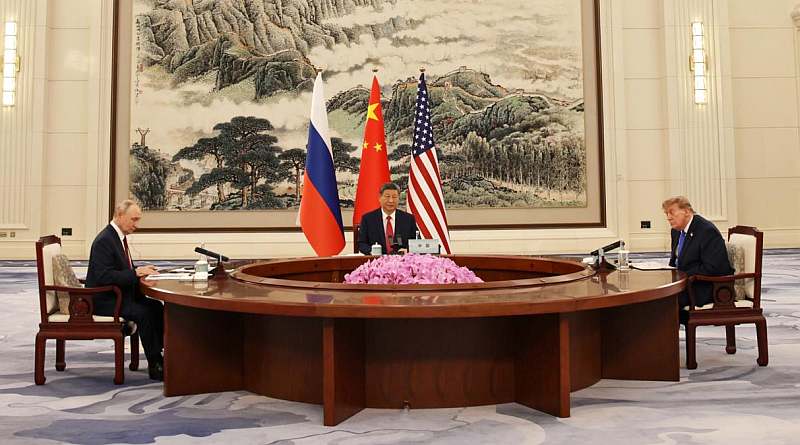
An hour and a half of talks between Trump, Xi Jinping, and Putin, four points in the declaration—and no historical decisions. Although Russian propaganda was already painting a map of a new world division.
However, in diplomacy, it is important who is invited to the table.
For Putin, the very opportunity to sit next to the leaders of the USA and China as the third major player is already an achievement. Russia lags behind them economically and technologically, but thanks to its nuclear arsenal and ability to initiate and conduct aggressive wars, it still claims the right to set rules for others.
Yet the content of the declaration is even more telling than the rather unsuccessful joint photo for the Russian dictator.
The most interesting is the third point: about the immunities of officials and the inadmissibility of abuses by international courts. For Putin, with an arrest warrant from the ICC, this topic is obviously painfully relevant. As it is for his entourage, who fear punishment. But the problem arises when great powers again raise the question of whether their power should grant them special privileges before international justice.
The second point—energy. Against the backdrop of the war in Iran, Moscow gains an additional bargaining chip: the stability of oil markets. Whether it will succeed in converting it into easing sanctions remains an open question.
The last point—nuclear weapons. Here is the final Chinese warning to Putin: there are no winners in nuclear war. For Putin, after years of nuclear blackmail, this is a public reminder of the limits of what is permissible. And that’s good news.
So, the world was not divided. But the temptation of great powers to negotiate its fate in a narrow circle has not disappeared.
Only Europe, India, Japan, and other centers of power do not disappear from the geopolitical map just because they were not invited to the table.
As with Ukraine, which despite all of Putin’s efforts remains a subject.


The meeting in Shenzhen, where Donald Trump and Vladimir Putin visited Xi Jinping, was clearly a well-orchestrated media spectacle. However, behind the ceremonious scenes of the pompous meeting of the new trio lay a noticeable lack of concrete resolutions.
The red carpet, round table with a green centerpiece, and loud statements about a new era in diplomacy created an image of a historic turning point, evoking the spirit of “Yalta 2.0,” but the actual agenda of the leadership talks remained deliberately vague and cautious.
Each of the three heads of state agreed to such a format for their own strategic calculations: Washington needs a leverage tool to resolve protracted crises in Europe and the Middle East, Beijing aims to secure its status as the main arbitrator of global politics at the APEC summit and protect its global trade positions, and Moscow critically needs to overcome international isolation and regain the appearance of an equal and acceptable partnership, rather than remaining in the role of a barbarian.
The Shenzhen Declaration published after the talks is a set of diplomatically vague formulas, where aspirations for strategic stability and UN Security Council reform sit alongside intentions to increase oil product supplies and limit the jurisdiction of international judicial bodies.
The provisions on the inadmissibility of nuclear war, protection of critical infrastructure, and immunity of high-ranking officials serve as convenient political cover for the major powers, but they lack control mechanisms and legally binding guarantees.
The attempt to divide the world into three separate spheres of influence directly contradicts modern economic geography, as the trade, technological, and financial chains of Europe, Asia, and America are too intricately intertwined, and European capitals are not willing to accept decisions about their own security made without their participation.
The sovereignty of small and even medium-sized countries is under serious pressure in the current circumstances, as major centers of power are once again attempting to return to the practice of behind-the-scenes agreements over the heads of countries whose fate they try to determine.
However, small and medium-sized states possess sufficient resources of subjectivity to resist such dictates, as they can form regional alliances, rely on the norms of international law, and defend their right to independently choose their development path.
The issue of Ukraine at the summit in China testified to the depth of existing contradictions particularly clearly, as not a single mention of Ukraine or the European security architecture was found in the joint communiqué, and the Chinese leadership clearly avoided making the war a central topic of the meeting.
Immediately after the negotiations concluded, Putin noticeably hardened his rhetoric, once again demanding the transfer of the devastated Donbas and threatening strikes in response to attacks on the Crimean Bridge. However, the real situation on the front and in the economy forces Moscow to cling to maximalist demands only to maintain a negotiating leverage. Thus, Russia’s tripartite participation in the world is quite doubtful, as the country itself might end up divided into American and Chinese spheres of influence.
