
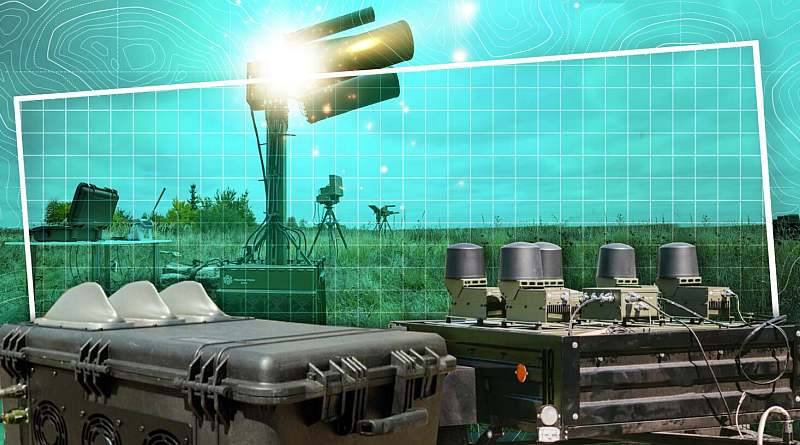

The issue of scaling this function according to today’s challenges.
Despite being more of a critic of EW, I never underestimated the capabilities of this function. I truly believe that we have a mess with EW, to be honest, and this can be seen in two issues:
1) Weak coordination between different units.
2) The existing EW cannot adequately respond to the development of means that Russia forms for the modern battlefield.
At the same time, the potential of EW remains underestimated. Although for relatively small investments, it performs unique work.
Why has this happened?
We (and Russia) rely on old Soviet clichés. In Soviet times, few tasks were assigned to EW units. Well, they jammed radios, blocked control channels for explosive initiation means, and did a little here and there, and that was it.
It’s like with drones. Drones existed before, but their role in the army was so minimal that it made no sense to form separate forces.
But time passed, and now drone technologies are one of the pillars of the modern army’s existence.
Unfortunately, EW did not develop symmetrically with drones. And if, as they say, drones are the sword, then we’ve made a huge sword. But the shield remained small. Well, a shield-buckler, if someone is a fan of cold weapons, they’ll understand.
Now we have tasks for it that were not principally included in its function. And those are:
1. Cyber warfare and cyber operations.
2. Systemic closure of satellite navigation over literally the entire country.
3. Counteracting mesh networks across the entire country.
4. Detecting enemy relay means both at the front and in the rear.
5. Forming unmanned units that can maintain drones in the sky with interference installation means, reconnaissance means, and other kinetic and non-kinetic counteraction means.
6. Introducing electromagnetic and laser weapons into the system for countering unmanned means.
7. Last but not least—systematic counteraction to enemy communication satellites (Rassvet) across the entire country and Express series satellites, as well as counteraction to enemy satellite reconnaissance means (such as synthetic aperture radars and others).
And it’s all complicated. Just for example, the same CRPA with 32 antennas, which is already a significant problem and which we didn’t manage to react to in time. What will happen when there are 40? 48? You understand that visual navigation systems like “Susanin” are primarily backup systems because so far, all visual navigation systems lose their location over long distances. And it’s CRPA that recalibrates it after losing its location.
What to do when Shahedi start installing not one but two mesh communication modules? Or three?
What to do when the enemy manages to establish a relay system through agents for remote control?
What to do when the enemy’s satellite constellation is involved in all this? How to counter it over the entire territory of Ukraine?
Now we approach the main question. Is our modern EW capable of effectively countering this?
Mostly—no.
The current EW and Cyber Warfare management simply lack the necessary number of directly subordinate units to work systematically on these tasks.
Most of these are EW units involved in coordination, but they are part of other structures, such as combat brigades, DSZI, different kinds, and types of troops. Operating them to solve the aforementioned tasks is unrealistic. They are more units of frontline influence.
So what’s left? Two centers and one regiment? For all of the above? It’s unlikely they will handle it.
Therefore, the more we analyze what range of tasks modern EW should cover, the more consensus emerges that to execute them, we need to have the GURK not as special support forces but to create the Command of EW and CW Forces, which would enable a more successful, centralized system capable of outpacing the enemy technologically and organizationally. The command can transform the chaotic actions of numerous scattered units into a targeted strategy and build new specialized units in response to today’s challenges.
I’m very interested to see how this idea, which is now being raised in high offices, will be implemented. It’s interesting to me as someone who, during the build-up of the first UAV battalion in the Armed Forces of Ukraine, heard a lot: “Are you making a whole drone battalion? Why, how many pilots are needed there? What tasks will they all perform? It’s too much! There are companies for unmanned systems, let it stay that way, a battalion is too much.”
I would very much like to speak with the respected officers who said this to me then, but today. How are things? What about unmanned brigades and a separate branch of troops?
So we’ll wait to see where the discussions on this topic in high offices will lead.
Maybe Sergey Flash will give insights on this because it’s the next step in the evolution of the Armed Forces during a technological war, in which we cannot afford to fall behind.
Collage: ArmyInform
