
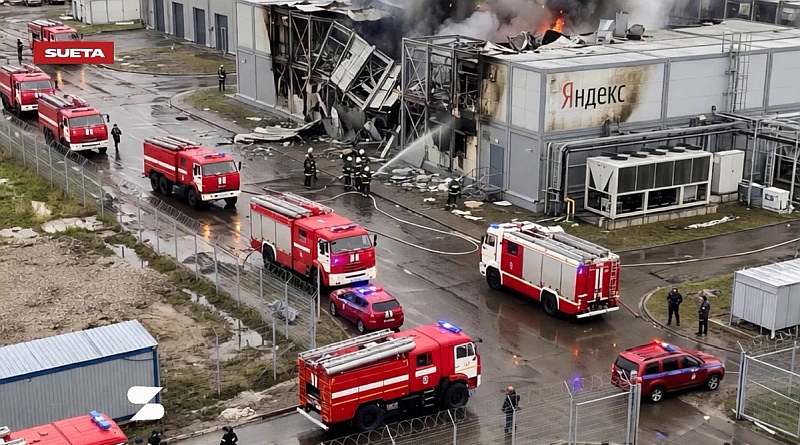

After the strikes by the Ukrainian Armed Forces on Yandex data centers, the service problems in Russia continue to escalate. And not only in Russia itself, but more on that later.
First of all, as of the morning of October 13, the Yandex data centers in Sasovo and the Vladimir region have completely stopped. The Yandex data center in Kaluga is partially stopped due to damage to several modules.
This led to the suspension of Yandex Cloud services and “Yandex 360,” as a result of which the company announced that it would temporarily cover the costs of these services for current clients. Some functions remain unavailable or limited, with no timeline for full recovery named.
There are also issues with “Yandex Pay,” where transfers and payments have only been restored for some users. The return of functions is occurring gradually. Previously, users reported access problems to funds, and the company assured that the money was safe. Ok. We believe.
As for maps, navigation, mail, and other services, access to “Yandex Mail,” “Disk,” “Taxi,” and other products has been partially restored, although some functions remain non-operational.
Meanwhile, Yandex agreed on the accelerated transfer of data and services of affected clients to the Selectel, K2Cloud, and VK Cloud platforms. It would be interesting to study the geolocation of their data centers, but that’s not even the point.
The replacement of damaged Yandex equipment may take about six months. The company will have to spend on equipment replacement, backup capabilities, and infrastructure protection. The specific amount of damage has not yet been published, but it’s clear that if the strikes continue, and not only on Yandex data centers, Russia will face a real 1990s scenario.
But the main thing is that the last 48 hours, from October 11 to 13, have clearly shown which political forces in Europe have real support on social networks and which have fictitious support, particularly due to Russian resources. Primarily, several far-right and far-left forces found themselves in an informational pit. How come? Why did this happen? Could it be they were receiving support from Russia?
And here an interesting moment arises.
If Donald Trump says that as part of some ephemeral agreements there is no need to hit Russian oil refineries, but if Ukraine does just that, yet starts demolishing all Russian data centers to the ground, this raises an existential question – what is more important for the KGB: the flow of oil for export or the informational influence on the West?
I believe that concentrating strikes on data centers in Russia should become an alternative to strikes on oil refineries. And if after this Donald Trump declares that striking data centers in Russia is also prohibited, well then, what should become an even brighter litmus test?

Demilitarization of “Yandex”
A series of successive strikes by Ukrainian drones on the key digital infrastructure of the IT giant “Yandex” demonstrated the high vulnerability of the technological foundation on which the logistics and computational support of the Russian military-industrial complex is built.
After a large-scale fire broke out at the “Sasta” plant in Sasovo, Ryazan region, due to a drone attack engulfing a strategic facility of the “Yandex DC” company, specialized services faced a critical threat of an emergency shutdown of computing capacities. The corporation’s press service officially confirmed that the Ryazan data center completely ceased functioning after the attack, which caused damage to the power and cooling systems.
Subsequent events showed the systemic nature of the infrastructure damage, as on October 9, a company representative announced a successful new attack on the Kaluga data processing center, where backup servers of the cloud platform were located. The situation reached the scale of a technological collapse on October 11, when the disabling of a major node in Vladimir forced engineers to urgently shut down equipment due to a direct drone hit and subsequent fire.
Military sector analysts interpret the incident as a planned operation, as modern precision weapons and distributed army management systems require continuous high-speed computing. The disruption of the stability of Yandex Cloud immediately affected defense sector enterprises, which actively use Russian cloud platforms for designing equipment, processing cartographic data, and computing complex ballistics.
The loss of three major data centers undermines the efficiency of Russian military logistics, which relies on closed digital algorithms for routing cargo flows.
The physical destruction of server racks inflicts irreparable damage to military production, as the current sanctions regime blocks the supply of high-performance processors and networking equipment from leading global manufacturers.
The loss of capacities in Sasovo, Kaluga, and Vladimir creates a cascading effect, where government defense orders face forced downtime due to the inability to quickly redirect giant volumes of processed information to remaining sites.
The methodical destruction of computing nodes reveals the vulnerability of critical facilities located deep within Russian territory. Systematic decommissioning of civil-military IT infrastructure deprives army structures of important technological superiority, as restoring burned-out high-tech equipment will require multimillion-dollar investments and a long time.
