
January 2008… Negotiations between Ukraine and the EU have been ongoing for almost a year about a new enhanced agreement to replace the Partnership and Cooperation Agreement.
Ukrainian negotiators are persistently promoting the ideology of a “European-type association” as a preparatory stage on the path to EU membership, based on the experience of neighboring countries in Central-Eastern Europe and the Baltics. Eurobureaucrats have entered a state of defensive silence and cite a lack of consensus among member states regarding Europe’s prospects and association for Ukraine.
One of the EU heavyweights — France — is preparing for its presidency of the European Council (the institution of presidency in the Euro Council still functions, as there is no elected President of the Euro Council) and is working on a package of possible “historic” breakthroughs for the French presidency in the Eastern European direction. President Nicolas Sarkozy’s office is approaching allies and Ukraine with the idea of a so-called “associated partnership” — more than the Partnership and Cooperation Agreement, but less than an Association Agreement.
Ukraine then did not agree to a vague political framework and ultimately obtained a full-fledged Association Agreement, including a comprehensive and deep free trade area and a visa dialogue that ended in visa-free travel.
This experience is important. Intermediate formats can be used if they increase the space for integration. But they cannot be accepted if they leave Ukraine outside full integration formats — then with association, and now with full membership.
The institutions and member states of the EU sincerely strive to help Ukraine withstand the war against the Russian aggressor and give hope for a safe, democratic, and prosperous future as an independent state. In this context, the EU’s rapid political response to granting Ukraine candidate country status and agreeing to start accession talks is understandable. And this clear, rapid track should continue to lead Ukraine to the ultimate goal of membership.
Chancellor Friedrich Merz’s initiative regarding the so-called “associated membership” of Ukraine in the EU at first glance seems like an attempt to finally advance the enlargement process, which has been stuck for too long between a major geopolitical promise and slow eurobureaucracy. And there is a positive aspect: Germany, as a heavyweight, is ready to be the engine of the enlargement process, to talk about Ukraine as a future full member of the EU, and to look for intermediate tools that won’t leave us in a gray zone.
This primarily refers to the possibility of Ukrainian representatives participating in European institutions without voting rights, broader access to programs, funds, and budgetary mechanisms, potential security obligations from the EU in the logic of Article 42.7, but without full membership itself.
Let’s analyze the main risks and potential opportunities of Merz’s initiative.
The main risk of such a structure is the dependency of the format on the political will of EU member states. Today, there is the political will of Berlin. Tomorrow, there might be elections in France, Poland, Germany, the Netherlands, or another country where the Ukrainian issue is part of internal struggles. For Ukraine, a status that can be frozen after any subsequent electoral cycle is not a guarantee of membership.
The second danger is the disconnection of Ukraine from Moldova and the “Balkan wave” of expansion. Ukraine and Moldova were moving toward the EU as part of a single geopolitical logic: two states emerging from the Russian sphere of influence and anchoring in Europe. If Ukraine is put on a separate track, the EU might have a convenient argument that Ukraine already has a special status, so opening clusters, closing negotiation chapters, and full accession can be postponed. This is particularly dangerous if Moldova and other candidates remain in the classic comprehensible process, while Ukraine ends up in an exceptional but less defined format.
The third problem is the decline in motivation on both sides. An intermediate status may decrease the EU’s motivation to carry the matter through and implement internal reforms. The most challenging issues of Ukraine’s full membership for the EU are clear: budget, agricultural policy, access to structural funds, voting rights, institutional weight, competition in the single market. “Associated membership” could become a way to say: we have already done a lot, rewarded Ukraine, and now we can take our time, as further steps are unpopular in European societies.
For the Ukrainian authorities, the risk is no less. Such a format could become a comfortable political security belt: EU flags exist, participation of politicians and bureaucrats in EU councils exists, endless visits to Brussels exist, and real reforms can be delayed because “we are seemingly already accepted.” This does not align with the interests of Ukrainian society. Ukrainians need not symbolic chairs without a voice, not photos of officials in euro-institutions, not various “European trinkets,” but real judicial reform, a reformed law enforcement system, independent anti-corruption infrastructure, fair business rules, protection of property rights, transparent regulators, a predictable and prosperous state.
The fourth risk is a lifeline for a government that does not demonstrate sufficient reformist capability and political will for reforms. There is a temptation to sell “associated membership” as a historic victory, even if in essence it will be a place without a voice, partial access without full rights, and a new improved wrapping for the old Association Agreement. This is dangerous not for the opposition or the government per se. It is dangerous for the country. Because European integration should not be a tool of political PR or a project of one party, but an effective and inclusive mechanism for unifying and transforming the state.
The Fifth Risk – is the discrediting of the EU idea for people and businesses. Ukrainians support EU membership not because they dream of a decorative presence in Brussels and deputies in the European Parliament. For citizens, the EU means security, dignity, quality of life, freedom of movement and employment, fair courts, prosperity, and a promising future. For business – unobstructed market access, standards, investments, protection from arbitrariness, cheaper capital, clear regulation. If instead, society is offered “quasi-membership” that doesn’t allow the tangible benefits of membership to be felt, it may discredit the very idea of European integration. Eurosceptics will have a simple narrative: once again, we are left in the lobby, in the mire. In a country exhausted by war, such distrust can grow quickly and have unpredictable consequences, including a return to ideas of multi-vector policy and a separate path, something actively propagated by Russian propaganda.
Firstly, Germany demonstrates the political will to move expansion forward. This is important because no significant European process can carry enough weight without Germany.
Secondly, the idea of opening all negotiation clusters as soon as possible corresponds to Ukraine’s interest. This should be the focus of discussion and effort, not symbolic institutional fantasies and forming lists of future “non-voting” EU deputies.
Thirdly, the concept can become an “Association Agreement Plus”: deeper access to the single market, EU industrial chains, defense programs, energy, transport, digital space, financial and other practical tools.
Fourthly, mechanisms for penalizing reform rollbacks can be useful for Ukrainian civil society. Ukraine needs not only “carrots” but also “sticks” against attempts by the authorities to halt or simulate reforms. But these conditions must work honestly: they should discipline and motivate the Ukrainian authorities, not give the EU a reason to indefinitely postpone membership.
Ukraine’s position should be simple: yes – to everything that accelerates full membership, no – to anything that substitutes or hinders it.
Ukraine can agree to intermediate benefits only under clear conditions: the status must be temporary; the ultimate goal – full membership – must be explicitly fixed; all negotiation clusters must open without political delays; Ukraine must not be separated from Moldova and other countries – such intermediate status should be granted to every candidate country, people and businesses must receive concrete benefits; reforms must be not a declaration but a strict requirement for the Ukrainian authorities.
And most importantly: no format without voting rights and real influence can be called a victory. Victory will be when Ukraine becomes a full member of the EU and participates in shaping the future of a united Europe.
Sarkozy’s initiative, with the right policy from the Ukrainian side, eventually accelerated the conclusion of the Association Agreement. Merz’s initiative can either speed Ukraine’s path to membership or, conversely, conserve it in the status of an “eternal candidate.”

The letter from Mertz to the EU leadership, published in Politico, can be perceived in very different ways. At first glance, it seems like pure “betrayal” and yet another attempt to leave us indefinitely in the EU’s waiting room. Even to me, it initially reminded me of jokes from the Kuchma era.
But… this is precisely the case where it’s worth stepping out of the usual thinking paradigm and delving into the details of the proposal, which is certainly not “luxurious fur,” but definitely better than the previous Franco-German proposal quoted by FT two weeks ago.
The reason for the emergence of such a format is obvious, Mertz speaks about it directly: the process of joining the bloc is lengthy and complicated by the political nuances of ratification by individual member countries. And there is no time to delay (ironically, it’s Germany writing about this now), at least some step forward is needed. And this cannot be disagreed with, further stagnation in Ukrainian-European relations will only play into the hands of one side – Russia.
So, what is actually being discussed now:
– Firstly, the format of associated membership in the EU proposed by Germany for Ukraine, as well as the Western Balkans with Moldova, which Mertz calls a “new impulse,” gives us the opportunity to have full participation in the EU internal market, i.e., trade without tariffs and quotas;
– Secondly, we will be able to indirectly participate in the bloc’s internal policy, particularly gaining voting rights at EU Council and Euro Council meetings, and also join (albeit without voting rights) the work of the European Commission and the European Parliament;
– Thirdly, Ukraine will gradually be integrated into the EU budget and will receive certain security guarantees from Article 42.7 of the EU Treaties on mutual assistance and defense.
The Mertz proposal currently lacks a key step for us: signing the accession treaty with the EU, in anticipation of which the proposed “associated membership” format may operate. And what should be discussed now is how we can achieve this. Because, aside from Ukraine’s desire, real results of government and parliamentary work will be needed to adopt and implement legislation for such a scenario.

The initial wave of reactions to Chancellor of Germany Mertz’s letter to the EU leadership regarding his proposal for future expansion steps, including for Ukraine, has somewhat subsided.
I will share my thoughts.
I do not view the German Chancellor’s proposal as categorically as President Zelensky reacted to it.
I believe that Friedrich Mertz’s aim is precisely an attempt to find a way to secure future full membership in the European Union for Ukraine. He speaks about the fact that full membership of Ukraine in the EU remains the ultimate goal, and does not propose a substitute for membership but only a certain transitional stage. This is a non-linear proposal, and we should deeply work through it – all the pros and cons. At the same time, there is no legal, binding mechanism for formalizing such a decision today, and this is important – the irreversibility of processes must be secured not only politically but also legally.
The Chancellor’s letter mentions the article of the European treaty concerning mutual support and assistance in the defense sphere. In my opinion, this article of the treaty is quite general, and therefore, it would be important for us to think more broadly and propose our vision of a real European defense model that would be mutually beneficial for us and our partners. That is, not exclusively within the framework of the European Union, but within the framework of all European countries – both members and non-members of NATO.
As for the “associated membership,” of course, there will be countries or leaders who will try to turn Mertz’s interim proposal into a final one, leaving Ukraine forever somewhere between candidacy and potential membership.
This cannot be allowed. And the best way to strengthen negotiating positions is to implement reforms, which, despite all slogans and declarations, Zelensky was not planning to do and is not planning to do.
Instead of his tales about EU membership in 2027, we need to start doing the homework and, as we did while fighting for candidate status, develop a common position among the executive power, parliamentarians, civil society, and business associations for joint advancement in European capitals.
So it is not Mertz who distances us from the EU, but the unprofessionalism of the government, multiplied by the lack of political will to change.
The government’s idleness threatens the loss of the chance for EU integration. The authorities in Ukraine have not managed to organize the implementation of agreed decisions for European integration.
As early as December 2025, a list of 10 reforms was agreed upon by Deputy Prime Minister Kachka and Commissioner Kos. As of April, experts assessed the level of its implementation at 9%. Currently, there is no progress.
This pushes European partners, at best, to seek weakened options for Ukraine’s integration, and at worst, to slow down European integration altogether.
German Chancellor Friedrich Merz, in a letter to EU leaders, suggested accelerating Ukraine’s accession to the EU by initially allowing a new special status for Ukraine as an “associate member” of the European Union – without the right to a decisive vote, without access to key benefits and opportunities of the EU.
The new Prime Minister of Hungary, Peter Magyar, stated that a necessary condition for Hungary’s consent to open the first cluster in negotiations on Ukraine’s accession to the EU is… granting the Hungarian minority in Ukraine the rights that minorities in other EU countries have.
The topic of different integration rates for Ukraine and Moldova, which are currently going as one package, has once again been raised.
Various trade restrictions arise from time to time, to which the Ukrainian authorities do not respond promptly, are unable to, or are unwilling to respond (both in the agricultural sector and in the issue of metal exports, etc.).
This forces the statement: the European integration of Ukraine must turn from a subject of endless PR by the authorities and senseless claims to partners into an area of clear planning, quick coordination, and effective implementation of necessary decisions. Because due to the incompetence of the authorities, Ukraine’s chance is at risk.
First. The unconditional implementation of the Kachka-Kos reform list must be organized. They do not involve complex tax or budget decisions and concern matters painful for the authorities but undoubtedly necessary for the efficiency and survival of the country:
– Restarting the State Bureau of Investigation, transforming it from a “State Bureau of Repressions” into a State Bureau of Investigations. Abandoning “Lyoshik’s station” in favor of a transparent and effective law enforcement agency will finally send a signal to both society and partners about the readiness of the Ukrainian authorities for serious changes;
– Adoption of the Anti-Corruption Strategy, which would provide a clear plan of necessary steps: from restarting the State Bureau of Investigation to the transparency of “advisors” around Zelensky and his “dynasty,” who influence state decisions but do not bear responsibility and are unknown to the Ukrainian people;
– Ensuring the rule of law through proper judiciary, transparency of procedures, and strengthening of anti-corruption bodies.
Second. Tax and budgetary issues necessary for providing assistance within the €90 billion framework, completing the Ukraine Facility, and cooperating with the IMF and other donors must be decided by representatives of all Ukrainian factions with the involvement of EU representatives and Ukrainian experts.
It is worth starting by putting order in customs, tax authorities, and the activities of regulatory bodies. These are quick changes capable of freeing up billions in corrupt funds and directing them to the budget – for the army and social programs.
It is necessary to abandon populist and unfair “cashbacks” and “e-rebates,” as well as excessive spending on officials, rear law enforcers, and corrupt budget expenditures.
Changes to tax legislation should be thoroughly worked out, taking into account the positions of expert practitioners, not expanding the government’s “discretion” and not setting new corruption traps, but guaranteeing transparent administration of revenues and their allocation for intended purposes.
Third. It is necessary to engage all levers of diplomacy – staffing, parliamentary, expert, etc. – to organize joint efforts with work both with the European Commission and other EU bodies, as well as member countries. After all, the intransigence of the latter is usually the result of incorrect communication and the absence or inadequate quality of work with them.
According to the Constitution of Ukraine, accession to the EU and NATO is not a free choice or a subject of PR, but a duty of all branches of government. And the government is obliged to treat it accordingly, seeking a way to achieve results rather than explaining failure.
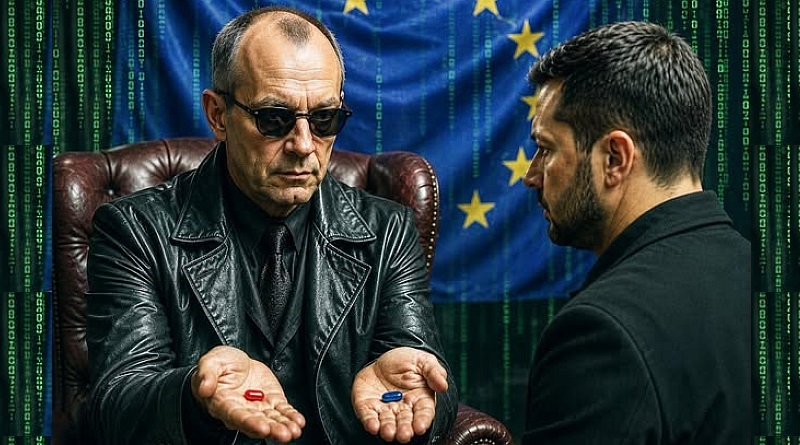
Illustration generated by AI: Lana Zerkal/Facebook
