
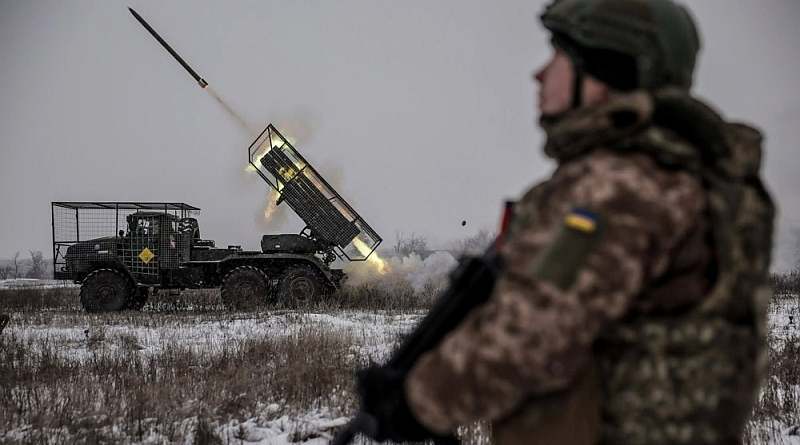
Last week, media and social networks reported certain successes of the Defense Forces in the Zaporizhzhia region. There is talk of a counteroffensive. What’s actually happening?
Understanding the geography of the events: they are developing in the Oleksandrivske and Huliaipole directions, most actively at the junction of Donetsk, Zaporizhzhia, and Dnipropetrovsk regions. The increase in the intensity of hostilities, according to the General Staff of the Armed Forces of Ukraine, began on February 12 and by the morning of February 16 amounted to 37 combat clashes per day compared to 13 on February 11. Although active actions likely began on February 6.
On February 12, battles were raging along the Tsvitkove – Staroukrainka – Zaliznychne line in the Zaporizhzhia region. The Defense Forces stopped the advanced units of the enemy’s 5th Army with several counterattacks, although south of Zaliznychne, enemy units advanced along the railway by about 1 km in the direction of Dorozhnianka – Zaliznychne, “clinging” to the outskirts of the latter, breaking through to the eastern outskirts of Tsvitkove.
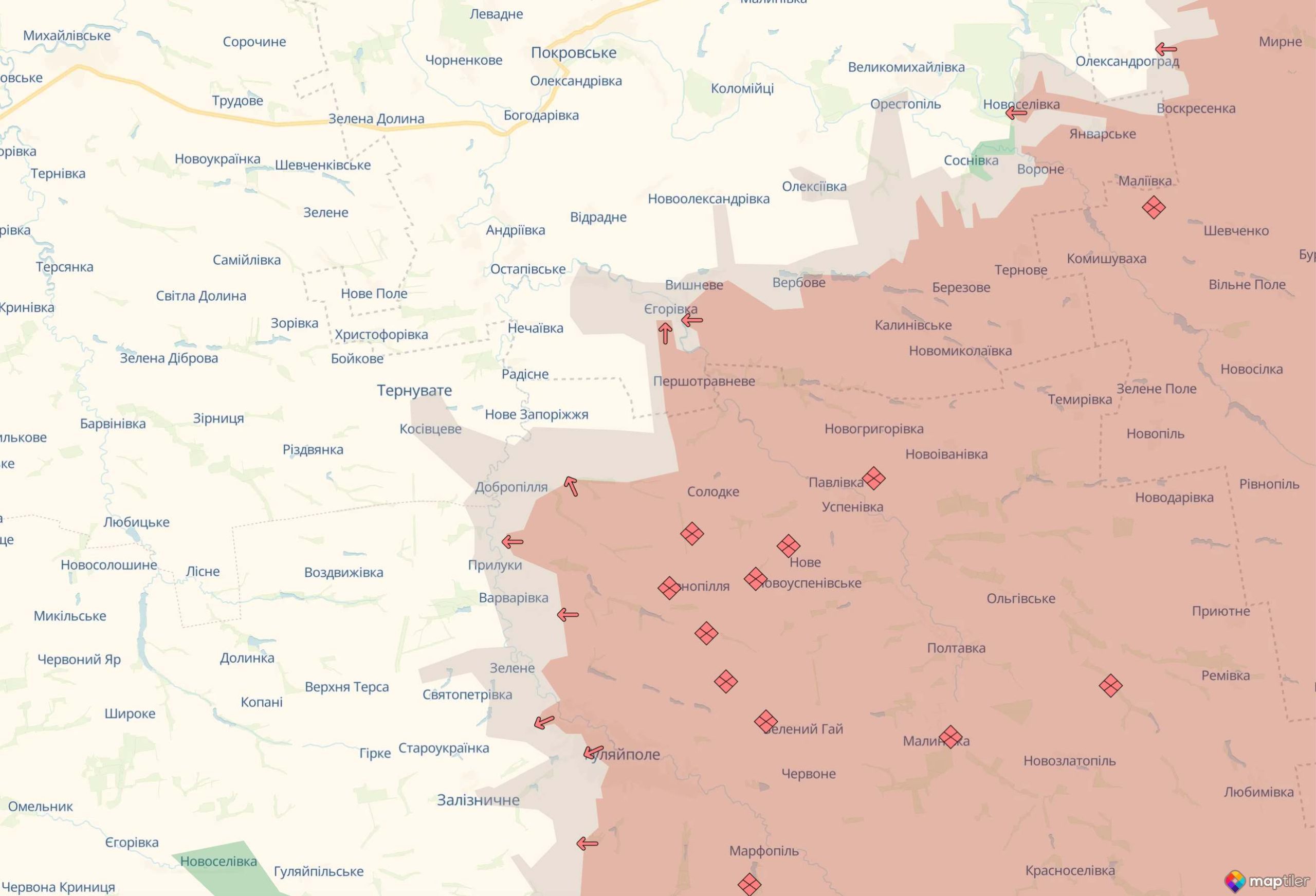
That same day, the enemy conducted 15 attacks in the Huliaipole area, towards Dobropillia, Zaliznychne, and Rybne, and carried out airstrikes on Kamianka, Verkhnii Tersa, Vozdvyzhivka, Barvinivka, and Luhivske.
The Defense Forces carried out a series of counterattacks in the sectors of the enemy’s 5th and 36th armies’ advance, significantly slowing the enemy’s progress to the west and forcing retreats in some sections of the front. Occupants were expelled from Oleksiivka and Orestopol. Defense Force units reached the outskirts of Berezove, Ternove, and began fighting for their liberation.
In the direction of Danylivka – Pavlivka, the enemy was pushed back from Danylivka, and Vysnove, Yehorivka, Pershotravneve, Zlahoda, and Rybne were liberated; the Defense Forces began battles for Pryvilne.
In the direction of Ternuvate – Dobropillia, the Defense Forces drove enemy infantry out of Ternuvate, Kosivtseve, crossed the Haichur River, and liberated Dobropillia.
In the direction of Vozdvyzhivka – Varvarivka, Defense Forces units pushed the enemy out of Pryluky and Olenokonstantynivka, crossed the Haichur and began fighting for Varvarivka.
The next day, February 13, a certain operational picture began to take shape in the area where our forces unexpectedly reminded the enemy that defense must be active. Three directions of action emerged:
• Sosnovka – Ternuvate, where the 2nd Battalion of the 425th Assault Regiment “Rock” broke through the defensive line of the 69th Brigade of the Enemy’s 36th Army;
• Stepove – Berezove, where the 92nd Assault and 67th Mechanized Brigades broke through the positions of the enemy’s 186th Territorial Battalion;
• towards Novohrigorivka, where the 2nd Battalion of the 95th Airborne Brigade and units of the 82nd Airborne Brigade broke through to the rear of the aggressor’s 36th Army, which is fighting to the west, in the area of Solodke – Zlahoda.

Simultaneously, other assault units of the Defense Forces attacked from the bridgehead on the right bank of the Haichur River towards Zlahoda and Solodke. The defense of the enemy’s 36th Army in the area of Danylivka – Yegorivka – Vyshneve was somewhat shaken, and some enemy units began to retreat.
Overall, by the evening of the 13th, it was clear that the Defense Forces had achieved positive momentum in seven areas. Although seemingly local, these well-coordinated counterattacks within the operational zone of the enemy’s “Vostok” troops over two days led to the destabilization of the enemy’s defense in its tactical zone on several fronts simultaneously. Forcing the headquarters of “Vostok” to respond simultaneously to sharp changes in the operational situation on multiple sectors of the front led to reduced troop control, worsened their interaction (and the enemy was never distinguished by it throughout the war), and some gaps in enemy defense appeared in the area north of Hulyaipole.
When we talk about troop management and interaction, we must remember the material basis of the management system – the communication system. And suddenly the world was surprised to learn that the enemy’s tactical communication is built on the American Starlink!
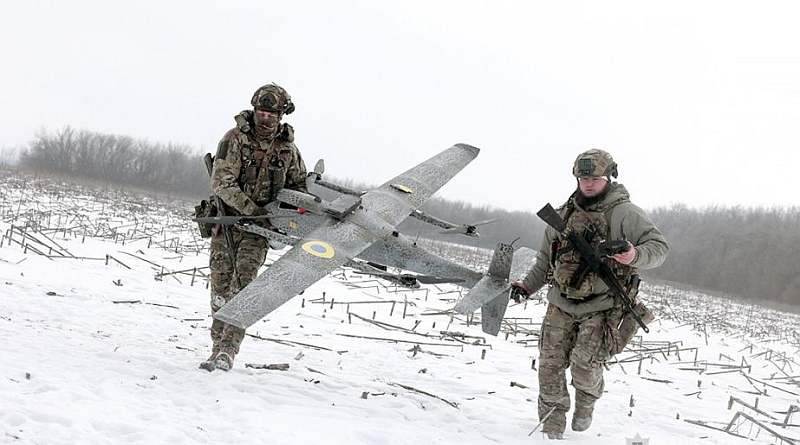
It coincided that just as Musk disabled “grey” terminals, our troops conducted a “series of coordinated counterattacks”! Without Starlink, the aggressor simultaneously lost operational control over small assault groups and infiltration teams, coordination of strikes with KABs and UAV strikes, application of artillery by batteries and individually. The resistant communication system ceased to function.
Now the once-second-largest army in the world is hastily returning to radios from the beginning of the invasion, deploying field Wi-Fi, and taking other immediate measures, mostly with a Chinese touch.
Additionally, the 82nd, 2nd, and 13th battalions of the 95th Air Assault Brigade attacked the junction of the enemy’s 29th and 36th armies in the Novohryhorivka area, while the 24th and 475th assault regiments targeted the junction of the 36th and 5th armies, breaking through to the Rivnopil area. Interaction was weak even before, communication was patchy, and then the Ukrainian assault troops hit the vulnerable spots.
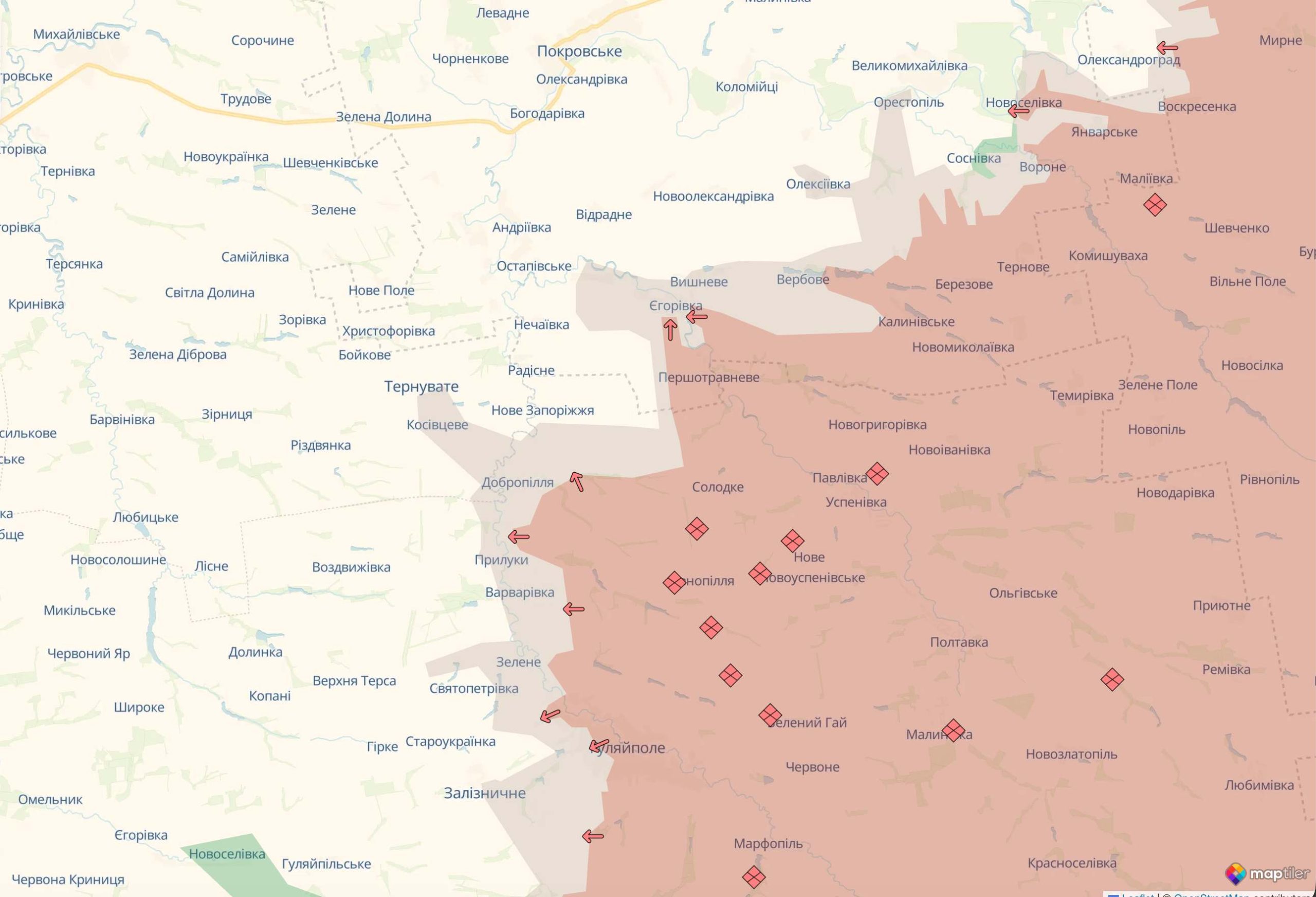
February 15 made it clear that the Defense Forces are nullifying the achievements of the enemy’s last three months of offensive. Our troops advanced maximally in the direction of Ternuvate – Uspenivka, i.e., from west to east, pushing the line of contact away from Zaporizhzhia, while also pressing the enemy from north to south, from Pokrovske to the same Uspenivka. This confuses the enemy’s battle formations, complicates maneuvering, logistics, and much more, turning the retreat into chaos.
This also gives engineering units time to relentlessly build up defensive lines on the hypothetical path of the enemy’s movement towards Zaporizhzhia. Similar works are ongoing around Pokrovske, which cannot be bypassed on the way to Zaporizhzhia.
Recently, speaking at the international Combat Engineer & Logistics 2026 conference in Krakow (Poland), the Chief of the Engineering Troops of the Command of the Support Forces of the Armed Forces of Ukraine, Brigadier General Vasyl Syrotenko, noted that the role of engineering troops is being transformed to a strategic level. Engineering troops are becoming the “architect of the battlefield,” responsible for the entire territory of the state, the formation of defense, maneuvering, and use of terrain in the interest of the success of operations. A fundamentally new task has emerged for military engineers – anti-drone protection of troop movement routes, i.e., the establishment of protected movement corridors to maintain troop mobility, reduce personnel and logistics losses under conditions of constant enemy air surveillance. As we can see, there’s a lot of work to be done.
From February 6 to 16, the Defense Forces effectively halted the advance of the enemy’s Vostok Operational Group and through successful counterattacks pushed back the enemy’s forward units in certain areas by 9-10 km.
Is there reason for optimism? Not quite.
This is not a counter-offensive, nor even a counter-strike. It is a combination of well-thought-out and prepared counterattacks in selected directions, i.e., stabilization actions purely at the tactical level. For understanding the situation: 10 km is the depth of the battle order of a first-echelon regiment, no more. Do not expect enclosures, encirclements, or encirclement, although there is a tendency to break into the rear of the occupiers’ 36th Army.
The Defense Forces took advantage of the exhaustion of the enemy’s 5th and 36th Army’s forward units in the previous two-month offensive battles, the sudden deterioration in the quality of Vostok Operational Group troop management, and interaction problems, which we undoubtedly commend the commanders for – from the chief commander to the aforementioned brigades and battalions.
The Defense Forces gained an operational-tactical opportunity to develop their success, but the enemy retained several trump cards, as they have enough operational reserves in the Oleksandrivka and Huliaipole directions (the most modest estimate is at least two brigades), capable of quickly transferring the 41st Army of the Central Military District or its 90th Tank Division from the Pokrovske direction (which is quite easy) or the 18th Army of the Dnieper Military District from the Dnipro region (which is somewhat more difficult, as it is further to travel).
The Defense Forces do not have air superiority, have parity with the enemy in UAVs, and unfortunately, do not have enough combat-ready reserves, which kills the hope of transforming tactical success into operational success.
It can be said absolutely clearly that the Defense Forces, with their active actions in the last ten days, completely disrupted the schedule of the preparation of the enemy troops’ groups “Vostok” and “Dnepr” for conducting the summer Orikhovo-Zaporizhzhia offensive operation.
What is happening now? Intense battles continue in the Dobropillia area. Defense Forces units are consolidating in Pryluky and Tsvitkove, which they have cleared. Fierce close-combat battles are underway in Varvarivka and Olenokostyantynivka. The occupiers are being squeezed out of key defense nodes, disrupting logistics throughout the tactical depth is one of the tasks. Assault brigades/regiments are pressing on the lines Verbove – Vyshneve – Stepove – Ternove, the enemy is being exhausted, although they are actively trying to infiltrate the area east of Havrylivka.
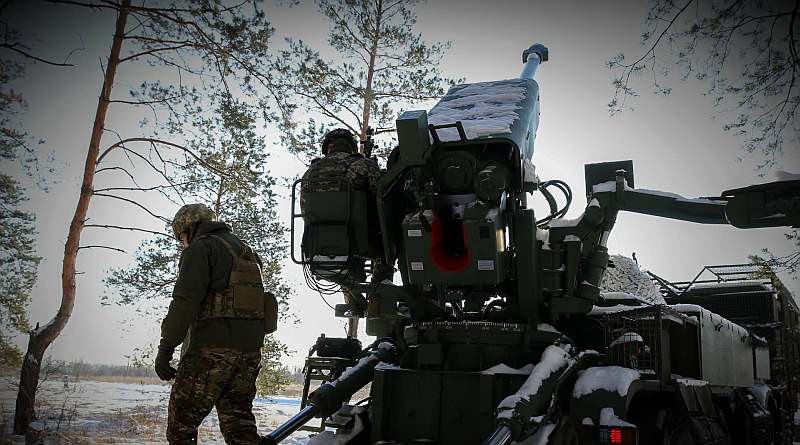
Photo on the cover: 24th OMBr named after King Danylo
