
Oleksandr Kovalenko / Obozrevatel
Within the negotiation process currently taking place in Abu Dhabi, one of the most contentious demands from Russia remains territorial—in particular, regarding the withdrawal of Ukrainian troops from the controlled territory of the “Donbas”. This demand is not only absurd but also topographically veiled and dangerous. The quotation marks are intentional.
More on this can be found in the joint project by OBOZ.UA and the group “Informational Resistance”.
Red Lines
First and foremost, I note that any demands for the withdrawal of our troops from certain Ukrainian territories contradict moral, ethical, constitutional, sovereign, and other principles—including international law.
A priori, this demand is absurd and represents a red line that Ukraine should not cross under any circumstances. Just as we will never reconcile with the occupation of our territories and even more so will not recognize them as Russian.
Territorial issues in such a context are taboo.
But the point is, Russia insists that Ukrainian troops be pulled out of the “Donbas territory” for a reason. This demand has many pitfalls, and let’s start with the first.
What is Donbas?
Is it a city? No. A district? No. A botanical reserve? No. A region? And here begins the main confusion, which Moscow seeks to achieve.
When we say “Donbas”, we mean the Donetsk region. But in fact, this is not the case.
Donbas is the Donetsk coal basin, covering Donetsk, Luhansk, and also Dnipropetrovsk, partially Kharkiv, and a small part of Zaporizhzhia regions.
When the Russian side voices the demand, it uses the term “Donbas” to later (if achieving some goals in the Donetsk region) declare that it meant not only that region, claiming rights to the rest of the territories, up to the outskirts of Dnipro and including Lozova. In this way, the aggressor country promotes a camouflage trap in the diplomatic arena. Moscow is eager for Kyiv, Washington, and Brussels to fall into it (agree).
Our partners’ topographical ignorance can be forgiven, considering the White House administration envisions penguins in Greenland, and Donald Trump believes Crimea is washed by oceans. But for us, it’s unforgivable. One of the tasks for our diplomatic and information sector should be to explain the difference between Donbas and the Donetsk region to our partners.
Donetsk Region
Today, Ukrainian troops control an area of about 5,500 km² in Donetsk region.
I will remind you that throughout 2025, the aggressor country’s army captured 4,329 km² of Ukrainian territory, while suffering losses of 418,010 during the year. When it comes to the Donetsk region specifically, estimating the exact area of captured territories in 2025 is difficult, considering correlations, but it is about 2,200 km².
The most intensive phase of the capture occurred in the first half of 2025, while the second half was minimized, and in several directions fell into stagnation or turned into failed campaigns – for example, the advance on Dobropillya.
Thus, even without specifics, it is clear that capturing the entire Donetsk region will require the enemy at least two more years.
And to be specific, the 5,500 km² of the Donetsk region in question is, as I would call it, the Sloviansk-Kramatorsk bridgehead (SKP). The most fortified part of the entire region in terms of saturation with defensive lines, borders, fortifications, topographical and landscape features challenging for the enemy, and small, medium, as well as large cities and agglomerations.
The Sloviansk-Kramatorsk bridgehead has been built, fortified, and formed since 2014, growing and expanding. Compared to SKP, the Bakhmut bridgehead is a piece of cake for the occupiers. Avdiivka would seem like a walk in the park. The Pokrovsk-Myrnohrad direction, where the Russians have been bleeding for a year and a half, losing over 10,000 personnel every month in this stretch of hostilities, is a simplified version of the Sloviansk-Kramatorsk bridgehead.
And it is not just the most fortified location in the Donetsk region, but I would say – in all of Ukraine. No other region boasts such concentrated fortifications as the SKP.
And if we consider the term “Donbas,” as used by Russia, not as a territory extending to five regions, but specifically as Donetsk, does that mean Moscow wants Ukraine to withdraw its forces from the most fortified bridgehead in the entire theater of operations without a fight?
Again, I am not even touching on the moral, ethical, constitutional, legal, or juridical aspects of this issue. I am talking specifically about military expediency – essentially giving up the most fortified bridgehead to the enemy without a fight.
I want to highlight that currently, a 170,000-strong group has been deployed by the Russian armed forces in the Pokrovsk-Myrnohrad direction. In total, the number of all military groups involved in the fighting in Donetsk exceeds 300,000 people. And they are bogged down in bloody and exhausting battles.
In essence, the Sloviansk-Kramatorsk bridgehead is a meat grinder where Russian armed forces will be stuck for several more bloody years, and the Russian command will need to concentrate there an even larger group than currently exists in the entire Donetsk region.
The Russian occupiers fear the Sloviansk-Kramatorsk bridgehead, understanding that it could become the turning point in the war, when the Russian forces are so exhausted that they can neither advance nor even hold the defense.
The SKP is precisely the opportunity for Ukraine to hammer the first nail in the coffin of the Russian offensive campaign, launched in October 2023, and effectively create conditions for its own counteroffensive.
Conclusions
Considering all of the above, Russia’s demands are quite understandable.
She not only lays the groundwork for further revanchist and aggressive actions towards Ukraine, relying on some agreements enshrined on a legal basis – the withdrawal of troops from “Donbas”, using regional terminology in a distorted, manipulative context.
The first stage of this well-thought-out campaign, based on topographical cretinism, is to force Ukrainian troops to leave the bridgehead without a fight, where the ridge of ROV will break in three places, with no chance of recovery. And if she manages to achieve this, the scenario of Donbas as a territory of other regions as well will immediately kick in.
I think this material will allow many not only to delve into why, at least from a military point of view, the SKP should not be voluntarily abandoned under any circumstances, but also provide an incentive for the dissemination of the correct terminology – without the ephemeral “Donbas”, but with a specification of geographical names.
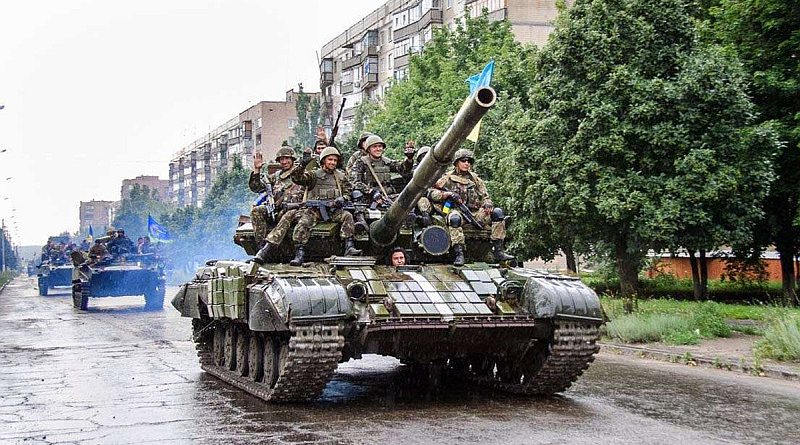
Pictured: On July 5-6, 2014, during the ATO in eastern Ukraine, the cities of Slovyansk, Kramatorsk, and Bakhmut (then Artemivsk) in the Donetsk region were liberated from the occupiers. Illustrative photo from open sources
