
After publications about the possibility of Russia’s “hybrid” attack on Estonia or other Baltic countries, both in Ukraine and the West, serious discussions began regarding the potential conflict between Russia and NATO countries and even the political bankruptcy of the alliance due to insufficiently serious reactions to such an invasion. But most importantly, they began to realize that the very possibility of such a conflict, which poses a real risk of the start of World War III, is associated with the inadequate reaction of Western countries to events in Ukraine in 2014.
At that time, the Russian president, for the first time since World War II, not only occupied but also annexed part of another country’s territory. However, the leading countries of the world — the same signatories of the Budapest Memorandum — tried to pretend that nothing extraordinary happened in Crimea. Looking back at the sanctions imposed against Russia by President Barack Obama’s administration and the European Union, it’s easy to understand why the Kremlin ignored calls from Washington not to intrude further and instead began the war in Donbas.
It is astonishing that this war was also hardly considered a war and occupation. Discussions began about Donbas “separatism,” attempting to overlook the presence of Russian troops and intelligence services in the region. And this despite the fact that before the Russian invasion, neither in Crimea nor in Donbas were there political forces or even respected public organizations advocating for regional independence or annexation by Russia. And indeed, how could such organizations arise when, before 2014, the country’s president, the head of the Verkhovna Rada, the prime minister, and almost all ministers were from the Donetsk region, and the parliamentary faction of the ruling Party of Regions was led by a native of Luhansk? What kind of separatism could there be?
However, this myth allowed both the West and Ukrainians to live in a fictional reality where the conflict could be resolved simply by negotiating with fictional separatists. It got to the point that not only Western diplomats spoke about finding a dialogue with representatives of the “separatist” (actually occupational) administrations, but even ordinary people talked about “separs.” This is the answer to the famous Russian question: “What were you doing for eight years?” What else? We were lying to ourselves that there was no occupation and facilitating your lies and preparation for a major war, during which there was no need to pretend to deal with “separs,” so Luhansk and Donetsk regions were simply annexed like Crimea!
And now the question arises: why can’t Putin use this same mechanism in Estonia’s Narva? After all, if Western capitals face the dilemma of believing in the “separatism” of the Russian population in Narva or fighting with Russia, what will be chosen in Washington or Brussels? We seem to know the answer. We know from the reaction to events in Ukraine.
So let’s fix today that no one will say tomorrow that they weren’t warned. There are no separatist sentiments in the Ida-Virumaa region, to which the border town of Narva belongs, just as there weren’t in Crimea and Donbas. If these sentiments begin to manifest, it will mean that Russian creeping occupation has begun. If this creeping occupation is perceived as a complicated regional and national conflict, if local collaborators, who will inevitably appear — because it is an essential attribute of occupation — are perceived as separatists rather than collaborators, it will not calm but only inspire Putin, and soon a major war will start in Europe. A war from which the United States will no longer be able to shy away, regardless of what they think in the White House today. Here’s an approximate prediction of a World War III with an Estonian… no, a Ukrainian accent.
All because political and security conclusions need to be made on time, my friends. Really, what have we all been doing for eight years?
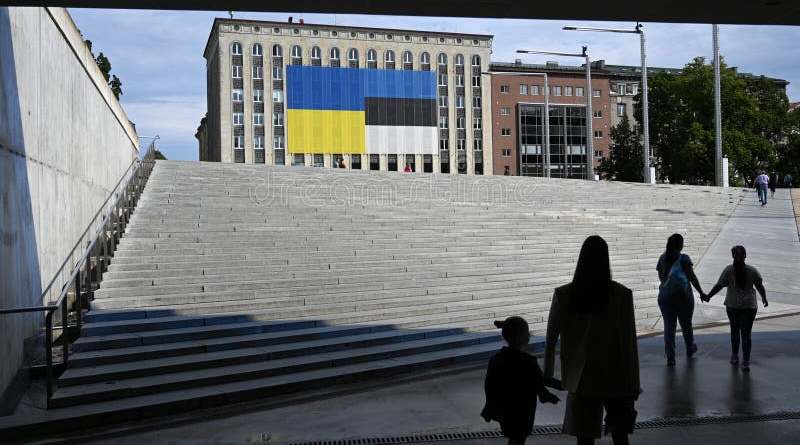
Pictured: Flags of Ukraine and Estonia on the Freedom Square in Tallinn, July 24, 2024. Photo from open sources
