
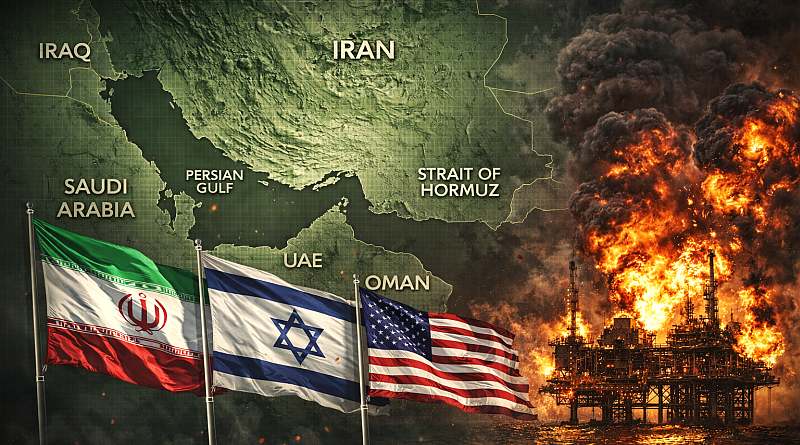
The thing about the blockade of the Strait of Hormuz is fear. Captains don’t want to venture into this narrow 35-kilometer bottleneck, where you’re led like sheep through two 3 km wide passages. Meanwhile, you’re carrying a load of crude oil or gas. It’s scary. An anti-ship missile could hit the bridge, and it’s goodbye.
Even though Bandar Abbas has been bombed by the Americans a couple of times, with fires there, the IRGC could fire an anti-ship missile from a cave, hit with a drone with satellite guidance (some have learned to be guided to the target by the operator), or simply attack with speedboats.
Of course, they’ll be struck back and the launch site will likely be taken out, but that’s later. Meanwhile, a tanker captain has to sit in the bridge and deal with the situation now. You can understand them. Most are contractors, they don’t own the vessel, and the company won’t be happy about entering a risky area. But at the same time, they’re under pressure because freights are getting more expensive, insurance rates are skyrocketing, and margins are shrinking.
However, there isn’t a physical blockade. The Iranians haven’t managed to lay minefields from ships. They wouldn’t have managed anyway — near Oman, they would have been killed at sea immediately. You can’t launch a helicopter either; Oman has air defense, and there are planes on standby, and Americans will definitely notice a launch, react, and shoot it down over the sea.
Iran itself is also scared: they saw how their fleet, including that drone carrier the size of a WWII escort, was destroyed in two days. They aren’t eager to sail or fly out. And you can understand them — there aren’t many suicidal admirals.
You can’t lay many mines with boats and drones. Plus, their positions have also been targeted, and the Americans are watching them in real-time. So, they won’t be able to completely block these two 3 km channels with mines, only occasionally strike with drones or use analogs of our Magur and Sea Baby.
But on the Iranian side of the strait, the Americans can launch about a dozen Tomahawks from depth right at these drones or boats, even if they are just planning to attack. So, they won’t close Hormuz — they have nothing to do it with.
Ships still pass through there from time to time. A Greek tanker went through yesterday. The owner wanted the money, and the captain, being smart, didn’t refuse. He turned off the transponder, sped up, and passed through. It’s the same way they went through during the Iran-Iraq war in the ’80s: there were fierce battles with hundreds of attacked vessels, yet everyone kept sailing.
Shipping has never been completely safe de facto. It has always been a risk. Before, a royal ship would pass on patrol, and pirates would jump out from behind the islands on a dhow and plunder the trader.
There has never been complete safety even in recent times — the vessel “Faina” won’t let you lie. There has always been risk at sea.
So, I think gradually three ships will go there, then five, and then many more. Because greed always overcomes fear; that’s precisely why we trade and develop.
And among them will be those hit by drones or missiles, there will be killed and wounded, someone may even drown, although modern tankers with double hulls are as resilient as terminators. But overall everything will be as usual — despite the risk, the thirst for profit will drive them forward into this narrow tube.
And they too will slip through, like that Greek. Just not all of them. And how many there will be — many or few who don’t make it — will also be a factor in the movement of oil prices. But water will find a way. Even through mines and burning tankers, as shown by our Grain Corridor.
If the war lasts the planned period — and this, in my humble opinion, is one and a half to two to three months, to deprive the ayatollahs of industry related to missiles and drones, there is simply no other option.
They cannot stand at sea for weeks, now everyone hopes that somehow it will be soon. But if the war continues, it will only be like this: either you take the risk and earn billions on the deficit, or you go bankrupt on the shore.
Soon the desire for cash will drive tankers forward more and more every day. That’s how I see it. Because oil has to flow, and fear is a quickly perishable good.

Oil will be $200. The EU will not give money, instead it will buy oil and gas from Russia. Trump will ban everything for us and allow everything for Putin. By autumn, Putin will occupy Kremenchuk. Orban will defeat Navrotsky in the battle for Ternopil. All this without water, light, and completed acts of work.
I also love to make such things up, it broadens horizons in the process of justification. The main thing is not to forget to insert the word “if” in the right places.
The key point is how long will all “this” actually last? What range of difficult-to-reverse and irreversible consequences will arise?
These are questions to which there are currently no answers. There may be some plan and calculation for insider actions that won’t materialize. Because war is war. Who better than us to know?
And since that’s the case, we follow the rule: in any unclear situation, one must look at the map.
1. The first map is the localization of the main oil and gas fields in the Middle East and Central Asia, highlighting some alternatives. Very clearly: in focus is a strip 300 km wide and 1500 km long, which has stirred the entire planet.
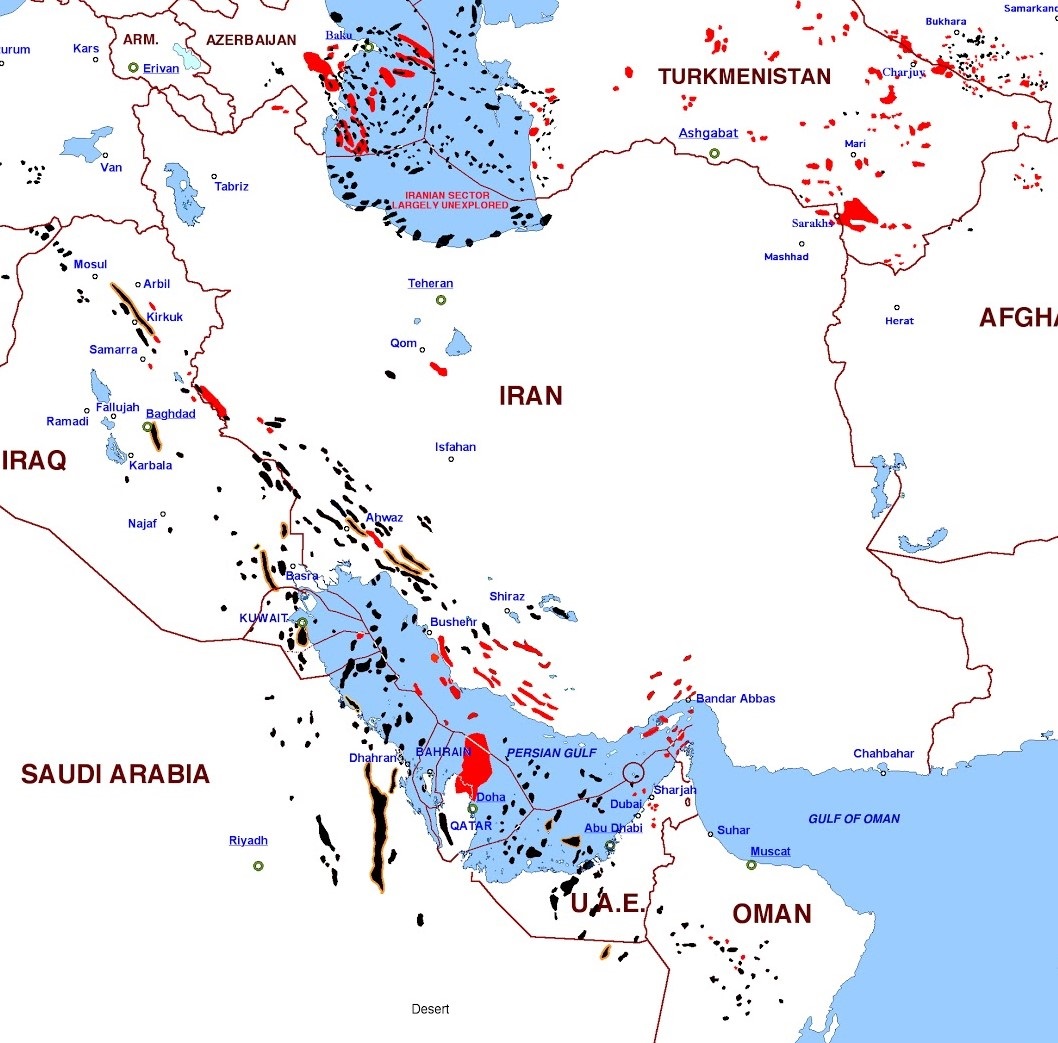
Given the landscape (desert, mountains, sea), we are dealing not with an area, but with a set of points around which this space is organized (infrastructure for extraction, storage, processing, transportation).
The first question is: who controls them?
For example, a large red spot in the center of the Persian Gulf is the largest gas field on the planet. A shared reservoir from which Iran (its part is called South Pars) and Qatar (North Fields/North Dome) draw.
The lion’s share of Iran’s oil and gas power is concentrated in three points:
• the widely publicized Kharg Island,
• South Pars and the accompanying infrastructure on the coast in the industrial zone of Assaluyeh (12 km of continuous tanks, pipes, factories, etc.),
• the port of Bandar Abbas.
Recently, not only the Chinese and Gazprom felt at home in Assaluyeh, but also Italians (Eni), French (Total), and other significant players. They would gladly revive and expand everything.
2. Capturing these points, and Iran largely turns into a pumpkin. Destroying this infrastructure even without capturing it is a long-term shock for Iran. Thus, there is a material goal achievable by military means, which is obscured by various Baloch people, searches for uranium, and not fully defeated ayatollahs. Comrade Kellogg said a very practical thing.
You can create a map of affected/beneficiaries. But the principal point is that this battle will take place in a glass house. Only external players can escalate it to the level of physical ground control or destruction of infrastructure.
The local sheikhs couldn’t care less. Whatever they may declare now, their motive is to quickly oust the elephant that has burst into their china shop. Even Turkey is not very enthused.
Playing with the confiscation of Iranian assets is risky. This is not even Russians and Belgium. They would simply destroy the image of safe gingerbread metropolises with a couple of bloody terrorist attacks. Or genuinely break desalination capacities. It was safe because Iran was one of the donors of this safety.
Hence, the fork in the road is very clear:
• go all-in, where the prize is territorial captures and forceful management of hydrocarbon flows,
• amidst militant rhetoric, quickly announce a victory, fix the roofs at airports, and sweep the war under the rug, discussing the degradation of Tehran’s nuclear and missile programs.
This fork has not yet been passed.
Azerbaijan wisely shows a reluctance to rush into the volcano’s mouth.
The story with the Kurds has already been hastily dubbed Trump’s failure, but it doesn’t work that way. Even when there is full agreement, time is needed to prepare a military operation. Weapons, MTO must be supplied, people must be properly motivated, efforts coordinated.
Even if the Kurds agreed (which is not a fact), it makes sense to wait, strengthening air dominance and weakening the IRGC. Because the Kurds will not physically control Kharg Island, Assaluyeh, and the port of Bandar Abbas. A professional, numerous landing force is needed there, which has not yet been deployed to the region. Therefore, news of wandering MANPADS either from Russia or from China resonates so much in the West. This is precisely what we experienced in November 2021-January 2022. Even in the case of a hypothetical agreement to fight, the Kurds’ task is to pin down the forces of the Islamic Republic.
3. Do the exercise. Go to Google Maps or any similar service and “wander” around the main locations of the hydrocarbon industry in the Gulf countries. Look for news like “Iran hit a plant in Bahrain, a tank is on fire, we’re all going to die!” And then count how many tanks are there.
Burning barrels smoke very impressively. The fact is, to seriously damage that infrastructure would require very lucky hits. We see this with Russian plants.
Therefore, if there is no escalation and very accurate targeted strikes, the damaged parts can be repaired relatively quickly. All these pricing games and apocalyptic forecasts are ways for various villains to profit.
I tried to estimate what is actually destroyed there. Even if you double or triple it, there is currently no basis for concluding any “strategic victory for Russia.”
These grounds may arise in a couple of days or a week. But now the damage is comparable to a severe dust storm. Once the strait is unblocked, things should return relatively quickly.
That is, Russia may get 1-2 successful months, but lose plenty of perks obtained from Iran/through Iran. These are tasks Moscow is not solving at all.
4. The second map provides a slightly more general picture and clearly leads to the obvious thought: why not lay pipelines from the coast of the Persian Gulf to the eastern coast of the Mediterranean Sea?
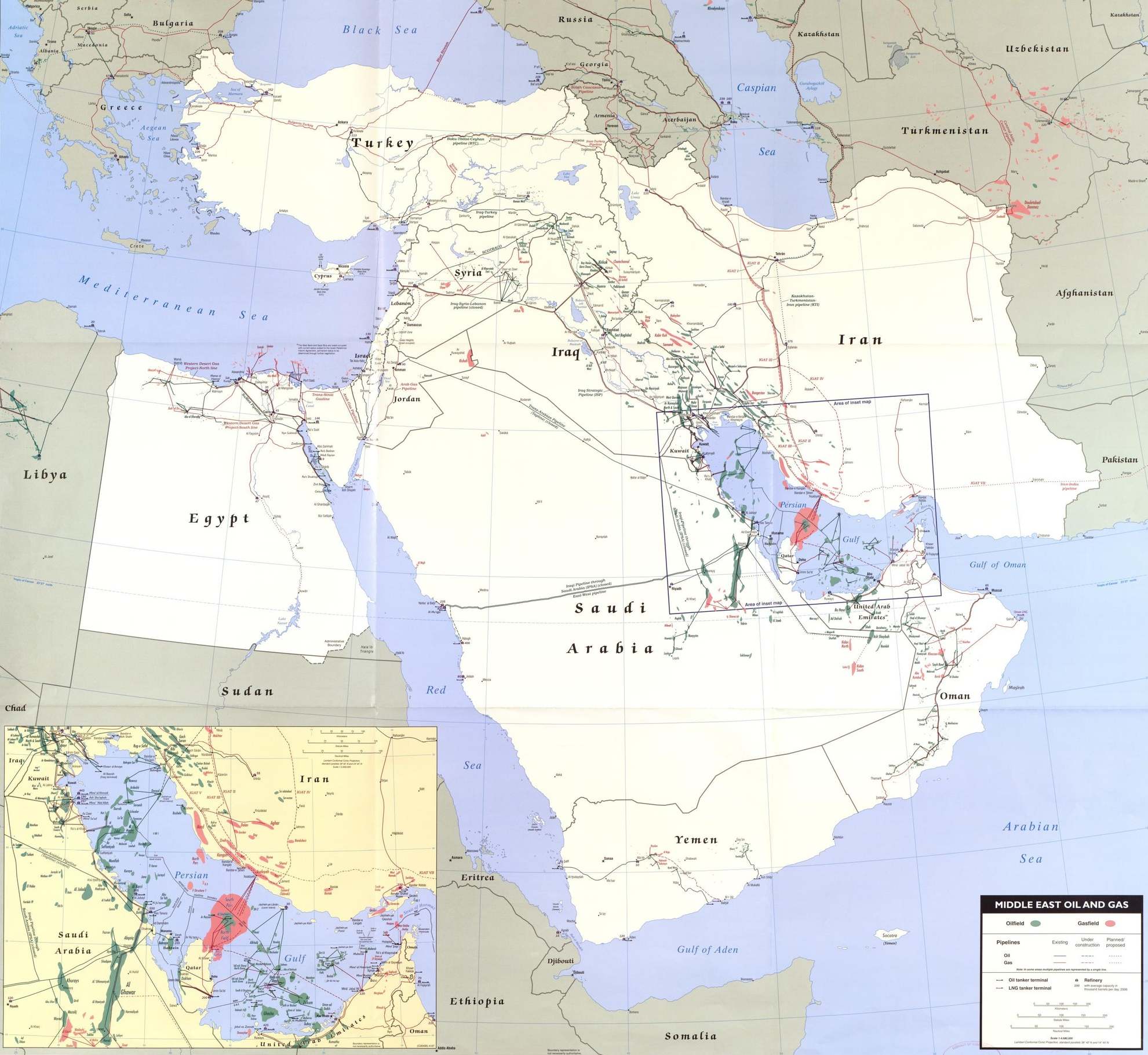
Especially since there is some experience with the Trans-Arabian Pipeline, pipes from Iraq through Syria with branches to Lebanon and future Israel. Or even drop one of the pipes through Turkey for overall harmony.
How did it happen that one of the oldest centers of civilization and a symbol of trade as a meaningful human activity (the Levant) turned into what it is now?
Who are these villains preventing the realization of such a logical project?
The attempt by Saudi Arabia (via the East-West pipeline) and the UAE (via the pipeline to Fujairah) to partially bypass the Strait of Hormuz does not solve the problem. And until it’s clearly demonstrated that the rest of the world, after a minor shock, can more or less do without the resources of the Persian Gulf, the impulse to inflame the region will remain.
If the monarchs are suddenly taken out of the equation, they themselves might have motives to jointly fight against unhealthy competition and various instigators.
The paradox is that the current war may have precisely such a therapeutic effect. It remains to distribute shares among intermediary “peacemakers.” It wouldn’t hurt to award Nobel Peace Prizes for three years in advance for that.
However, this is an extremely crude oversimplification that considers only the economic dimension. There’s a whole tangle of contradictions there.
A question immediately arises about hypothetical alternatives to the Persians and Arabs. And here, Central Asia, particularly Kazakhstan, finds itself in a very specific situation.
We are used to considering Russia, China, and Turkey vying for influence there. But since 2022, Gulf countries, especially the UAE and Qatar (which partly aligns with Turkey), have become more active there.
In conclusion, Trump initiated a chain reaction with numerous consequences. Through public statements, the US is trying to create the appearance that they control the main networks of consequences. Most likely, this is not the case. But right now, there’s no need to wring hands in horror. There are simply no grounds for it.
Basically, in our interest is a short-term operation that significantly weakens Russia’s ally and forces Moscow to spread itself thin. A prolonged campaign theoretically benefits Russia in terms of money and restoring some connections. But only 10 days have passed. And purchasing oil/gas from Russia will only increase military risks for Europe. It has already been proven – economic ties without military balance do not work.
And if Ukrainian specialists and interceptors prove themselves, who knows how it will play out?
There are many discussions and recipes online about how to survive during this crisis or how to prepare for the collapse of everything. Anyone can find something to their liking.
The main thing is not to lose sight of the real successes that exist. It is precisely they that will encourage a change in the Kremlin’s position, even if oil brings joy to the spiteful old men for some time.
Illustration on the cover: SpecialEurasia
