
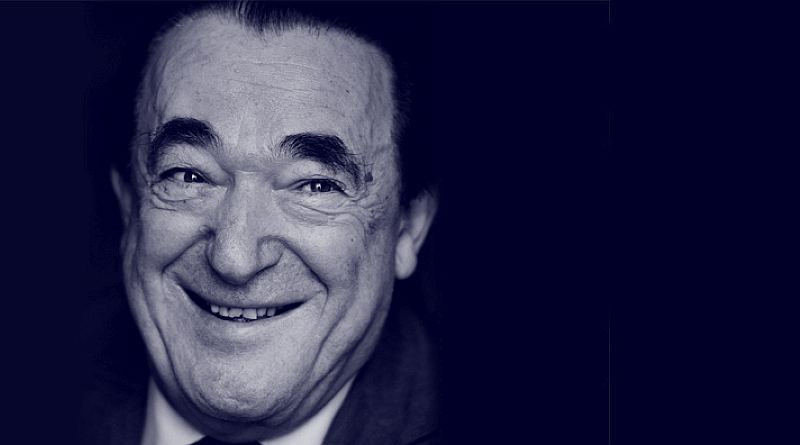
From the hills of Solotvyno, a picturesque view of the neighboring town of Sighet unfolds: it lies there like on the palm of your hand, romantic and peaceful with its temples and narrow streets. And when you see Sighet from Solotvyno, you might think that this small town is just a door to big life, to metropolises whose panoramas can only be seen from the roofs of skyscrapers, not from rural hills.
Perhaps this is how Jan Ludvik Hoch, a boy from a traditional Jewish family—one of the thousands of families who lived in these blessed lands where the views at each new turn of the road take your breath away—might have thought, gazing at Sighet at the beginning of the 20th century. One of the thousands of families that would not survive the war decades and rest not in the ancient Jewish cemetery of Solotvyno, but in the dreadful furnaces of Auschwitz.
And the boy, who left Solotvyno as a young man, survived. Survived and became one of the most successful media magnates of the 20th century, one of the most influential representatives of the Western elite, and one of the most famous adventurers of his time.
He became Robert Maxwell. A man who received everything from life—and lost it all. For when Jan Ludvik Hoch died one sunny November day on his luxurious yacht near the shores of Tenerife in the Canary Islands, he was already a complete bankrupt and a suspect in the theft of hundreds of millions of pounds. The circumstances of that death raise questions even after 35 years. And when, on a day as sunny as the one that became the last in Robert Maxwell’s life, I looked into the ocean expanse from the promenade of Santa Cruz de Tenerife, I thought: how strange it was that a boy from Solotvyno found his death so far and so unclearly…
On the other hand, why unclearly? Maxwell’s entire publishing career was connected with stable contacts with communist leaders—from Brezhnev to Honecker. He published their books, met with them, received profitable contracts, one might say—normalized evil not without benefit to himself. And he died practically when the Soviet Union and the “socialist camp” were dying, his very death confirming rumors about his possible connections with communist special services.
Could Maxwell’s daughter Ghislaine have known about these connections? Probably, because out of the entire large family of the magnate, she was perhaps the most integrated into Maxwell’s publishing activities and the structure of his various connections. The fall of her father’s empire and his unexpected death were not the collapse for Ghislaine, she merely changed the country of her activity: while Robert Maxwell operated in Great Britain and was even a member of the British Parliament, his daughter moved to the United States even before her father’s death to find there the love of her life—Jeffrey Epstein, who became not only her partner but a true friend. Well, to find love is more of a romantic phrase, because it was her father who introduced Ghislaine to Epstein, who was involved in the development of the future successful financier.
Ghislaine Maxwell not only introduced Epstein to influential Europeans—for example, the same Prince Andrew who was a long-standing friend of the Maxwell clan—but also took direct part in the trafficking of minors and intimate relations with girls. And when Jeffrey Epstein died—almost as mysteriously and unclearly as Robert Maxwell did—it was Ghislaine who became the main accused in the “Epstein case.” She is alive. She is in prison. And she remains silent.
This family biography could have been a plot for an adventurous novel if not for its bitter consequences for people who became victims of self-confident adventurers. And from the realization of the simple fact that the people who were an organic part of the Western elite might not have earned their billions, but received them from those same structures that, after the collapse of the USSR, would create “their” billionaires in the post-Soviet space. Adventurers are easy prey and a weapon for those who try to defeat the civilized world with simple blackmail and “their people,” who sell their souls to the devil for the next billion or an island. And it could be that this very island—“Epstein’s island”—could have been another special operation of the Maxwells and those who always stood behind them and signed the books published by their publishing house.
And now when we hear intrusive talks about the need for trade with Russia or about 12 trillion from the so-called “Dmitriev package,” we must realize that work with swindlers and adventurers continues successfully—these people have come closer to real power than Robert and Ghislaine Maxwell or Jeffrey Epstein could ever dream of. And that is why we try to perceive the continuation of special operations as politics.
But this is not politics, no. This is an entirely different process, which will end for its participants with an empty deck of a lonely yacht or the last breath in a prison cell.
Because deals with the devil end exactly like this.
