

Oleh Chernysh, BBC News Ukraine
During January-February, the Ukrainian General Staff reported three strikes with powerful “Flamingo” missiles on Russian territory. The last one set a record for range and accuracy.
The use of FP-5 “Flamingo” missiles produced by the private Ukrainian company Fire Point was first reported by the General Staff of the Armed Forces of Ukraine in November 2025, though without specifics.
For instance, on November 13, while informing about the striking of several oil depots and military facilities in Crimea and Russia, the Ukrainian military command mentioned the use of FP-5 missiles among other means.
At the beginning of February this year, the General Staff reported a strike with this missile on the “Kapustin Yar” range (Astrakhan region) and announced its consequences.
According to the command of the Armed Forces of Ukraine, one of the hangars on the range was “significantly damaged.”
However, OSINT analysts were divided in their opinions regarding the effectiveness of this strike. Some pointed to likely damage to a workshop where parts of the “Oreshnik” ballistic missile were assembled. Others said there were no visible damages to the building, and likely the Ukrainian missile fell several dozen meters from the range.
Verification of the strikes was complicated by bad weather over the range during those days, which prevented the capture of quality satellite images from space.
On the night of February 12, another “Flamingo” missile strike was made. The target was a large ammunition depot near the village of Kotluban (Volgograd region), as stated in the Ukrainian General Staff’s announcement.
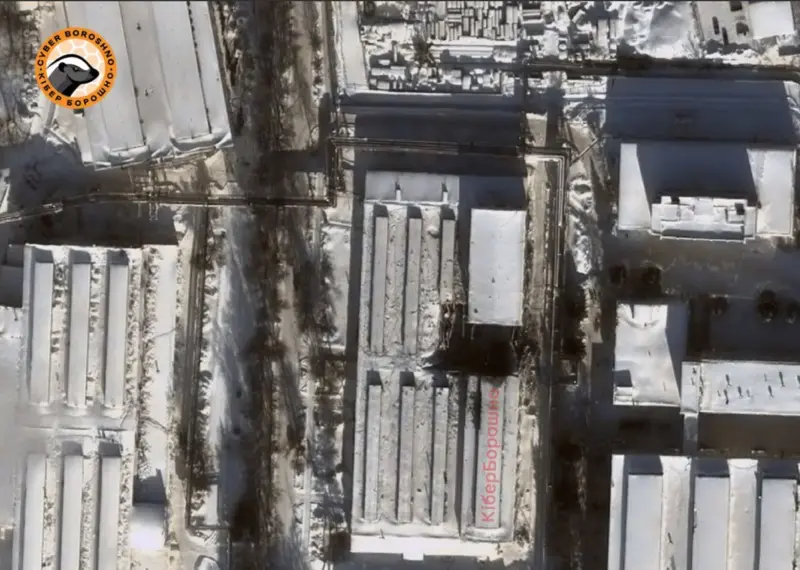
Satellite images published by the OSINT project “CyberFlour” show that “Flamingo” hit a munitions storage bunker with an area of 1,200 square meters at the arsenal. The photographs show significant damage to the shelter.
All these targeted objects are located 500-600 km from the Ukrainian territory.
The next “Flamingo” strike on the night of February 20-21 was even more successful.
Record Strike
That night, the Ukrainian army launched several “Flamingo” missiles at a military plant in the city of Votkinsk (Udmurtia, Russia).
The General Staff of the Armed Forces of Ukraine reported damage to this facility and a fire on its territory. The Russian authorities confirmed only that “one of the facilities” was attacked, but not with missiles, rather with drones.
“One of the facilities in the republic was attacked by drones from the Kyiv regime. According to operational data, there are damages and casualties,” said the governor of Udmurtia, Alexander Brechalov, at the time.
Previously, Ukrainian long-range UAVs had already attacked military enterprises in this remote region of Russia. On July 1, 2025, several drones of the Security Service of Ukraine hit the “Kupol” electromechanical plant located in Izhevsk, the capital of Udmurtia.
This plant manufactures anti-aircraft missile systems for the Russian army.
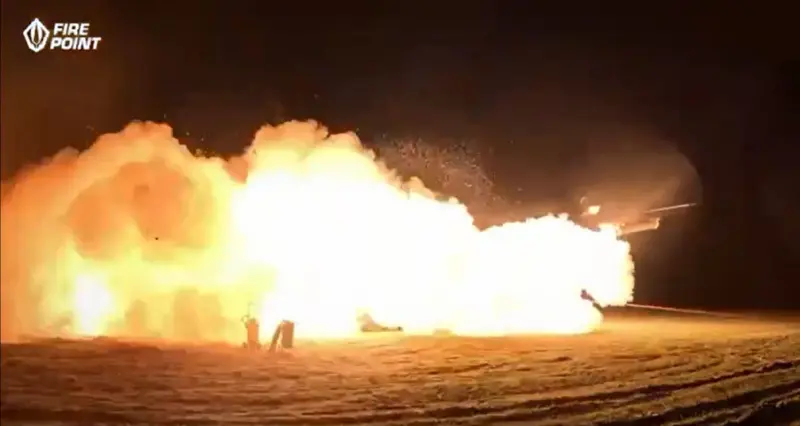
However, for the first time, it was not UAVs but powerful Ukrainian-made cruise missiles that traveled such a long distance—over 1500 km.
Moreover, the management of Fire Point informed journalists at a press conference on February 21 that this was a record-breaking long-range cruise missile strike.
According to BBC sources in the Ukrainian Defense Forces, the “Flamingo” covered about 1700 km on the night of February 21. The manufacturer’s stated maximum range for these missiles is up to 3,000 km.
“This was the longest cruise missile strike in history… And it wasn’t even the maximum capability of the ‘Flamingo’,” said Fire Point’s technical director Iryna Terekh.
How it was achieved
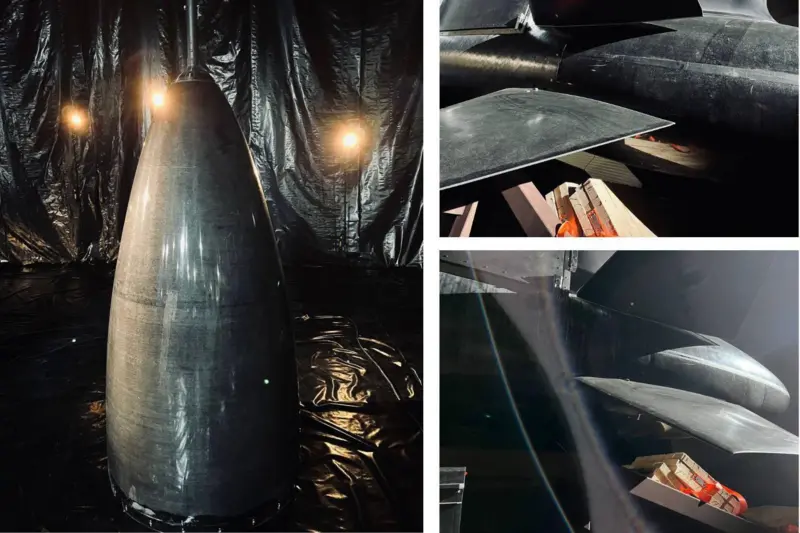
The “Flamingo” is a rather large missile with a wingspan of 7 meters and a warhead of about one ton. Its lift-off weight is approximately 6 tons.
It is launched from a ground-based launcher and can fly to its target at fairly low altitudes (the manufacturer specifies altitudes from 20 m to 10 km). Its cruising speed is 650-700 km/h, with a maximum speed of up to 950 km/h.
This makes it a very large and relatively slow target. For example, the Russian “Kalibr” cruise missile has a stated speed of about 1000 km/h and a warhead of about 450 kg.
So how did the Ukrainian “Flamingo” manage to fly almost the entire European part of Russia undetected and hit its target?
The FP leaders did not disclose these details at the press conference but noted that the success was largely due to a change in missile deployment tactics.
“Last time at the press conference (in November 2025, – Ed.), we said that we were refining our deployment tactics, and I think we’ve found it,” said company co-owner Yehor Skalyha.
Chief engineer Denis Stiller emphasized that the “Flamingo” is constantly being improved, particularly in terms of terrain navigation.
“We are constantly working on this, and as soon as we have terrain maps with an error margin of about 1 meter in height, we will be able to use the TERCOM system (Terrain Contour Matching is a terrain contour orientation system used in American missiles) and fly without GPS. We practically always fly without GPS now… Unfortunately, we don’t have such maps yet, so we use other means of correction,” he said.
Military analyst and aviation engineer Kostiantyn Kryvolap explained to BBC News Ukraine that the successful flight of the cruise missile was ensured by several factors.
Firstly, “Flamingo” likely managed to fly at extremely low altitudes over a significant distance across Russian territory.
“It appears that the ‘Flamingo’ missile incorporates principles that allow it to fly very low. I think the improvements to this missile primarily involved reducing altitude… The Russians essentially didn’t see it,” explains the expert.
For example, the leading Russian air defense system S-400, says the engineer, can detect aerial objects at a distance of up to 400 km, but only if they are flying at a significant altitude and not near the ground.
Secondly, the Ukrainian missile evidently managed to bypass areas in Russia where the air defense system (ADS) is most densely positioned.
“The Russian air defense system is concentrated, roughly speaking, in only three main locations,” says Kryvolap.
According to him, the strongest air cover is around Moscow and the Moscow region, in Crimea, and along the state border and the line of contact.
“That is, if you cross the border and do not divert towards the Moscow region, then there are virtually no ADS means beyond that. And even if there is observation, meaning they understand where the missile is flying, they lack the means to shoot it down.”
Moreover, in his opinion, the developers managed to improve the accuracy of the “Flamingo.” According to his estimates, the circular probable deviation when hitting the Votkinsk plant was no more than 10 meters.
Where it hit
A BBC source in Ukraine’s Defense Forces confirms the information about the high accuracy of the strike.
According to him, the missile destroyed two workshops of the plant. It directly hit one, and the other was damaged by debris.
“As a result of a single ‘Flamingo’ missile strike with a warhead of 1150 kilograms, the entire building of workshop number 19 — the galvanic-stamping workshop — was completely destroyed. The adjacent workshop was also destroyed as a result of a fire caused by the spread of zirconium debris from the missile,” said the interlocutor.
Such results were achieved due to a modification of the “Flamingo” warhead, which is designed to hit large targets.
Satellite images released by OSINT projects the day after the strike recorded a large hole in the roof of one of the Votkinsk plant’s workshops, approximately 30 by 24 meters in size.
Russia did not comment on the consequences of the strike on the facility.
This despite the fact that this plant is critically important to the Russian defense industry, says BBC expert on Russian armed forces, senior fellow at the Jamestown Foundation (USA) Pavel Luzin.
“The strike on the Votkinsk plant is hard to overestimate — it is the only plant in Russia producing ‘Yars’ intercontinental ballistic missiles, ‘Bulava’ submarine ballistic missiles, and ‘Iskander’ tactical ballistic missiles,” notes the analyst.
It was the Iskander ballistic missiles that were a key element of the air attack campaign on Ukraine’s energy sector in the winter of 2025-26. In less than three months, Russia launched nearly 200 of these missiles, of which only about a third were intercepted.
According to Ukrainian Defense Ministry advisor Serhiy Beskrestnov (call sign “Flash”), Russia currently produces 60 Iskanders per month, and they are 90% composed of Russian components.
Pavlo Luzin noted that the electroplating and stamping shop, which was damaged by the strike, is responsible for part of the technological process of manufacturing missile bodies, and its damage is expected to “for some time” reduce the plant’s production capabilities.
Aviation expert Kostyantyn Kryvolap believes that the destruction of this specific shop will delay Russia’s ballistic missile production by at least 3-6 months.
“This shop is the very beginning of producing what later becomes the missile. If you don’t have that ‘metal piece,’ which first undergoes stamping and then processing in the electroplating shop, you have nothing to assemble the missile from,” the expert explains.
In his opinion, Russia might have sourced microelectronics for the ballistic missiles from abroad, but the assembly of the bodies was done solely at the Votkinsk Plant.
What’s Next
On February 14, Ukrainian President Volodymyr Zelensky announced that Russia attacked the plant producing the “Flamingo,” and this has slowed down the production of this weapon.
“We had technical problems… One of our major production lines was destroyed by missiles – Russian missiles. I can now talk about this because the production has been relocated and partially restored. The restart is ongoing,” the president said.
The company Fire Point evasively responded to the BBC regarding the consequences of this strike but assured that it did not affect the fulfillment of state contracts for missile production.
“I don’t want to specify when, how, or where (this happened) and what was lost. But I can say that after absolutely every impact, we see how well we have managed to build a resilient system. Because despite these military losses, we manage to avoid human losses, which is the most important. Regarding the material aspect, the system is now so diversified and strong that while it’s unpleasant financially, it hasn’t affected or delayed state contract deliveries by even a day,” said Fire Point Technical Director Iryna Terekh.
She also noted that the planned increase in “Flamingo” production is constrained by limited state funding.

In the second half of 2025, FP’s leadership publicly announced the production of about 50 of these missiles per month and plans to increase it to 200.
“There is the issue of our production capacities and the issue of their contracting. Today, they are not on the same level… Our country is currently facing significant challenges, and there are many priorities that need to be addressed. It’s not just about a single missile program… Therefore, we are very hopeful for the help of our partners,” commented Iryna Terekh on this issue.
According to her, in addition to manufacturing cruise missiles, the company is now also focused on creating its own ballistic missiles. A corresponding plant has already been built, and the first samples of ballistic missiles are undergoing necessary tests to obtain codification from the Ministry of Defense of Ukraine.
The company’s technical director predicts that the ballistic issue will be resolved within the “next few weeks.”
