
Phillips P. OBrien / Translation iPress
Renowned historian and war researcher Phillips O’Brien, summarizing last week’s events, analyzes an unpleasant situation with our allies: they turned to Ukraine for help, but instead of mutual support for our country, they are actually appeasing and defending the Kremlin. He also emphasizes that Washington supported Moscow not only with rhetoric but also with actions: the US and Israeli campaign against Iran, which began just when Moscow started to feel a particular lack of money, will now aid in increasing Russia’s oil revenues.
Last week, we saw two forces in action. One of them is Ukraine, which has adapted to the realities of modern warfare. It has not been easy, but Ukrainians have shown flexibility, determination, and ingenuity. The other is the USA: overconfident, powerful, and not understanding what they were doing. It is no surprise that the result was that the United States proved unprepared for war and were forced to ask Ukraine for help for themselves and their allies.
Such miscalculations during war happen. But it is unprecedented for the USA, while asking Ukraine for help, to simultaneously provide protection and unexpected support to the force trying to destroy Ukraine—Russia. So we have a situation where Ukrainians are helping the USA, and the USA is helping and protecting Russia. This should have been the main topic of the week.
Data for February’s ground war worth mentioning has also come in. In the last few weeks, Ukraine liberated more territory than it lost, and at the same time seemed to maintain Russian losses at extremely high levels. Only a month has passed, but Ukrainians seem to believe their strategy is paying off. The silence of the press and analytical circles means they are right.
The week when Ukraine decided to help the USA…
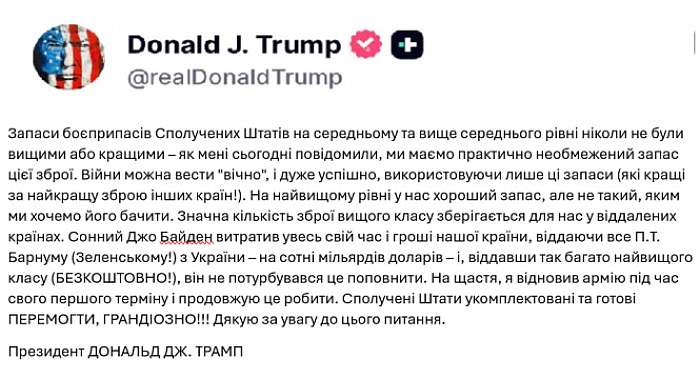
At the beginning of last week, Trump and the White House just couldn’t help their insults towards President Zelensky and the very idea of helping Ukraine. It is worth noting how pathological this behavior has become. Here’s a tweet from Trump on March 3, where Zelensky is compared to the famous circus impresario P.T. Barnum.
This was not the only insult. White House spokeswoman Caroline Leavitt also criticized the assistance the US provided to Ukraine under President Biden, calling it a mix of foolishness and imprudence.
You can watch her press conference below. She starts talking about aid to Ukraine at around 1:30.
Leavitt calls Biden a “stupid and incompetent leader” who “gave away many of our best weapons for free to a very distant country called Ukraine.” Additionally, she emphasizes that Trump considered aid to Ukraine “foolish.”
It was not only a manifestation of Trump’s pathological need to criticize Zelensky and Biden at every opportunity but also a desperate attempt to deflect blame for his own incompetence. At the moment this was said, the war he had chosen to start against Iran was already showing how elements of “rot” had infiltrated American military and diplomatic services.
On Thursday, my article on this phenomenon was published in The Atlantic, and on Friday I published a continuation on Substack. In both articles, I noted that the Trump administration seemed unprepared to intercept cheap UAVs, ignoring perhaps the most important technological breakthrough in the Russian-Ukrainian war over the past four years. This was one of the reasons why I used the word “rot” to describe what we are seeing. Here’s a brief remark from the post published on Friday:
The most incompetent military-industrial preparations for war in U.S. history. Guess what? Cheap drones are a reality and need to be shot down effectively. You would have had to live in a cave for the last four years not to know this, but it seems the Trump administration and the U.S. Department of Defense didn’t learn this lesson. The United States began spending costly air defense resources at such rates that they were shocked when the campaign started. Only after this did Trump convene industry leaders for a panic meeting, demanding to increase production. (Read the full translated version of the post below – iPress).
Today, there is one country that has clearly not ignored this area, and that is Ukraine. Ukrainians are world leaders in intercepting inexpensive drones. They have done tremendous work in implementing innovations, summarizing experiences, and developing a range of low-cost systems for intercepting such UAVs. Their success is significant. According to CSIS, the average cost of a Russian “Shahed”/”Geran” drone (these are “Shaheds” initially sold to Russia by Iran, then modernized by Russia and now produced domestically) is $35,000.
To shoot down these cheap “Shahed”/”Geran” drones, Ukrainians have developed a range of systems with costs starting at $1,000. This is an excellent cost-to-result ratio for Ukraine. Ukrainians have also developed a number of auxiliary technologies, such as acoustic tracking devices that help detect the sounds of “Gerans” in the air and direct interception means towards them.
So, while in 2025 Ukrainians actively developed cost-effective means of UAV interception, the US seemed to not prioritize this area. This means that the US and the Gulf countries they support, entering the latest war against Iran, are forced to use some of the most expensive and advanced systems to shoot down cheap Iranian drones. If you want to learn more, there is another article by Simon Shuster and Nancy A. Youssef in The Atlantic.
Therefore, last week began with Trump and the US government insulting Ukraine, only to find that Ukrainians have what they so desperately lack. So, without publicly commenting on this, the US government has evidently approached Ukrainians for assistance. We know this because P. T. Barnum rather sharply and publicly stabbed them in the back. Unlike Trump, who seemed unpleasant and irritating, Zelensky was polite and willing to help. Here is the public comment of the Ukrainian president from March 5.
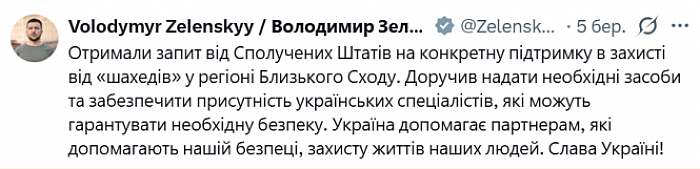
By the way, this Ukrainian aid is claimed to have been provided extremely quickly. While the US has reduced all aid to Ukraine over the last year and sometimes even slowed down and halted deliveries of weapons already purchased for Ukraine (which, by the way, is happening even now), Ukrainians responded immediately. For example, as early as March 1, the British stated that Ukrainians had already set out to help them.
Ukrainians are not foolish and operate under two considerations. Firstly, they have the ability to influence the USA. Over the past year, the United States has openly exploited Ukraine and treated it absurdly. Moreover, the Trump administration, forced to accept Ukraine’s assistance, may find it harder to so openly attempt to impose Putin’s desires on Ukrainians. Secondly, providing such assistance will help Ukraine in Europe and further demonstrate to Europeans how crucial Ukraine is for their future security.
Ukraine is showing Europe an area where it can become a global leader.
But this concerns the future. The main thing is that last week it was Ukraine that came to the aid of the USA, which found itself in a difficult situation, precisely at the moment when the American government once again insulted Ukrainians, who continue to fight for freedom.
The week when the USA supported Russia
Of course, the Trump administration does not admit that it miscalculated and was forced to ask for help from Ukraine. Assisting Putin and Russia is so deeply rooted in their thinking that they cannot openly speak about Ukraine’s strategic value. Therefore, while Ukraine was assisting the USA, the USA was providing significant support to Russian military actions on all fronts.
This happened in three ways. The first two are oil prices and the Trump administration providing political and diplomatic cover to the Russians, who at the same time are helping Iranians kill Americans. There was also a depletion of US air defense stocks, which likely means that Ukraine will receive much less in the future.
Since this is so shocking, we must start with the fact that the US government is protecting Russia at a time when Russians are helping Iranians kill Americans. The Washington Post first reported last week that the Putin regime is helping Iranians target American armed forces, particularly American military ships and aircraft.
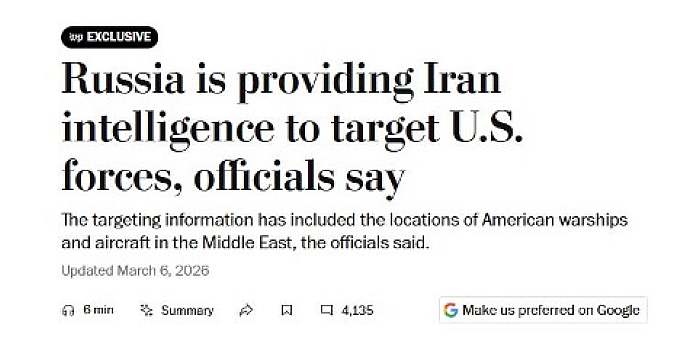
Under normal circumstances, this would provoke a furious reaction from the US government, which would threaten to take action against Russia if the Russians did not stop their actions. However, to my surprise, the Trump administration immediately came to the defense of Russia’s actions. They clearly articulated and disseminated the position that Russia’s actions were not serious.
By the way, I expected them to simply ignore this story and hope it would be forgotten, but in fact, they actively began to defend Russia.
The first to defend Putin was Levitt. In a press statement, she expressed what is usually considered a terrible excuse: the Russians allegedly had the right to help Iran attack Americans because the Iranians were suffering defeats.
“Frankly, whether it happened or not doesn’t matter much since President Trump and the US armed forces are completely destroying the criminal Iranian terrorist regime. Today we are on the sixth day of Operation ‘Epic Wrath.’
Next was Trump himself. When a very friendly and loyal Fox News host asked him about this story (in the most gracious manner), Trump couldn’t help but exclaim: “I respect you a lot. You’ve always been very nice to me. What a stupid question.”
And Defense Minister Ghegset joined the conversation, saying that Russian attacks on his department’s military are actually not a cause for concern. “We’re not worried about that (the Russians helping the Iranians)… The only ones who should worry now are the Iranians who think they’re going to survive,” he said.
It’s surprising to see the US government’s top officials immediately rush to defend Russia when the Russians are helping Iran kill Americans. If the US defended Russia in this case, they also significantly helped the Russians economically, particularly concerning oil prices and sales. The cost issue was simple. By engaging in military actions on one of the most important oil transport routes, Trump caused nearly a 50% increase in crude oil prices in just a week. The price rose from a little over $60 a barrel to over $90 in just a few days. Here’s a chart for the past month where you can see the impressive growth that started a week ago.
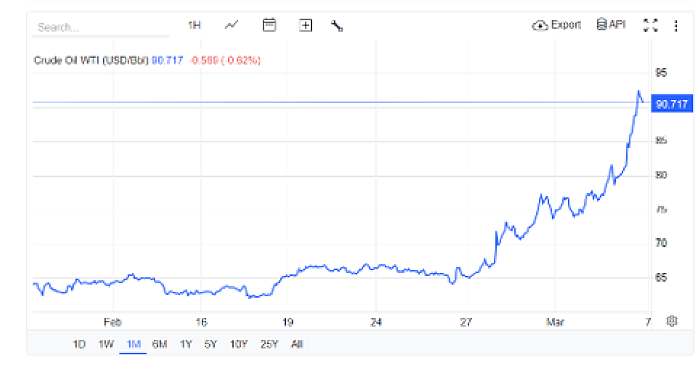
This became a significant and much-needed boost for Russian revenues, as the drop in oil prices over the past year had hit them hard. But that’s not all. To appease the Indians, the U.S. effectively lifted their weak sanctions on the purchase of Russian oil, aimed against India (which were only marginally useful anyway). And although this step was called “temporary,” there is no guarantee that even the previous weak sanctions will be reinstated.
Though not currently discussed, all of this will also help Russia earn much more money from China. The Chinese were major buyers of Iranian oil, which was sanctioned, and they will need other sources of supply. Now they are also buying record volumes of Russian oil. Though not openly discussed, since the Trump administration imposed “sanctions” on Russian oil, the Chinese have significantly increased their purchases from Russia and treat the American sanctions with the disdain they deserve. Now that Iranian supplies are blocked by war, the Chinese will almost certainly decide to buy even more Russian oil.
Put all this together, and you get a much larger volume of oil sales at much higher prices for Putin, thanks to the decision of the United States government.
I will briefly mention the last aspect. The U.S. is depleting its air defense reserves at an alarming rate. Since February 28, there is a reliable estimate that the United States and its allies have fired over 800 Patriot missiles (worth $2.4 billion) at Iranian targets. This extraordinary level of use is almost as many Patriot missiles as have been provided to Ukraine and fired since the beginning of the full-scale invasion. It is certainly much more than Ukraine could have used against the massive Russian air campaign in the winter of 2025–2026. What Trump is doing now is ensuring that Ukraine will have far fewer Patriots in the future.
The result is that Trump’s decision to attack Iran became an economic, political, and military win for Russia at a time when the Russians desperately needed help. There will be a discussion about how much this could have influenced the thinking of the Trump administration. I know some people who think this is entirely coincidental. I am inclined to think it was an additional factor. Trump knew it would help Russia, and that strengthened his desire to act. So, while he did not start bombing Iran to help Putin, it was an additional bonus in his reasoning.
Add all this together, and we have an extraordinary moment. It was the week that Ukraine stood up for the U.S., and the U.S. stood up for Russia.
Think about it.
Ukrainian Territorial Gains and Russian Personnel Losses in February
As I’ve repeatedly told my regular readers, in the past two years, the situation on the ground in this war has changed little in a historical sense. The Russian successes, which the press proclaimed as an inevitable march to victory and analysts, who truly do not understand the essence, considered a sign that Ukraine was on the brink of collapse, were historically insignificant and achieved at a high price. As I have noted, from a historical standpoint, what the Russians have “achieved” is usually viewed as a sign that they are stuck in a strategic quagmire.
Therefore, I don’t think we should react too dramatically to the news from the second half of February. The front line has also shifted relatively little — in fact, almost unchanged. However, something interesting happened: when the dust settled, Ukraine liberated more territory than the Russians captured. The best report on this was given by the Institute for the Study of War, which, unlike many analysts, does not regularly overestimate Russia’s military capabilities. Here is the report and their findings.
According to ISW, since January 1, 2026, Ukrainian forces have liberated approximately 257 sq. km of territory. From February 14 to 20, Ukrainian forces achieved a net gain of nearly 33 sq. km, and from February 21 to 27, they recorded a net gain of approximately 57 sq. km.
“The last time Ukrainian forces achieved a net territorial gain was during the counteroffensive in the summer of 2023, when in June 2023 Ukrainian forces liberated 377 sq. km, in July 2023 – 257 sq. km, and in September 2023 – 1.47 sq. km,” the report states.
Meanwhile, the founder and president of ISW published an article in the Washington Post detailing the situation. You can read it in full here.
Ukrainians are liberating more territory than they are losing, and they continue to inflict significant losses on Russian troops. Zelensky detailed this issue on March 3.
Indeed, Ukrainians are beginning to feel that their strategy of reducing the number of soldiers on the front and using machines (primarily drones) to inflict, as they hope, intolerable losses on Russian troops, is justified. This choice by Ukraine has been criticized for years by Western analysts, who spoke of a human resource crisis for Ukraine on the front line and warned that if Ukrainians did not recruit more young people and send them to the front, it could lead to collapse.
Ukrainians disagreed with this and currently believe they were right.
The best argument in favor of the fact that Ukrainians are right? Western analysts talk much less about the human resources crisis in Ukraine, and leading newspapers do not write about what is happening on the front lines. Their narrative for the past two years has serious flaws, so they remain silent.
Perhaps this is the best we can hope for.
The Rot is Real – and There’s More
My latest article, published in The Atlantic, caused a bit of a sensation, as well as some resistance. The central idea of the article is to show that during the Trump era we are seeing early signs of decay in the military and diplomatic capabilities of the US, highlighted by Trump’s ongoing decision to bomb Iran.
The standard objection to my thesis was that mistakes during war are the norm, and that the US made some at the start of the bombings means little. This is certainly an argument worth considering, though it completely ignores half of the article devoted to the diplomatic decay the US has inflicted upon itself.
Nevertheless, what we see only in the first days of the US bombing of Iran is not the usual fog of war. I would say it is unprecedented. We have witnessed perhaps the worst incident of friendly fire in recent US history, the worst formulation of military goals, the worst economic and industrial preparation for war, and, tragically, what might well turn out to be one of the worst war crimes in US history. To have only one of these phenomena at the start of a war would already be a failure, and to have all of them together…
I decided to lay out the arguments in more detail. The article in The Atlantic, due to space constraints, only touched on the problem superficially. There are many other signs of decay and its causes, and I decided that they should be outlined here.
Causes of the Decay
The main causes are twofold: corruption and the replacement or loss of competent people in favor of incompetent loyalists and fanatics. Corruption is now endemic at the top of the American government — so much so that even publications that support Trump are starting to get nervous about it. Corruption at the top always trickles down. When it becomes open and acknowledged, it breeds corrupt and negligent actions throughout the system. The acknowledgment by Kristi Noem that she awarded a massive no-bid contract worth hundreds of millions to an acquaintance is just one recent example.
Want an example of what happens to corruption and the military over time? Look at Putin’s armed forces when he threw them into Ukraine during the full-scale invasion in 2022. Although the analytical community amusingly told us about the eradication of corruption in the Russian armed forces, it was nonsense. Corruption was everywhere — from rotten food to logistics and explosive protection that lacked actual explosives.
The second point is even more direct. The Trump administration, upon taking office, appointed an incompetent Secretary of Defense and dismissed outstanding senior officers, including the Chairman of the Joint Chiefs of Staff, C. Q. Brown. This initiated what can be described as a mixed voluntary-compulsory purge of independent thinkers. Some people were dismissed, like Brown, others understood the direction of the wind and left on their own. Even more simply stayed but refused to take initiative out of fear of repercussions.
It is worth adding that I witnessed this intellectual demise up close. Over the past year, I have had invitations to speak at several events or participate in Pentagon-funded conferences withdrawn. People are afraid.
And when to the dismissal, loss, or silencing of great individuals in favor of loyal incompetents (or religious fanatics in some cases) you add the blatantly anti-intellectual campaign of the US Secretary of Defense, you create a culture in which people fail. It’s that simple.
Thus, the reasons for the rot are obvious.
Evidence of the Rot
The article only scratched the surface of the problem. Here is an overview of what I have seen and what causes terrible concern. And I would like to note that this campaign is precisely the one that the US chose unnecessarily and for which they had more than enough time to prepare. This time includes not only the last two months when the Trump administration began moving aircraft carriers and planes into the region, but it actually dates back to last spring when the United States began preparing and then joined the initial Israeli bombing campaign of Iran. This is at least nine months during which the US should have started accumulating intelligence, rehearsing procedures with allies, and assessing their military-industrial needs for such a campaign as we are now observing.
Instead, what did we see?
- The Costliest Friendly Fire Incident in Modern US History. It is reported that a Kuwaiti plane shot down three modern American F-15Es. This is shocking. Again, the US had months (and in Kuwait’s case, years) to work out procedures to prevent this. This is not a common mistake. I searched and cannot find any instance of the United States losing an aircraft to friendly fire during the entire Operation Desert Storm in 1991 (if anyone can find such a case – please let me know). Since then, there have been isolated cases of losing one aircraft, but never three such modern machines simultaneously during what was supposed to be a well-prepared campaign.
- The Most Incompetent Military-Industrial Preparation for War in US History. Guess what? Cheap drones are a reality, and they need to be effectively shot down. One had to live in a cave for the last four years not to know this, but it seems the Trump administration and the US Department of Defense didn’t learn this lesson. The US began spending expensive anti-aircraft resources at such a rate that they were shocked themselves when the campaign began. Only after that did Trump convene industry leaders for a panic meeting demanding increased production. The US preparation was so weak that they had to ask Ukrainians for help – which President Zelensky tweeted about. This is a stunning failure for the supposedly best army in the world.
- The Worst Formulation of Strategic Goals in US History. I’ve written much about this. However, it should be noted that since then there has been no clarity on what exactly the US hopes to achieve. Is “regime change” a key goal? I still don’t know. It was forgotten for a few days, but then Trump demanded to have an influence on the choice of any new Iranian government.
- Possibly One of the Worst War Crimes in US History. I have been concerned about this for some time. From the very outset of the American campaign, there have been credible reports that a girls’ school in southern Iran was hit, and possibly more than 100 Iranian schoolgirls killed. And it increasingly looks like this was the result of an American strike. If true, there is no excuse. Yes, there have been intelligence failures, such as the US bombing of the Chinese embassy in Belgrade in 1999. But that was not an initial strike in a seemingly well-prepared campaign, and today the US has even better surveillance tools. Sure, the school was near a naval base, but American munitions are extremely precise. Distinguishing a school from a military base today is not difficult. Sorry, but it is, at best, horrible incompetence, and if it was an American strike, it is a major crime.
- The Use of the US Military as a Quasi-Mercenary Force. I always laugh grimly when people call me a neoconservative interventionist. Nothing could be further from the truth – especially regarding the Middle East. Shortly after October 7, 2023, I wrote an article calling for the withdrawal of as many American forces from the Middle East as possible, and since then my confidence in this has only grown. I initially supported helping Ukrainians because they were willing to fight on their own. I believe that American interventions, where the US fights instead of other countries, almost always end in disaster. I talk a lot about this in “War and Power.” I don’t know why Trump eventually decided to bomb Iran, but it seems…
- It becomes apparent that pressure and incentives from Arab states and Israel helped convince him to put American soldiers at risk. I cannot understand how this war aligns with the interests of the USA, but it seems to serve the interests of Saudi Arabia and Israel. Such treatment of the US army leads to its degradation.
This is just some of what we have seen today. There was, in particular, a disturbing example of extreme religious fundamentalism and apocalyptic ideology from the Bible that clearly unfit American officers are imposing on the US armed forces. Moreover, there are ongoing worrying failures in American diplomacy caused by incompetence in allied diplomacy over the past year.
And all this – in less than a week. That’s a lot of rot.
