
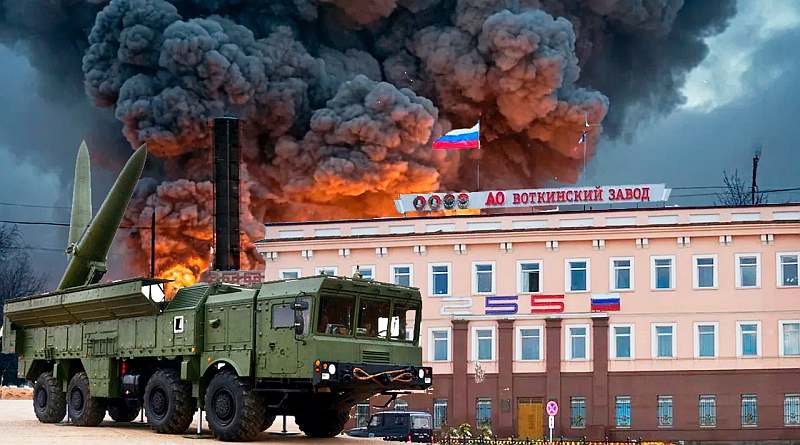

While Slovak-Hungarian deviants threaten to cut off Ukraine’s money, light, and fuel, routine work is underway to bring peace closer.
1. Ukrainian missiles that supposedly don’t exist have indeed visited the “Votkinsk Plant” (Votkinsk, Udmurtia; 40 km from Izhevsk), where the Russians produce a wide range of components for their missile sword and shield. Mainly – the sword, means of air attack.
The consequences of this attack are multidimensional.
Everyone who has been to Soviet military factories knows that seriously damaging them, even with a series of missile strikes, is difficult. Nevertheless, even a pinpoint strike can disable irreplaceable equipment, which for some time will slow down/stop production. This is on the surface.
But indirect costs also instantly increase.
The strike was carried out yesterday. And today, within a radius of 100 km from Votkinsk, plan “Carpet” was preventively introduced, closing the Izhevsk airport. Public events for Maslenitsa have been canceled. Because the Russians understand: if they hit once, they can continue to hit the vulnerable spot.
The configuration of the air defense system in the Izhevsk-Votkinsk area is known to those who need to know. The Russians will now frantically try to somehow strengthen it. The question is – what reserves do they have for this?
Leaving gaps is unacceptable. Because there is not only this – truly super-important – plant, but also nearby on the route is the Kalashnikov concern. And within the radius – there is plenty of critical infrastructure.
This region was previously considered relatively protected. Therefore, it’s not a fact that something can be quickly strengthened or reorganized in terms of protection. This means they will increase administrative measures to ensure safety, engage the “better safe than sorry” mode, which always leads to a slowdown.
But these are tactical difficulties. Strategic ones are no less interesting.
Firstly, potentially this is the longest documented cruise missile strike, which immediately changes the requirements for the missile defense system. For Russia, this means a lot more money is needed.
Secondly, before 2022, it was unimaginable that anyone would dare to attack one of the key centers of the Kremlin’s missile construction. But now it has become possible and, as practice has shown, technically achievable.
Therefore, everyone who considers Russia a threat or competitor has a skyrocketing temptation to break everything there to the maximum. Because it’s not only strategic missiles there, but also operational-tactical ballistics that can threaten European capitals from Belarus and Kaliningrad. Specially trained people in Moscow are obliged to think about this and press alarm buttons.
Thirdly, in Europe, there is now a growing discussion about their own ballistics and other offensive missiles. For Germany, this topic was no less taboo than nuclear weapons. But if nuclear weapons are a completely red line, then there is no such thing regarding ballistics. Everything is as realistic as possible.
The Germans have been focusing on air defense systems for decades, which is why there are things like the Iris-T and the purchase of Patriots. Additionally, a discussion has begun about a European missile launch early warning system.
At the same time, the French conglomerate ArianeGroup has already entertained the idea: if we know how to launch peaceful rockets into space, maybe we should start making ground-based ballistic missiles? The French are ready. But as always, they are increasing the price, saying it will take money and several years.
The Germans are interested, but their experience in Ukraine shows them that there is no need to produce “Rolls-Royces” among drones and missiles. It’s necessary to produce a lot of effective weapons at a reasonable price and quickly.
Russians might suddenly realize that their strikes on Ukraine have triggered missile activity not only in Ukraine but also among those with whom it’s technically very difficult to compete. The grandchildren of the creators of the V-2 and other marvels are going through a phase of de-tabooing and will not miss this opportunity. And you can’t put that genie back in the bottle.
2. Special Operations Forces reached the Neftegorsky Gas Processing Plant in the Samara region. There were explosions and smoke. No emphasis on what caused it yet, only missile rumors.
There’s some fire at the “Electrovipryamitel” plant in Saransk (Mordovia).
3. The Special Operations Forces excited with beautiful video of the destruction of a Tornado-S MLRS in the temporarily occupied territory of Zaporizhzhia region. This is a rare expensive beast. Russians use it to shell Kharkiv because the distance is up to 120 km.
Why did they reach it? My hypothesis is that recently in the temporarily occupied territory of Zaporizhzhia region, the tactical zone air defenses have been significantly reduced. Therefore, middle-strike drones began operating in the tactical and operational rear of the Russians. This is evidenced by dozens of videos of strikes on ammunition depots, logistics, locations, and more. As I have noted, this is our asymmetric response to HIMARS, for which there will never be enough missiles.
4. Additionally, the General Staff reported that there was considerable nervousness in Crimea.
In Yevpatoria, Ukrainian Defense Forces reached two Be-12 aircraft, which will complicate the Russians’ fight against our naval drones.
In Inkerman, damage was inflicted on project 22460 “Hunter” patrol border ships. And rightly so. They shouldn’t be patrolling there at all.
Additionally, another oil depot tank in Hvardiyske was hit.
In three weeks of February, the Special Operations Forces took down 6,200 occupiers, of which 3,500 were killed.
5. The SBU published a weekly report.
SBU fighters eliminated about 2000 occupiers from the “special military operation,” as well as:
• 3 tanks and 4 armored fighting vehicles;
• 16 artillery systems and 4 MLRS;
• 3 air defense systems and 2 electronic warfare systems;
• 231 vehicles;
• 17 enemy NKR;
• 4 ammunition depots and 4 fuel and lubricant depots.
I think, politically, something will be resolved with Orbán and Ficó. But the resentment will remain. The villains were encouraged after Rubio’s visit. But they live in Europe, and rely on EU budgets…
The time will come to adequately assess the role of these characters. Meanwhile, we try to see not only the bad.
Collage: MixNews
