
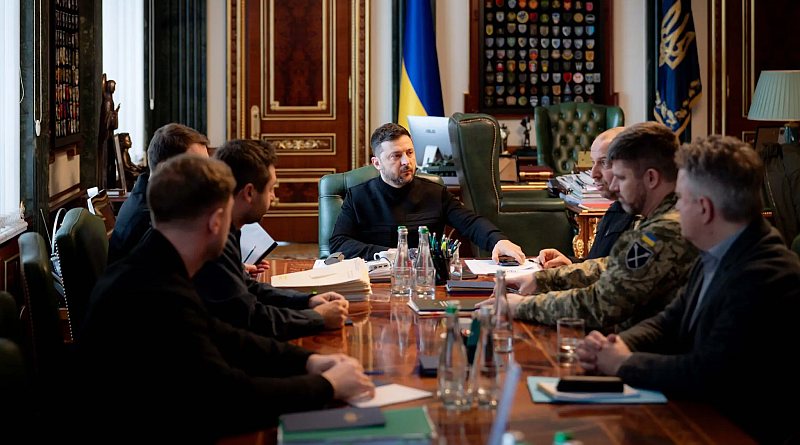

Responding to journalists’ questions, Zelensky explained staffing changes in the Office of the President as a bet on a “single negotiation track,” which is thus meant to be strengthened.
“For a long time, I formulated how to reach plan ‘A’ and ‘B’. Plan ‘A’ – negotiations and peace, plan ‘B’ – a prolonged negotiation track, meaning the strengthening of the defense, military component… I gathered in the Office, a very close team of people who are engaged in negotiations or who potentially can do so. By this, I showed that there will be only one communication from Ukraine, there will be ‘one boat,’ one negotiation direction, not three or four, or more. These were important corresponding steps,” Zelensky noted.
“Kyrylo Budanov accordingly became the head of the Office, Rustem Umerov the Secretary of the National Security and Defense Council, he also spends a lot of time in the Office because his work involves tasks that I assign him, and the head of the faction, Davyd Arakhamia, is also actively involved because it’s important for everyone to understand the mood of the parliament,” he added.
It all seems logical. At least, the winners of the current backstage competition around Zelensky are named individually. They even came up with a beautiful legend as to why all this was done – instead of stopping with the nonsense and going on to form a coalition and unity government.
However, if we delve into what was said, several disappointing conclusions can be drawn.
Before Zelensky was forced to dismiss Yermak under pressure from corruption accusations, his ‘plan A’ and ‘plan B’ was one – Yermak himself.
This “universal soldier,” or shaman on a budget, was ready to both negotiate a quick peace and ensure a “prolonged negotiation track” in case the war continued. Now, several people have to replace one Yermak.
Until the last moment, there was no “single voice” in the negotiations, and the negotiations were conducted along several negotiation directions simultaneously. It’s interesting, what are these directions?
Until this time, the Office of the President had deeply disregarded the position and “mood” of the parliament. Only now has it become so important that the head of the monomajority faction has been included in the negotiation group.
Negotiations were not a priority since, according to the president himself, he conceived to strengthen the “negotiation track” only now.
Therefore, the logic that Zelensky himself offers the public seems much less convincing than it might appear at first glance. If negotiations and peace really were “plan A,” then why has the entire architecture of the negotiation process only begun to take shape now, in the fourth year of full-scale war?
Why does the “single voice” appear only after Yermak’s resignation, and the parliament suddenly becomes (and actually does not become) “an important element of negotiation logic”? It seems that it is not about a strategically thought-out state course, but an attempt to retrospectively arrange a chaotic system of decisions, personal channels, and backstage agreements that have long existed without proper democratic control or public accountability.
In this situation, the key question is not the names of the new negotiators or the beautiful formulations about “one boat,” but whether the authorities are finally ready to transition from personalized diplomacy to institutional politics, where negotiations rely on a clearly defined position of the state, a mandate from the parliament, and transparent communication with society.
Without this, any “single negotiation track” risks remaining just a rhetorical construct, intended to mask the belated acknowledgment of the obvious: negotiations cannot be the improvisation of a narrow circle of individuals.
