
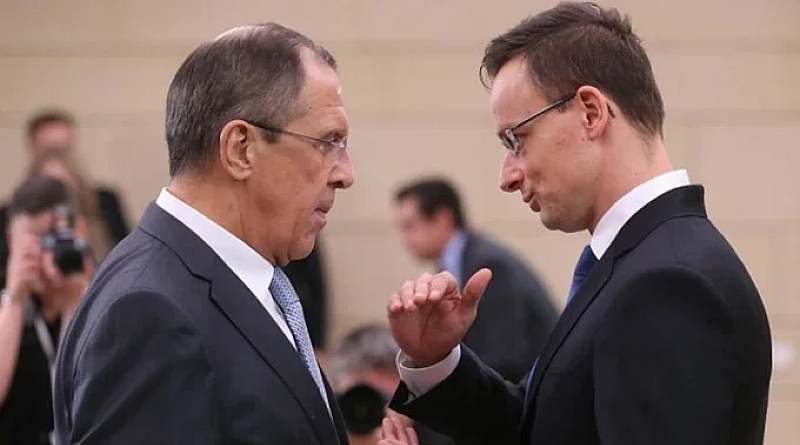
The European publication Politico claims that the EU is forced to restrict Hungary’s access to confidential negotiations due to suspicions that the Orbán government is passing secret information to Moscow. The publication emphasizes that Hungarian Foreign Minister Szijjártó allegedly informed Lavrov in real-time about the progress of closed EU Council meetings. Despite the seriousness of the accusations, Brussels’ formal response is postponed until the Hungarian elections on April 12 to avoid influencing their outcome. As noted by the publication, the scandal intensifies the longstanding conflict between Budapest and its EU partners and once again raises doubts about Orbán’s Hungary’s compatibility with EU principles.
The Hungarian foreign minister has been accused of passing information from closed negotiations to Moscow, writes the European publication Politico. According to it, the EU is currently restricting the flow of confidential materials to Hungary, and leaders are holding meetings in a narrower circle, while Polish Prime Minister Donald Tusk warned of longstanding suspicions that Viktor Orbán’s government is sharing information with Russia.
However, there will be no formal EU response to the new accusations due to potential influence on the Hungarian elections on April 12, five European diplomats and officials told Politico, expressing concern about the risk of Budapest leaking sensitive information to the Kremlin.
“The news that Orbán’s people are informing Moscow in detail about EU Council meetings should not surprise anyone,” Polish Prime Minister Donald Tusk wrote on Sunday in X, supporting Hungarian opposition leader Péter Magyar in the elections. “We have long had such suspicions. This is one of the reasons why I only speak when absolutely necessary, and I say only as much as necessary,” he added.
Washington Post reported that the Orbán government maintained close contacts with Moscow throughout the entire war in Ukraine, and Foreign Minister Péter Szijjártó informed his Russian counterpart Sergey Lavrov during breaks in meetings with representatives of other EU member states.
Fears that Hungary is directly passing information to Moscow have led to the spread of meetings in a narrow circle among like-minded leaders instead of sessions involving all 27 EU members, said one European government representative.
“In general, it is the less loyal member states that are the main reason why most important European diplomacy now takes place in various smaller formats – E3, E4, E7, E8, Weimar, NB8, JEF, etc.,” the official explained.
The numbers indicate the number of European leaders in the group. The Weimar format includes France, Germany, and Poland. NB8 is eight Nordic and Baltic countries. JEF is the Joint Expeditionary Force of ten Northern European countries.
“Fake News”
Former Lithuanian Foreign Minister Gabrielius Landsbergis, who was often present at Council meetings attended by Szijjártó, told Politico that back in 2024, he was warned that the Hungarian side might be transmitting information to Russia, and therefore he and his colleagues limited the amount of information they shared in his presence.
On the eve of the critically important NATO summit in Vilnius in 2023, country representatives decided to exclude Budapest’s delegation from sensitive negotiations, Landsbergis noted.
“We spoke only within formal frameworks and then stepped out to discuss without Hungary what could realistically be achieved at the summit,” he explained.
The Bucharest Nine, a club of countries on the eastern flank of the military alliance, reportedly considered excluding Budapest from this format next year due to its inability to agree on supporting Ukraine.
Hungarian Minister for European Affairs János Bóka told Politico that the reports, which surfaced over the weekend, are “fake news” designed as “a desperate reaction to the Orban party Fidesz gaining momentum in the election campaign. But the Hungarian people will not be fooled”.
For his part, Szijjártó refuted the contents of the Washington Post article and accused the media of spreading “conspiracy theories, more absurd than anything seen before”.
In light of new accusations, even more information might be concealed, one diplomat revealed. “There are arguments for the EU to classify information and documents”, the diplomat stated. Although using secrecy “is not a universal solution”, it could “serve as a deterrent against leaks and the transmission of sensitive information to third parties. It would also make investigations more automatic”.
No Surprises
Five diplomats said they were not surprised by this information, but any formal response would depend on whether Orban is re-elected in April. Despite lagging behind the Tisza party in polls, the Hungarian Prime Minister told Politico on Friday that he “definitely” could secure another term.
“It undermines the trust, cooperation, and integrity of the European Union,” the second diplomat commented on these accusations. “It’s a disgraceful situation. If he remains after the elections, I think the EU will have to look for other ways to respond”.
Another interlocutor warned that whatever the EU and its leaders do, Orban will use it to his advantage in the campaign. “I don’t think anyone is eager to do something that could pour oil on the fire before April 12,” he noted.
Despite a broad understanding of the threat from Russia, the fourth diplomat remarked that the content of discussions between leaders and foreign ministers regularly leaks to the press, and the meetings themselves often take place in an unprotected format, meaning leaders do not leave phones outside the room to minimize the risk of eavesdropping. However, the very appearance of an EU government working so closely with a hostile state remains politically explosive, the publication notes.
“The fact that the Hungarian foreign minister, a close friend of [Russia’s foreign minister] Sergey Lavrov, was practically reporting to the Russians in real-time about each EU meeting is a blatant betrayal,” said Magyar at a pre-election rally over the weekend. “This person has betrayed not only his own country but also Europe.”
These allegations emerged as Orbán’s foreign allies headed to Budapest to assist him in the final stage of the election campaign. Polish President Karol Nawrocki, a political rival of Tusk, will participate in events on Monday, and U.S. Vice President JD Vance will arrive ahead of next month’s voting.
Politico reminds that Orbán refused to approve €90 billion in urgently needed loans for Ukraine at the European Council summit on Friday, which prompted an intense reaction from other leaders.
“It wouldn’t be surprising if this proves to be true,” said a fifth EU diplomat about these accusations. “Hungary has long been an ally of Putin within the EU and continues to undermine European security. The blocked €90 billion is just the latest example of this behavior pattern.”
