
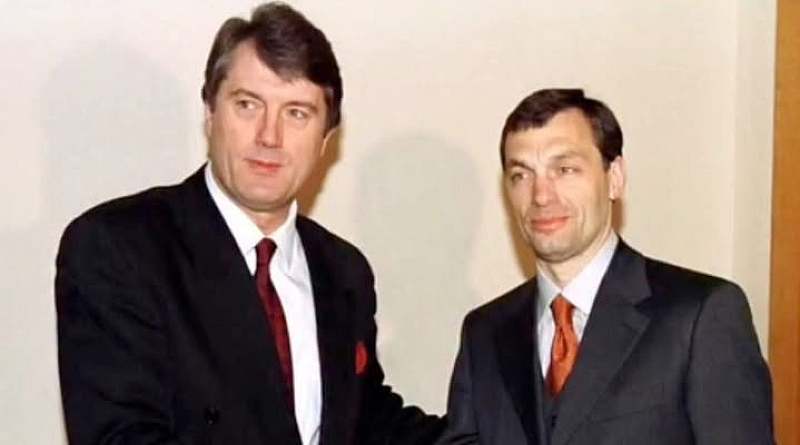
After the scandal in Hungary with the seizure of Ukrainian cash couriers along with their vehicles and money, Viktor Yushchenko addressed an open letter to Viktor Orban, who was the prime minister of his country for the first time when our future president held a similar position, but in Ukraine.
The issue is not even what Orban replied to this bitter letter from his former negotiation partner and—no denying it—political ally. The issue is that Orban to whom Yushchenko is appealing does not actually exist—not even from the perspective of political views and morality. That “first” Orban does not exist institutionally.
Viktor Yushchenko met with the head of the government of the Republic of Hungary. Today, Viktor Orban has headed the government of Hungary for 16 years—they officially abandoned the name “Republic of Hungary” in the neighboring country. One might say that Ukraine also doesn’t have this word in its name, which does not prevent our country from remaining a democratic republic. But the issue is not even in the name as such, but in the essence.
After his return to power, Orban deliberately and confidently engaged in the dismantling of republican institutions. First, he changed the electorate composition by extending voting rights to all ethnic Hungarians—thus turning his small country into the political successor of the Kingdom of Hungary before Trianon. Second, he introduced references to God and the Christian faith in the Constitution—symbolically, it references traditions but changes the very nature of the modern state. Third, he diminished the role of the state president, the parliament, the judicial system, the free media, and effectively became similar in influence on decision-making to the pre-war regent of the Hungarian state, Admiral Miklós Horthy, whose numerous monuments started appearing in Hungarian squares just after Orban returned to power. And yes, after this return, Orban spoke of an “electoral revolution”—and he was not lying. In fact, his FIDESZ returned to power and formed a constitutional majority as a party of new people who opposed the tired corrupt nomenclature, former communists, the self-absorbed and incomprehensible to the “ordinary person” liberals—all those who formed governments and contributed to changes in the abolished republic.
Thus, among all European politicians of recent years, the closest analogue to Viktor Orban is not Viktor Yushchenko.
The closest analogue to Viktor Orban, his political brother, is the one he hates the most, whose posters he has put up all over Hungary, whose name he uses to scare his voters—especially after they promised to inform the Ukrainian military of his address.
The closest analogue to Viktor Orban is Volodymyr Zelensky. If you look closely, he is almost our Orban.
Zelensky also carried out a real electoral revolution against the existing political elite (who came to power after the real Revolution of Dignity in 2013–2014, not a revolution invented by Zelensky, just as the Hungarian elite came to power after the real anti-communist revolution of the late 1980s, not a revolution invented by Orban). Zelensky didn’t need to rename the country, but he also stripped it of the essence of republicanism after the party formed under him effectively nullified the functions of the parliament and the government, when independent media began to lose their role amid the war, and judicial procedures were replaced by a sanctions mechanism. As in the case of Orban, key positions were occupied by people linked to the first person or completely loyal to his desires. And thus, the conflict between Ukraine and Hungary is a conflict of mirrors.
The difference is that Orban governs a state that lost its imperial lands (but not its imperial mindset) and formed after territorial losses during the world wars—so he can afford, while remaining in Europe, to create special relationships with Putin, Trump, and Xi Jinping. And Zelensky governs a state that was enslaved by empires and is currently going through a period of territorial losses and asserting its own sovereignty—so he cannot afford relations with authoritarian rulers who try to deny him subjectivity and question the very existence of the country he leads. Moreover, Orban’s dependence on Europe is financial only. But Zelensky’s dependence on Europe is a question of survival not only of his power but of the state itself.
Therefore, despite the process of dismantling the republic, which only intensified for us during wartime, Ukrainians have every chance to return to republicanism, and thus to responsibility, even with Zelensky as head of state. Paradoxically, a similar chance for the first time in the last 16 years has also appeared for Hungarians—but, of course, without Orban.
