

Anastasia Zanuda, BBC News Ukraine
The fifth year of the war will be decisive for millions of Ukrainians who went abroad during the conflict. This year, their conditions in Europe — and not only — will significantly change. Therefore, many who were hesitating will have to make a choice: to stay or return.
We tell how and who among Ukrainians can stay abroad, as well as why and how many will return to Ukraine.
Five years is enough
A week after the start of the full-scale Russian invasion of Ukraine, on March 4, 2022, the EU decided on temporary protection, which allowed millions of Ukrainians — mostly women and children fleeing the war — to be accepted.
At that time, few probably considered the bureaucratic nuances of this decision, which were only appreciated later — the ability to legally stay in EU countries for a long time, work, have access to healthcare, education, and social services.
Each country provided for these rights in its own way within the framework of the joint European decision.
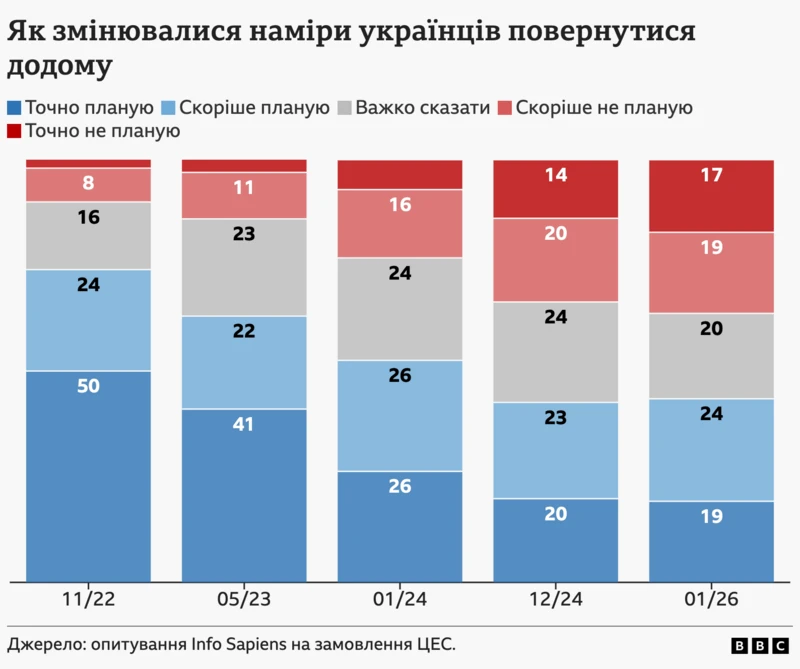
The main point was protection. But back in 2022, three-quarters of Ukrainians abroad said they planned to return to Ukraine.
However, in the second half of 2025, the emphasis changed: Ukrainians were reminded that from the very beginning, it was about the temporary nature of this protection. Yet now only 43% consider returning to Ukraine, and 17% say they definitely will not return.
At least these figures were obtained during the fifth wave of research conducted by the Center for Economic Strategy (CES), which has been studying the conditions and moods of Ukrainians abroad for several years during the war.
During this time, much has changed, including how Ukrainians who ended up abroad during the war are referred to — from refugees and escapees to war migrants and even the diaspora.
In September 2025, the EU Council finally adopted new Recommendations for a coordinated approach to the termination of temporary protection for displaced persons from Ukraine.
Legally, the possibility of its extension remains, but politically and practically, this is unlikely to happen, they say in Brussels.
On March 5, 2026, EU countries began negotiations on the future status of Ukrainians after the expiration of the directive on temporary protection.
What this status might be is currently unknown. As Commissioner for Internal Affairs and Migration Magnus Brunnes stated, this has just begun to be discussed. Not discussed, as it seems, is only the winding down of temporary protection.
“Temporary protection — as the name suggests — is temporary protection, so we need the next plan after March 2027,” the Commissioner stated.
The EU Commission’s special envoy for issues concerning Ukrainians in the EU, Ylva Johansson, stated that she would be “very surprised if the temporary protection continued in its current form.”
“I think five years is sufficient for a temporary measure,” Johansson said.
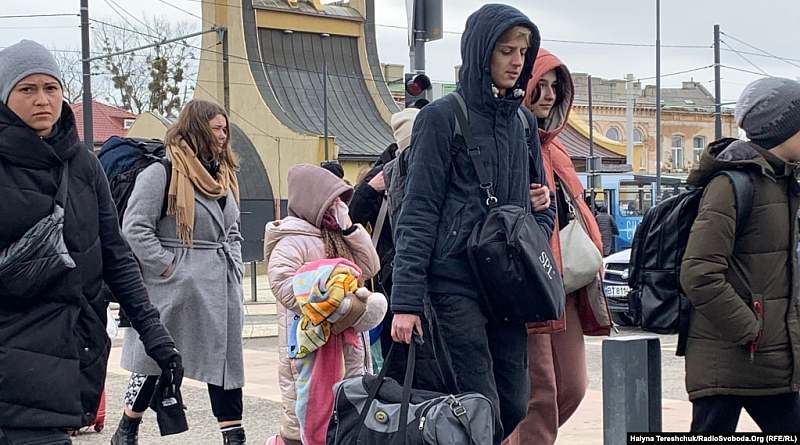
It also appears that after the temporary protection ends (or even before), Ukrainians wishing to stay in Europe will need to formalize their stay based on general grounds.
These grounds could include employment — local contracts/entrepreneurial activities, student visas, or other forms of long-term residence legalization that exist in each individual country or jointly in the EU.
Therefore, in a year — at the beginning of March 2027 — the temporary protection for Ukrainians in the EU is set to end. What will happen after this?
Temporary Protection in Numbers
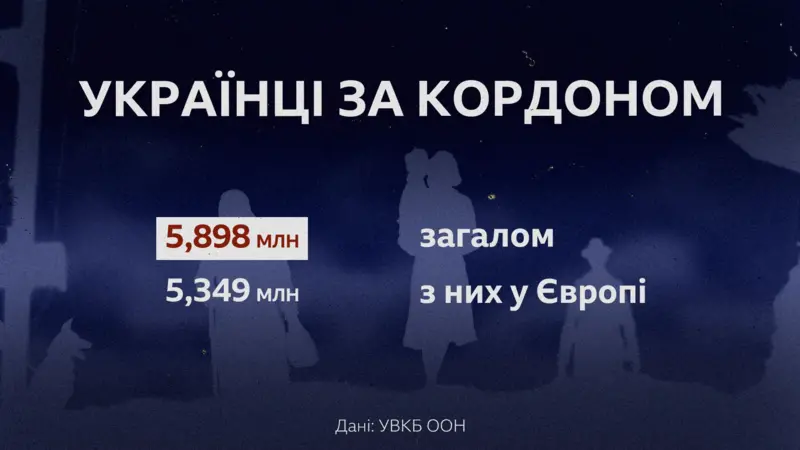
Europe took in the lion’s share of Ukrainian refugees — 5.3 million out of 5.9 million globally, according to UNHCR data.
According to Eurostat, at the end of 2025, 4.35 million Ukrainians had temporary protection in the EU.
Women (40%) and children (31%) still remain the two largest groups, but in 2025, the share of men increased from 27% to 29%.
In terms of the number of Ukrainians accepted, the leading countries are Germany, Poland, and the Czech Republic.
If counting the number of Ukrainian refugees relative to the population of countries, the top three are the Czech Republic, Poland, and Slovakia.
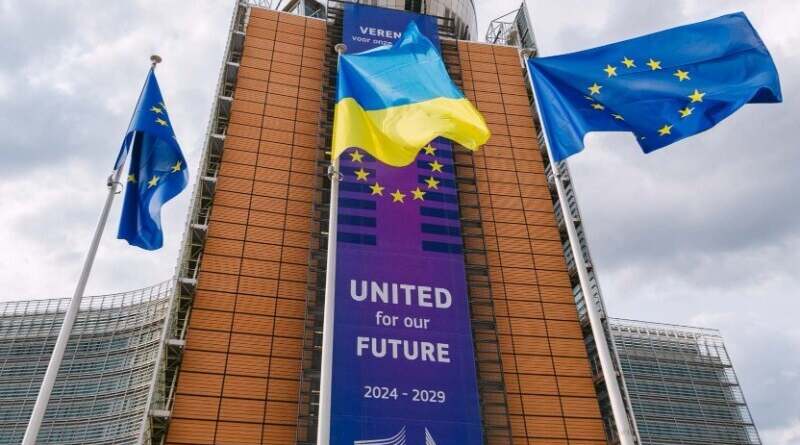
After the introduction of the temporary protection mechanism, the EU allocated about 15 billion euros to member states hosting people from Ukraine. Another 13.6 billion euros were received by EU members under the so-called “cohesion policy” of the EU.
Additionally, 1.4 billion euros were redistributed within existing funding programs to provide direct support to displaced persons from Ukraine.
In the financial period 2025–2027, the EU will allocate another 3 billion euros from the Asylum, Migration and Integration Fund (AMIF) and the Border Management and Visa Instrument (BMVI), as well as about 1 billion euros by reviewing AMIF programs of member states. Thus, the protection of Ukrainians during the war cost the EU at least 34 billion euros.
However, Ukrainians did not sit idly by — most of them work, pay taxes, and support the economies of the countries that accepted them — both as workers and consumers.
Where, how, and for how much Ukrainians work
One of the main grounds for further staying in Europe is employment.
According to a UNHCR survey, by mid-2025, the average employment rate for Ukrainian refugees aged 20-64 in European countries, including self-employment and informal work, was 57%.
Meanwhile, as noted by the authors of the UNHCR report, the results vary significantly from country to country: in Ukraine’s neighboring states, the highest employment rates are generally recorded, while in Western and Northern Europe this indicator is lower.
Countries with higher than average employment rates for Ukrainians include:
Estonia — 72%;
Hungary — 71%;
United Kingdom — 69%;
Poland — 68%;
Bulgaria — 67%;
Czech Republic — 66%;
Netherlands — 64%;
Spain — 61%;
Italy — 58%;
Lithuania — 57%.
Lower than average rates are observed in:
France — 53%;
Romania — 50%;
Moldova, Ireland, and Belgium — 46% each;
Sweden — 43%;
Finland — 40%;
Denmark and Germany — 39% each;
Norway — 37%;
Switzerland — 29%.
About 3% of refugees are self-employed or entrepreneurs.
At the same time, there is a less appealing side to these statistics. Almost 60% of working refugees from Ukraine say they work below their qualification level, and they are almost twice as likely as citizens of host countries to perform low-skilled work, according to the UNHCR.
Among refugees with higher education, over a third work in low-skilled jobs (the equivalent average for EU citizens is only 7%).
Researchers believe this mismatch between skills and employment is likely the main reason for the 40% difference in wages between Ukrainian refugees and citizens of host countries.
Yet, despite this difference, even the lowest European salaries exceed what most refugees could expect at home. Over four years, Ukrainians have become well aware of this difference—even when adjusting for the cost of living.
The minimum wage in Poland is now 4,806 zlotys (almost 57,000 UAH) per month, in the Czech Republic – 22,400 crowns (46,500 UAH) per month, in Germany – 13.9 euros (707 UAH) per hour or about 2,482 euros per month before taxes.
The largest number of working Ukrainians is in Poland, where 900,000 Ukrainians have official jobs. In the Czech Republic, about 390,000 are working, and in Germany – over 300,000.
The relatively low number of working Ukrainians in Germany is explained by several factors. On one hand, Germany offers larger social benefits than other countries. It’s no secret that a significant portion of refugees from Ukraine chose Germany specifically for these benefits. For the elderly, people with disabilities, and single mothers, these benefits have become vital support.
On the other hand, entering the labor market in Germany is more regulated than in Poland or the Czech Republic—not to mention language proficiency. Germany imposes strict requirements on diploma recognition, language proficiency, and job qualifications matching the individual’s educational background.
Despite all this, the number of employed Ukrainians in Germany is growing: from about 65,000 in January 2022, before the Russian invasion, to 373,000 by November 2025 (including those Ukrainian citizens who are not refugees). However, even among the employed, at least 55,000 Ukrainians have short-term contracts with limited income or work part-time.
Currently, according to the Mediendienst Integration portal, the employment rate of Ukrainians in Germany is 37.5%.
For those who want to stay
According to the EU Commission’s special representative Johansson, surveys of Ukrainians in Europe show that most of them want to stay. However, she states that “member states are asking for a coordinated approach, but they also say: we do not want new EU legislation in this area.”
EU legislation stipulates that the issue of migrant residency is within the national regulation prerogative of member states. This means that each country will have its own specifics for those who wish to stay.
After the expiration of the EU’s special mechanism, they will have to transition to national residence permits, and the conditions will differ depending on the country of residence.
Obviously, national residence permits will be common or similar, based on shared European principles or programs:
- employment or self-employment;
- study or scientific projects;
- family circumstances or so-called “family reunification”;
- programs for highly qualified workers (EU Blue Card).
“Those who have been here for many years should no longer have temporary protection status. They need to transition to other legal statuses,” explained the special representative of the European Commission regarding the logic of changes for Ukrainians in the EU.
According to the CES, about 20% (approximately 870,000) of Ukrainian refugees are already on a different status that allows them to be abroad. The remaining 80% (about 3.4 million people) “either intend to obtain such documents or are awaiting more information.”
Germany
In Germany, where nearly 1.2 million or up to 25% of all war migrants from Ukraine currently live, there are no plans to introduce a separate status for Ukrainians after March 4, 2027. This was stated by Hans-Ulrich Benr, head of the Ukraine group at the Federal Ministry of the Interior.
Berlin urges Ukrainians who wish to stay in the country to independently change their status. It is advised to do this now, without waiting for the formal end of temporary protection.
Available options include work and student visas, “blue cards” for highly qualified workers, marriage with German citizens, or family reunification, or obtaining German citizenship — with requirements that, obviously, very few Ukrainians can meet. However, according to legislative changes in 2024, Ukrainians no longer need to renounce Ukrainian citizenship when acquiring German citizenship.
Other changes that will occur in parallel should also be considered.
In particular, Ukrainians who arrive in Germany after April 1, 2025, may lose the right to receive Bürgergeld (“citizen payments”) and will instead be eligible only for payments under the asylum seeker program. The relevant bill was approved by the government and passed the first reading and is preparing for a second in the Bundestag.
If the changes are approved, the monthly payment for a single person will decrease from approximately 563 euros to 455 euros (almost a 20% reduction). The Ministry of Labor plans to save 1.5 billion euros on current aid to Ukrainian citizens, which is currently about 6.3 billion euros per year. According to a survey conducted at the end of 2025 commissioned by Bild magazine, two-thirds of Germans (66%) are currently against continuing Bürgergeld payments for Ukrainian refugees. Only 17% of Germans support this idea.
Simultaneously, the Bürgergeld system as a welfare payment for the unemployed is undergoing changes — on March 5, the Bundestag voted for its cancellation. From July 1, 2026, it will be called “new basic provision” for the unemployed, and the rules will be tightened to encourage people to seek work more actively. Almost half of those currently receiving “bürgergeld” are foreigners, including Ukrainians since 2022.
Germany may also limit free access to integration courses for Ukrainians. Without the applicant coordinating their applications with migration, social services, or an employer, they will have to pay 1600 euros for the integration course independently.
There is also a reduction in accommodation options for refugees: at the end of last year, it was announced that the largest reception center for Ukrainian refugees at the former Tegel airport in Berlin would close.
The attitude towards refugees is changing as well—especially towards men of conscription age. This became particularly noticeable after Ukraine allowed young men aged 18-22 to travel abroad. According to a Bild survey, 62% supported the idea of returning able-bodied conscription-age men who arrived in Germany after 2022 back to Ukraine. 18% opposed this.
According to demographic statistics obtained by DW from the German Interior Ministry, of the 1.157 million Ukrainians granted temporary protection, about 484,000 are men and about 672,000 are women. Among them, about 305,000 individuals were minors at the time of receiving protection, and 85,266 were men aged 18 to 26.
German Chancellor Friedrich Merz has publicly called on Ukrainian President Volodymyr Zelensky at least twice to ensure that new waves of young Ukrainian men do not come to Germany.
Poland
Since 2024, Poland has been discussing replacing temporary protection for Ukrainians with the CUKR status (Cudzoziemiec z Ukrainy)—a kind of hybrid special regime for Ukrainians and a “residence card” that would legalize Ukrainians’ stay in Poland for up to three years.
Several times, approximate dates for the start of electronic applications for this status were announced, but it has not happened yet. The Polish government has not repealed the introduction of the CUKR system, but the timing of its implementation is currently unknown.
Instead, changes were made to the special law on aid to Ukrainian refugees, which equate the rights of Ukrainians with other foreigners who have temporary protection in Poland, and the law itself was named the Law on the Withdrawal of Aid Decisions for Ukrainians Due to War.
“The special law of March 2022 was a response to the mass influx of refugees from Ukraine due to Russia’s aggression against the country. Almost four years later, the situation has stabilized—most adult Ukrainian citizens work, and their children attend Polish schools,” the Polish government explained. “Therefore, in accordance with the recommendations of the European Union, we are moving towards systemic solutions that will establish equal rights for all foreigners residing in Poland and save public budget funds.”
From March 5, 2026, the temporary protection system in Poland operates for all foreigners, and Ukrainian refugees will have several options: to switch to temporary or permanent residence or remain under temporary protection for another year.
Polish President Karol Nawrocki, who in the autumn promised not to sign extensions for temporary protection for Ukrainians, signed the law, although de facto it extended the legal stay of Ukrainians in Poland until March 4, 2027, as in other EU countries, albeit under stricter conditions.
For example, changes involve restricting access to free medical care for migrants without insurance,— such refugees will receive medical services under the same conditions as uninsured Polish citizens. Exceptions are possible for children, pregnant women, victims of violence, wounded military personnel, cases requiring emergency medical assistance.
Even before the adoption of this law, Poland began to limit certain types of assistance. Specifically, this pertains to changes in the single social benefit that Ukrainian refugees in Poland can apply for – child support under Family 800+.
In June 2025, it was linked to the mandatory in-person attendance at school or kindergarten by the children receiving the benefit. And from February 1, 2026, parents of the child must also confirm professional activity in Poland under an employment contract or running a business, which will be verified in the pension and insurance system registers, where social contribution payments are recorded.
According to Polish Radio, 268,500 Ukrainian citizens receive this 800+ support.
At the same time, Poland recognizes the contribution that Ukrainians make to the Polish economy.
According to the Polish Economic Institute (PIE), since 2022, Ukrainians living and working in Poland generated about 328.6 billion zlotys in additional GDP for the country’s economy. This is almost eight times the Polish budget expenditure on supporting Ukrainians and aid to Ukraine, which amounted to 40.3 billion zlotys.
In 2024, according to a Deloitte study commissioned by the UNHCR, the contribution of Ukrainians to GDP was 2.7%, equivalent to almost 99 billion zlotys of additional economic growth. It is predicted that by 2030, the share of Ukrainians in Poland’s GDP formation will grow to 3.2%.
Simultaneously with the reduction of assistance to Ukrainians, Poland also began to consider how the possible departure of some Ukrainian workers might affect the Polish economy, which last year entered the world’s top twenty largest.
According to ZUS (Social Insurance Institution in Poland), last year, the number of working foreigners in Poland increased by 8% and totaled approximately 1.29 million people. The largest group of foreign workers in the Polish labor market is Ukrainians – over 857,000 people.
According to the National Bank of Poland report published at the end of 2025, approximately 51% of pre-war migrants from Ukraine and 24% of refugees plan to stay in Poland after the war ends. Thus, the number of workers from Ukraine may significantly decrease at some point.
According to PIE, 40% of adult migrants have a high or very high likelihood of remaining in Poland even after the war ends, but most refugees do not have clearly defined plans for the future.
“From the labor market perspective, this means that under a less favorable scenario, the Polish labor market may lose even more than 0.5 million working immigrants from Ukraine,” the institute’s study states.
Czech Republic
In the Czech Republic, a political conflict is gradually flaring up regarding the future of Ukrainian refugees. The far-right SPD party led by the Speaker of the Chamber of Deputies, Tomio Okamura, blocked a government initiative aimed at simplifying the transition of Ukrainians from temporary protection status to long-term residence, allowing them to legally stay in the Czech Republic for 5 years and have access to the labor market without attachment to a specific employer.
The previously introduced special long-term residence permit (ZPD) for Ukrainians requires meeting rather strict conditions: staying in the Czech Republic for no less than two years under temporary protection status and an official income of over 440,000 crowns per year ‒ approximately 17,400 euros per year, or almost one and a half thousand euros per month. Such incomes are verified through the tax office. The applicant must also confirm that they do not receive any social assistance, pay taxes, and contribute to health insurance. Additionally, the application is accompanied by documents on housing rental and confirmation of children’s schooling.
The government hoped that such strict requirements would encourage Ukrainians to strive more actively for “financial independence.” However, these requirements were criticized by public organizations as unattainable for most refugees. Figures confirm this. By the end of 2025, over 393,000 Ukrainians had temporary protection in the Czech Republic. About 80,000 people applied for long-term residence, but only over 16,000 received the permit.
The Czech Ministry of the Interior developed a draft law to make the procedure for obtaining long-term residence more accessible for Ukrainians. However, the SPD insisted that no exceptions should be made for Ukrainians.
“It is necessary for all foreigners to meet the standard conditions. No one should receive simplified rules,” said Okamura. His political force suggests tightening conditions for all migrants.
On the other hand, Czech President Petr Pavel urged not to view Ukrainian refugees as a burden for the Czech Republic. Speaking at a rally in support of Ukrainians, he stated that they contribute more to the Czech economy than they take.
There Will Be Support. But Restrictions Too
Certain restrictions or tightened conditions for the stay of Ukrainian refugees in the fifth year of temporary protection will also be implemented by other European countries.
In April, the Danish government will consider a bill to change the rules for providing special protection to Ukrainians. Specifically, Denmark plans to suspend temporary protection on general grounds for newcomers from 14 regions “less affected by military actions.” This includes Cherkasy, Chernivtsi, Ivano-Frankivsk, Khmelnytskyi, Kirovohrad, Lviv, Poltava, Rivne, Ternopil, Vinnytsia, Volyn, Zakarpattia, Zhytomyr, and Kyiv regions (excluding Kyiv city).
The proposed changes may also affect men of conscription age (23-60 years) if they cannot prove their exemption from military service.
The Norwegian government, which is not an EU member, has also announced similar intentions to tighten conditions for conscription-aged men.
Meanwhile, the European Commission emphasizes that temporary protection for Ukrainians until March 2027 will be the same, regardless of age and gender.
Afterward, if the war in Ukraine continues, Ukrainians will not be denied protection, but it will be under different conditions, stated EU Special Representative Ylva Johansson:
“If the war continues, we will, of course, provide asylum to those fleeing Ukraine. But the scale of measures may be different ‒ for instance, only for people from regions that are evidently dangerous.”
Outside the EU, the trend is similar: support for those already in the country is maintained, but new entries and stay conditions are restricted.
Who Will Not Return
Despite all the restrictions, according to CES estimates, between 2.1 and 3 million Ukrainians might remain outside Ukraine under various scenarios. The authors of the latest study presented in February 2026 acknowledge that this is 300-400 thousand more people than they estimated in November 2024.
Notably, in the event of the cancellation of temporary protection and the inability to obtain another permit, returning is not the only option Ukrainians consider. Other options include exploring opportunities in other countries abroad, as well as staying abroad even without a permit.
Additionally, about 20% of those who do not yet have other permit documents beyond temporary protection do not know what they will do if their current status is canceled.
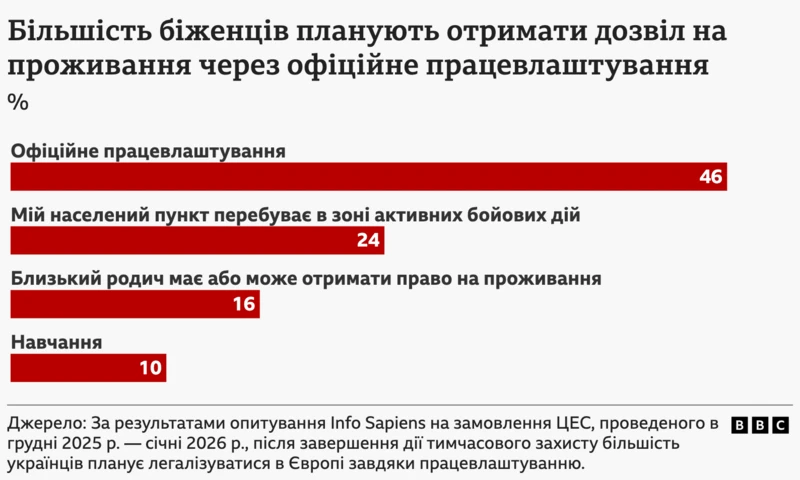
In Germany, Poland, and the Czech Republic—countries where about 60% of Ukrainian refugees who have gone to the EU reside—an average of 24% of Ukrainians already have documents, other than temporary protection, that allow them to stay there.
This percentage roughly coincides with the group that researchers conditionally call “new life trajectory”—mainly young Ukrainians who have already decided to build their lives outside Ukraine.
Moreover, of those who went abroad between 2022-2024, an average of 20% have changed their minds in favor of not returning to Ukraine at all.
Refugees who left with children assess their intentions to return to Ukraine more pessimistically than adult refugees in general. Especially confident in not returning are parents of students.
“The non-return of Ukrainians will have a significant impact on the Ukrainian economy,” the study authors believe. According to their estimates, the losses could range from 2.3% to 10.1% of GDP annually.
Who and How Will Return
The EU is also preparing a voluntary return and recovery program for Ukrainians. However, in Brussels, they fully realize that no one is ready for the mass return of 4-5 million people when there are about 4 million internally displaced persons in Ukraine itself, and rebuilding the infrastructure destroyed by Russia will take years.
“We will not give money directly to the people. We want to invest in local communities,” stated Special Representative Johansson.
The EU also recommends member states encourage familiarization trips to Ukraine at the Ukrainians’ own expense—especially in those countries that currently limit such trips by time. During these trips, Brussels believes Ukrainians can assess the level of destruction and general living conditions in Ukraine.
The EU also advises extending the stay for parents whose children are attending school after the end of temporary protection, so they can complete the school year. Within a year after the end of temporary protection, the EU recommends Ukrainians retain the right to stay in the EU.
Member states should pay special attention to people with special needs who may require additional time and support before returning to Ukraine, and their return should only occur when Ukraine is ready to meet their needs.
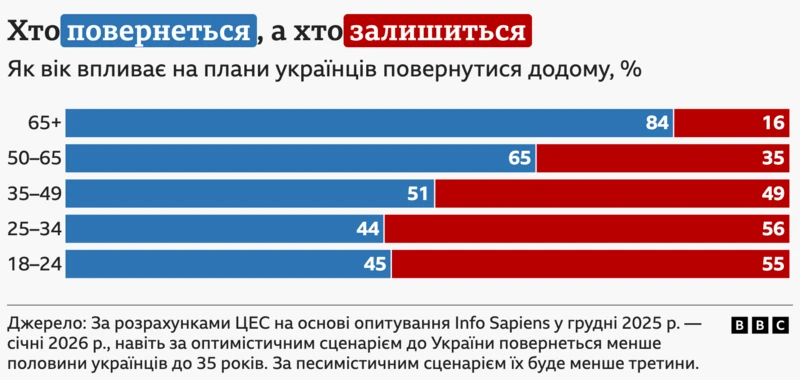
However, in general, according to most estimates, mostly elderly and middle-aged people will return to Ukraine.
Yet, there is another category of those who declare intentions to return — despite having quite successful integration abroad. In this group, there are mainly middle-aged people who either had their own business in Ukraine or still receive a salary from Ukraine. This is the most Ukrainian-speaking group highlighted by researchers.
Representatives of European governments and experts agree that the key to the return of Ukrainians is the economy. According to a CED survey, a higher standard of living in Ukraine is among the main factors that would stimulate return. It ranks second — after the complete end of the war and before the absence of air attacks. Among the obstacles is the growing disbelief in the future of Ukraine.
“To bring people back, we have to offer them some perspective,” says senior CED researcher Iryna Ippolitova.
Another game-changer, as incredible as it may seem now, could be Ukraine’s accelerated accession to the EU, as the union allows for the free movement of the workforce, and Ukrainian refugees are increasingly becoming labor migrants.
This possibility is also being discussed as part of peace negotiations brokered by the USA. Meanwhile, EU member state ambassadors recently dismissed the European Commission’s idea of “reverse enlargement,” according to which Ukraine would first receive EU membership and then gradually acquire full rights.
As the European Commissioner for Enlargement Marta Kos stated, for Ukraine, the EU plans to change the accession rules that have been in place for over 40 years. However, this requires the consent of all member states. Meanwhile, some of them manage to rather easily block even already agreed decisions to grant Ukraine a 90-billion credit to withstand the war with Russia.
Cover illustration: KPMG
