
Four years ago, in the first weeks of the great war, many thought that if Ukraine could endure these difficult days, push the enemy out of Kyiv and other major cities, increase its losses, the Kremlin would agree on the senselessness of further attacks, enter negotiations, or at least agree to maintain the status quo. After the liberation of Kharkiv and Kherson regions, the status quo no longer satisfied us. In public consciousness and in the statements of politicians, the position that the war should end at Ukraine’s state borders began to strengthen.
The moment when the Kremlin shifted from a war for the conquest of Ukrainian territories to a long-term war of attrition simply passed us by, because honestly, it was not our focus. Meanwhile, familiar Western politicians and experts, with whom I communicated almost non-stop in the first weeks of the war, told me that if the war cannot be concluded somehow within six to eight months, we should prepare for a long-term conflict with an uncertain outcome.
Comparisons to the war in Syria, in which Russia actively participated before the onset of the large-scale Russian-Ukrainian war, were most often heard. However, it’s worth remembering that at that time, none of us could have known its end.
Moreover, it seemed to us the outcome was already evident. The regime of dictator Bashar al-Assad managed to hold on with the help of allies from Moscow and Tehran; the opposition was virtually destroyed and marginalized in one of the Syrian provinces, sustaining itself only due to the Russians and Iranians’ unwillingness to enter a direct conflict with the Americans and Turks. However, the elimination of the opposition base was a matter of time and agreements among the “real” players.
A few years later, the Syrian opposition would triumphantly and briefly march on Aleppo and Damascus, the dictator would flee to Russia, leaving us only to try to understand how Assad lost control over the country literally within a few days, and how Russia’s and Iran’s involvement in new wars impacted their readiness to support a friendly regime.
But if we take a closer look at the Russian-Ukrainian war, we indeed see the same players as in Syria. On one side, the West, interested in stabilizing the situation and upholding principles of international law. On the other side, the same Russia, the same Iran, behind which looms the shadow of China, interested in destabilization, creating additional positions for Chinese communists in their competition with the United States and fight against democracy. And it seems that Russia presses, prevails, and that the war will end, if not on its terms, at least on conditions comfortable for the Kremlin. But we thought the same in Syria!
The defeat of Assad and his allies appears quite logical: like the Ukrainians, the Syrian opposition could use Western resources in resistance, while Damascus relied on Russia and Iran, and the diversion of Moscow’s and Tehran’s focus to their own “wars” spelled the regime’s doom. We must also remember that China, which appears to be a real alternative to Western aid, never helps “just because”; it is interested in enslaving its allies, not in empowering them. This Chinese approach differs from the European one, and until the last administration differed from the American one. Furthermore, the opposition army was motivated by the idea of a new Syria, while Assad’s army was made up of mercenaries or people who had no other choice.
For us, this only means that we can follow the tactics of the Syrian opposition. “Our Assad” from the Kremlin does not want to negotiate peace with us; he wants to destroy us and is confident that he effectively controls not only his country but also part of ours. But he is depleting Russian resources, both economically and demographically, operates with an army of mercenaries, and can exist not so much thanks to China but due to discounts and privileges for China. While this doesn’t create prerequisites for a quick end to the war, it excludes the possibility of Putin gaining a strategic advantage.
Yes, today it is a classic dead end, but the Syrian war was also at such an impasse for several difficult years for the opposition and ended in their victory. However, to win, we must first learn to live in this stalemate. First, to acknowledge its existence. Second, to remove illusions regarding the possibilities of a quick end to the war. Third, to see that we are not alone in the dead end but alongside the enemy. This means that escaping the stalemate only depends on our resilience and realism. Again, if we are not alone in the dead end, it means if the enemy shows signs of realism and resilience, and we again fall into the comfortable mire of illusions and dreams of the impossible, they will win, and we will disappear.
This is precisely why the Syrian scenario—as well as many other similar event development scenarios—must remain an excellent example for us of the conditional weaker side defeating the seemingly stronger one. But this example reminds us: always and despite the circumstances, we must prepare for victory, not defeat.
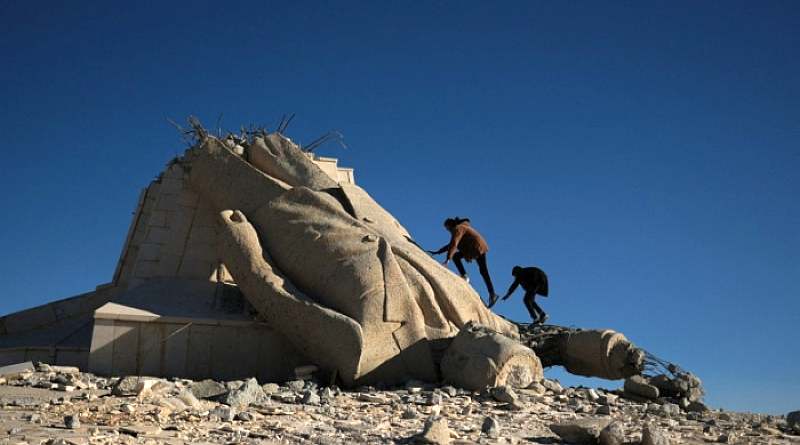
On the cover: A destroyed statue of Hafez al-Assad on the “Hill of Statues,” located 88 kilometers north of Damascus. Photo from open sources.
