
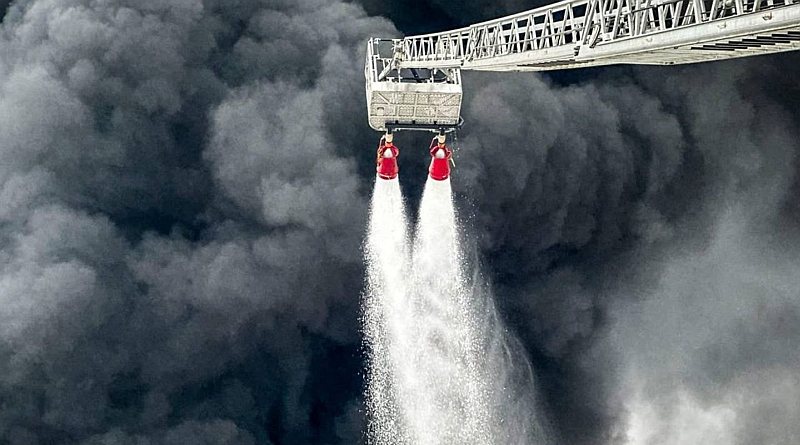
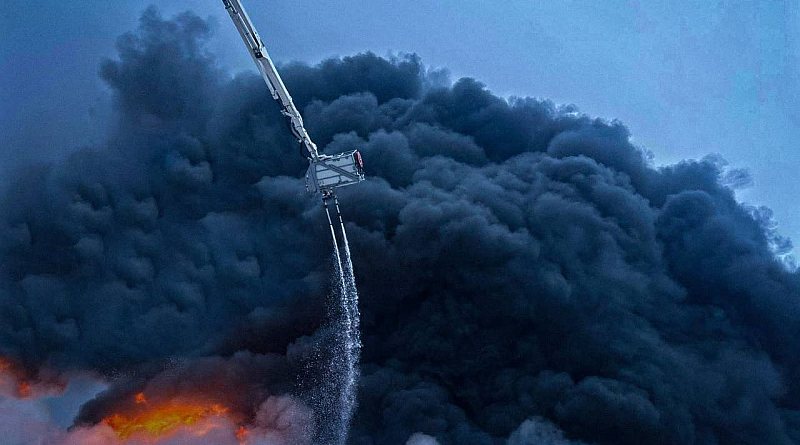
On Tuesday, January 27, the Russians struck the energy infrastructure in the Lviv region. It turned out that a drone might have hit a section of the pipeline that supplies Russian oil to Hungary and Slovakia. Naftogaz confirmed the attack but did not specify the exact target. The company only noted that this was the fifteenth attack on its facilities this month.
A large-scale fire broke out at the site, which could not be extinguished within a day. Smoke spread in Brody, and schools and kindergartens switched to remote learning. Residents were asked to keep their windows tightly closed.
On Wednesday morning, the Lviv Regional Center for Disease Control and Prevention reported an exceeded concentration of carbon monoxide and soot. Experts noted that there is no threat to public health. However, people with chronic respiratory diseases are advised not to stay outside for long.
Targeted Strike or Accidental Foolishness?
Russia did indeed strike directly at the Druzhba pipeline, confirms Mykhailo Honchar. At the same time, the expert in international energy and security relations adds that Ukraine’s oil transportation infrastructure has repeatedly been targeted by Russian drones and missiles. Since 2022, the Kremlin has attempted to hit at least one major pumping station and port oil equipment.
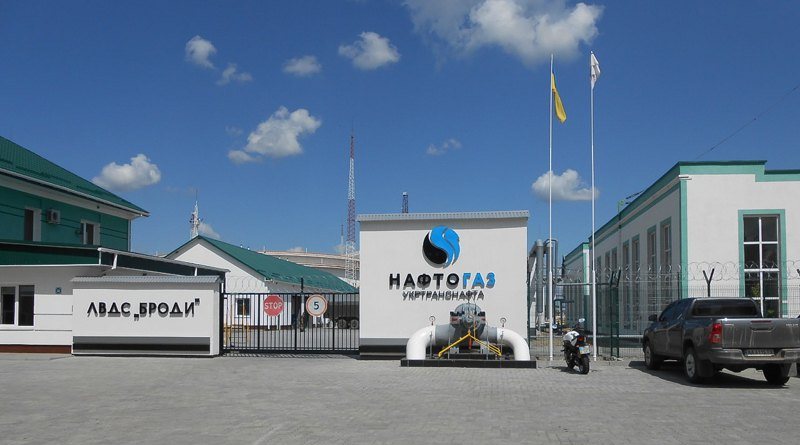
Meanwhile, on January 27, Russia damaged one of the key links in the oil supply to Hungary and Slovakia. This refers to the linear production and dispatch station “Brody”. Without it, pumping through this pipeline cannot occur. This station is the most powerful in Ukraine, built back in the 1960s, consisting of almost two dozen tanks. There is also the largest oil tank in our country with a capacity of 75 thousand cubes. It has a double-wall structure and a floating roof, ensuring a high level of environmental and fire safety.
In 2019, Ukrtransnafta reported on a major renovation of the “Brody” station. The work lasted eighteen months: during this time, equipment was updated and facilities were repaired. Most of the work was carried out without halting oil pumping.
Mykhailo Honchar believes that Ukraine should have long ceased the transit of Russian oil to Hungary and Slovakia. The expert reminds us: for example, pumping Russian gas did not protect the Ukrainian GTS from Russian attacks. Something similar could happen with the Druzhba pipeline.
“If the Kremlin has decided that the priority is to target Ukraine’s oil transportation infrastructure, then commercial interests and the interests of the Hungarian satrapy become deeply secondary,” says Mykhailo Honchar.
Several versions should be considered as to why Russian missiles or drones hit the Druzhba infrastructure, according to energy sector expert of the Ukrainian Institute for the Future, Andrian Prokip.
First, the Russians might have deliberately targeted the production-dispatching station to once again blame Ukraine for the halt in oil transit. Secondly, it’s possible the attack was accidental.
“It’s important to remember that Russia is actually highly dependent on supplies to Hungary and Slovakia via this pipeline, as other supplies are under sanctions. Although Russia successfully circumvents them,” says Andrian Prokip.
The Russian strike on Brody is definitely not accidental, believes Volodymyr Omelchenko, director of energy programs at the Razumkov Center. He explains: with this attack, the Kremlin aimed to harm not its friends in Budapest or Bratislava, but specifically Ukraine. It is no coincidence that the Russians directed a drone at the largest oil reservoir in our country.
“My version of events is this: most likely, they could have been storing Ukrainian oil there intended for export to Poland. That is, transfer and then delivery by rail, since there is no pipeline to Poland. Why? Because there is no oil refining in Ukraine, Russians destroyed everything, including the Kremenchuk refinery,” explains Volodymyr Omelchenko.
Instead, analyst Oleksandr Sirenko believes that “any resource” could have been stored in Brody. The expert recommends waiting for official information.
At the time of the strike, the reservoir was half empty, says energy sector specialist Hennadiy Ryabtsev, yet a significant amount of oil was still engulfed in flames. He immediately clarifies: the Ukrainian fuel market is not facing a shortage. If necessary, dealers can find additional batches of fuel on the European market.
Furthermore, the state always has a 20-day fuel reserve. This is a strategic operational reserve, the storage of which is regulated by law.
“Although there were approximately 35,000 tons. And most likely, this reserve is completely lost. But this attack will not affect overall price levels. One thing concerns me: why wasn’t there a fire squad there? One ‘shahed’ flew in, and it wasn’t shot down. And what about the engineering protection? Although, it’s such a large reservoir that you can see it not only from the air,” says Hennadiy Ryabtsev.
The expert suggests: it is unlikely that this strike will significantly affect the supply of Russian oil to Hungary and Slovakia. The maximum that might occur is a temporary technological halt.
Show of Hungarian Silence
Neither Hungarian officials nor Slovak authorities responded in the day following the Russian attack. For example, in August, when the “Druzhba” pipeline was shut down, the governments of Hungary and Slovakia reacted immediately, mostly with curses and threats towards Ukraine. This time, even the Hungarian propaganda machine controlled by the “Fides” party remains silent.
“As of late Tuesday evening, the consequences were still being dealt with. I am not sure the pipeline will resume full operation quickly. I think it is currently stopped because its operation is unsafe. The Russians had previously targeted the transit section. It’s hard to comment on the Kremlin’s logic. I think this was probably a mistake. They saw a target — an infrastructure facility in the oil and gas extraction area — and hit it,” says Oleksandr Sirenko, an analyst at the “Naftrynok” Consulting Agency.
At the same time, Moscow could have offered Hungary and Slovakia other supply routes, suggests Mykhailo Honchar. For example, transporting fuel from the Black Sea to the Adriatic coast. And further — by pipeline through the Balkans. Indeed, both Hungary and Slovakia have alternative oil supply routes, and there is no shortage of sellers on the market.
However, the governments of Viktor Orban and Robert Fico stubbornly refuse to end their cooperation with the Russians. There is a simple explanation for this: the Kremlin offers these two countries substantial discounts on resources, reportedly reaching up to 25%. Such conditions are unlikely to be received from other sellers by either Fico or Orban. It is not difficult to understand what they do for Moscow in exchange for the discount.

“One might venture into politics and assume that it is the Russians sending a ‘hello’ not to us, but to the Slovaks and Hungarians. There is no official data, but I understand that the strike affected the section responsible for transit to Slovakia. However, what, who, and whom wanted to convey something remains a guess,” says Oleksandr Sirenko.
Technically, it is not difficult for Ukraine to stop the transit of Russian oil to Hungary. This is entirely a political issue, and the Ukrainian government explains the pumping of resources with legal nuances. Allegedly, in response, Ukraine could face serious lawsuits and fines. Additionally, stopping transit would supposedly violate several important international agreements with the European Union, including the Association Agreement.
“This document provides grounds to stop the transit. With the motivation of Ukraine protecting its national security. If we are afraid of lawsuits and penalties, we should minimize the pumping. This can be done elegantly,” argues Mykhailo Honchar.
The contract for the transit of Russian oil through Ukraine is valid until 2030. The benefit from this agreement for our country is quite questionable. Russia pays up to $300 million for transit. In return, it trades approximately $6 billion, according to calculations by analysts at the Razumkov Center.
One should not forget that the oil transit infrastructure is quite energy-intensive. During a period of severe deficit, Ukraine has to spend electricity to ensure the pumping of Russian fuel.
“There are no sanctions applied to the supply through this pipeline. Accordingly, Kyiv tries to adhere to the sanctions regime applied by the European Commission. Officially, this is how the Ukrainian side explains the continuation of transit,” says Andrian Prokip.
Viktor Orban’s regime relies on Russian oil
Russian oil is among the guarantees of maintaining power for Viktor Orban’s party. The resource is purchased by the Hungarian company MOL, in which the state has a significant ownership share and key influence. The company owns several oil refineries in Hungary and Slovakia.
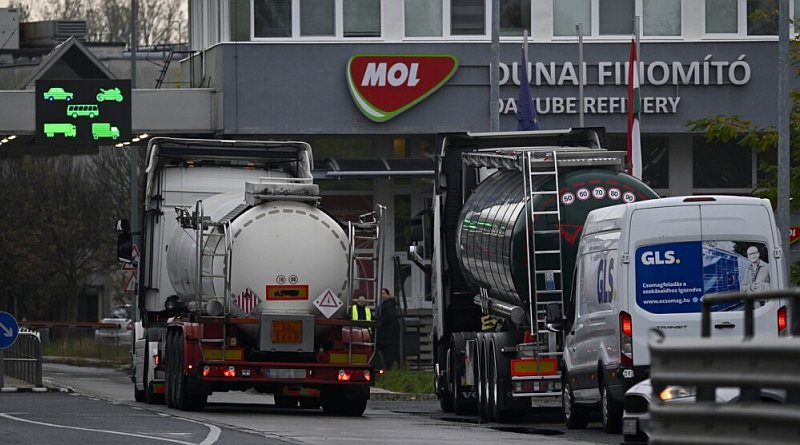
In total, Hungarians and Slovaks buy 10–11 million tons of oil from Russia per year. Earlier, the third major buyer was the Czech Republic. However, last year it refused to work with the Kremlin and now receives oil via alternative routes.
Trade with Russia is generally going well for Hungarians and Slovaks. However, last year the volume of oil sales still decreased by about 14%, calculated the “Naftrorynok” Consulting Agency. Despite the decline, Hungary and Slovakia are still catastrophically dependent on supplies from Russia by their own initiative. These two countries in 2022 managed to secure an exception from EU sanctions through blackmail. The European Commission allowed Hungarians and Slovaks to temporarily receive Russian oil through pipelines.
Cooperation with Russians allows the government in Budapest to maintain some of the lowest fuel prices. They also export gasoline and diesel to other countries and receive large sums for so-called social projects, more precisely, for vote-buying before the parliamentary elections to be held this year. Therefore, Orban categorically does not want to lose such a profitable oil feeder.
“If Ukraine now does not stop transit, I do not know what has to happen for this to occur. I see absolutely no arguments for continuing pumping. Russian oil through ‘Druzhba’ is corrupt fueling of Orban and his party by Moscow,” believes Volodymyr Omelchenko.
