
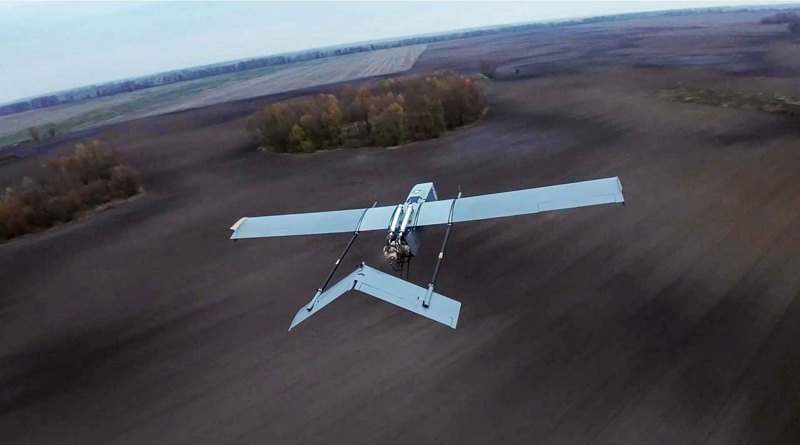
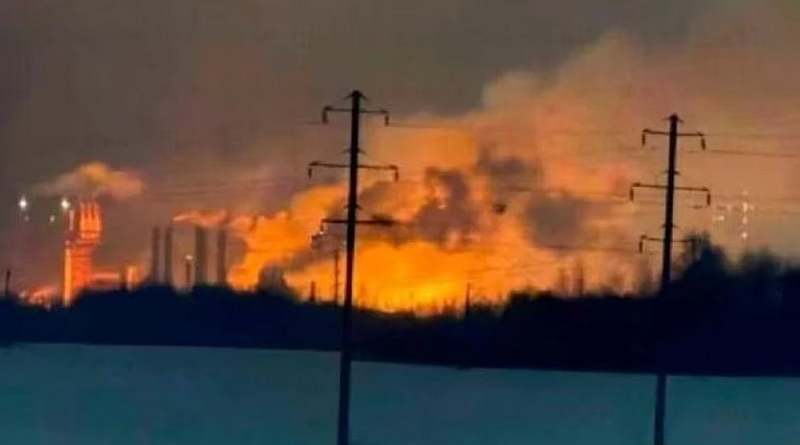
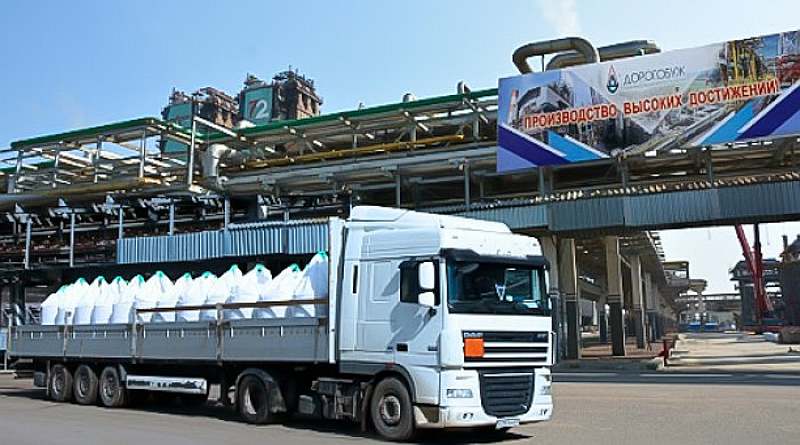
In the Smolensk region of Russia, drones attacked the Dorogobuzh fertilizer plant, which produces ammonium nitrate and other nitrogen compounds. Local authorities reported seven dead and injured.
This is undoubtedly a brilliant and extremely effective operation by the Ukrainian Defense Forces. Here’s why.
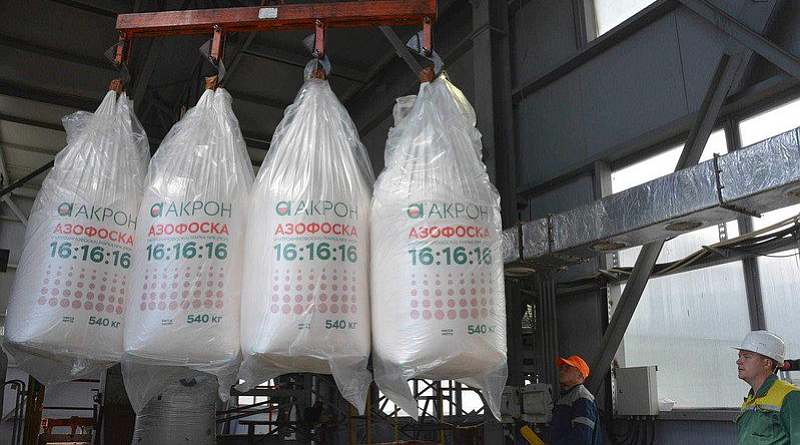
To the average person, ammonium nitrate means bags of fertilizer for agriculture. But for military logistics and heavy industry, it is the basis for industrial explosives. Ammonal, igdanite, cheap TNT mixtures — all of this is based on nitrate. Without it, the Russian mining industry, which feeds the budget with ore and coal and is currently very troubled, begins to falter. To extract a million tons of coal in Kuzbass or iron ore in the Urals, hundreds of thousands of tons of rock must be blasted. And igdanite (a mixture of nitrate and diesel fuel) accounts for 90% of all industrial explosives in Russia.
The main thing is that this is the most powerful blow to the production chain of explosives for those same cast iron FABs and KABs that they shower the front with. Russia drops 3,000-3,500 KABs per month. A FAB-500 contains about 300 kg of explosives, a FAB-1500 nearly 700 kg. This amounts to thousands of tons of pure explosives each month. Mixtures used in their manufacture consist of 70-80% ammonium nitrate because pure TNT or RDX is too expensive and takes too long in the production cycle.
The Dorogobuzh plant provided about 10% of all ammonium nitrate in Russia, which is a colossal volume — almost a million tons per year (to give you a sense of scale: this is over 360 warehouses like the one that exploded in Beirut, or a continuous “train” of 15,000 fully loaded hopper cars) out of their total of ten to eleven. Cutting out ten percent of the country’s basic explosive/chemical resource overnight is like a knockout in macroeconomic terms.
Anatomy of a Strike: Logistics and Secondary Detonation
The genius of this operation lies in the choice of the targeting point. We did not aim solely at workshops or pipes, which are hard to penetrate with a light drone. The strike hit directly at the logistical heart of the enterprise — the shipping section, railway terminal, parking areas, and finished product warehouse. The drone functioned here merely as a detonation capsule.
The main destructive work was done by the nitrate itself. There was a chain detonation of thousands of tons of their own product. Let me remind you that Beirut port collapsed from the explosion of 2700 tons, and at a large chemical terminal under loading, from three to five thousand tons easily concentrate. This is a kind of controlled Beirut effect in miniature, only in the forests of the Smolensk region.
When such a volume detonates in the confined space of wagons and bunkers, the temperature in the epicenter jumps over 2500 degrees Celsius, and the speed of the detonation wave exceeds 2500 meters per second. The power of this secondary volumetric explosion was such that the shockwave simply demolished capital loading estacades and tore apart nearby production facilities within a radius of several hundred meters. It literally turned steel structures as thick as a finger into dust. The plant has now effectively turned into a cut-off container from the world.
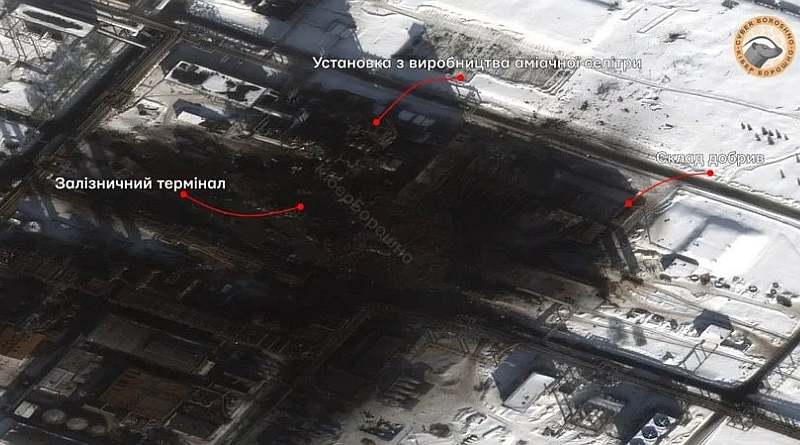
Even if the reactors deep in the territory partially survived, there is physically no way for them to package and ship the products — the terminals have been reduced to zero. The strike hit the junction where conveyor belts, buffer storage silos, and the railway branch converge. Replacing a rectifying column is only half the problem, but rebuilding an automated packaging hub from scratch with kilometers of belts, weight control sensors, and storage hoppers is an engineering nightmare. Now imagine trying to restore a chemical loading bridge, piping system, and automation under strict sanctions, when industrial controllers from Siemens or ABB and specialized pumps are no longer for sale to them. This is at least 80–100 million dollars in direct capital losses just on hardware and concrete.
Scale of planning and failure of Russian air defense
Also, assess the scale of planning. Five hundred kilometers from our border, a massive swarm of drones breaches through their layered air defense. The Smolensk region is not remote taiga. It’s a direct western corridor to Moscow. Their radio-technical troops, S-400 divisions, “Pantsirs,” and electronic warfare complexes are deployed there. This means our intelligence calculated the schedules of wagon accumulation at the terminal to the minute, and operators launched the “birds” exactly at the moment of maximum concentration of explosive materials in the warehouses. Our drones flew at extremely low altitudes, using the terrain, below the radar horizon. Meanwhile, their air defense missed everything, and most of the UAVs entered the target unhindered, proving the complete degradation of their continuous radar field.
Profitability Mathematics: 1 to 120
Now let’s calculate the mathematics. We take the maximum of our costs. According to OSINT data, a flock of our new long-range FP-1 drones flew there. Since the flight to the target was only 500 kilometers (with their maximum range of 1600 km), they could carry the heaviest warhead of 120 kilograms. The declared price of one such drone is about 55 thousand dollars. Let’s say 30 of them were used. That’s 1.65 million bucks for the entire massive salvo.
Now we calculate their minimum losses: 100 million for terminal restoration plus a plant downtime of at least a quarter. I think more, but let’s play devil’s advocate. A quarter year without shipments is a minus of 250 thousand tons of products, which translates to another 75-85 million dollars of pure loss in the market.
Plus, the destroyed rolling stock is another point often forgotten. One specialized hopper wagon costs from 50 to 80 thousand dollars. If at the terminal at least 30-40 wagons were burned or turned into scrap metal, that’s another 2-3 million dollars in losses just in RZD logistics, which is already suffocating from a bearing shortage. We invested a little over one and a half million dollars, and extracted at least 200 million from their economy. The strike ratio is one to one hundred twenty.
Bottom Line: Evolution of Our Strategy
The bottom line is as follows: Ukraine, with drones costing as much as a mid-range SUV, burned their key logistics hub, knocked out 10% of the strategic raw material market on the eve of spring sowing, and created a significant deficit for their manufacturers of industrial explosives. This is a classic method of drying out their military-industrial complex from the inside, methodically and as painfully as possible. We are not just striking factories; we are breaking their economic multiplier.
Our goal is their pocket, and we are dealing heavier blows to it. I once compared this to an awl in the foot many times. Now it’s not an awl, but a shiv with a file.
