

Territorial and border conflicts in the early 21st century seemed senseless and occurred on the deep periphery of the international system. Russia’s armed invasion of Ukraine completely overturned ideas about the modern set of norms of behavior. Now, instead of peaceful coexistence, co-development, and integration projects, the trend is towards a spirit of militarism and a tendency to resort to forceful solutions instead of dialogue.
Peace has become a commodity, whose value is rapidly increasing, which is why U.S. President Donald Trump claims achievements as the most outstanding peacemaker of modern times. Yet, he has not been able to fully stop the main conflict of today, the Russian-Ukrainian war, despite working on it for more than a year.
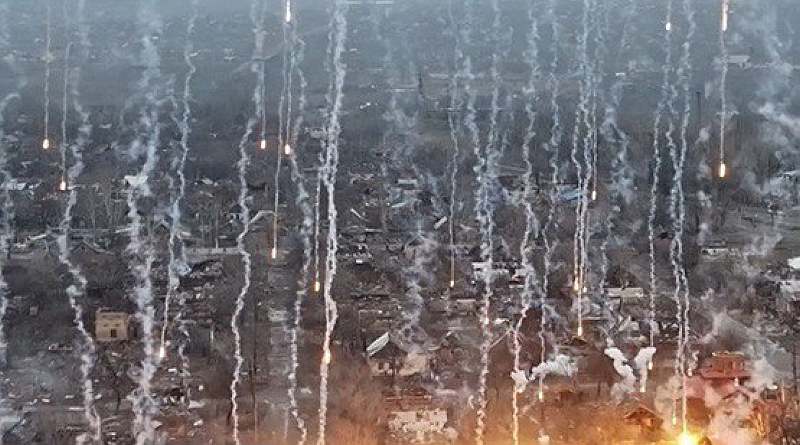
Trump’s hopes and plans are shattered by Putin’s position, who still does not desire peace, being ready to mobilize Russian soldiers and grind down the Kremlin’s offensive potential on the Donbas strongholds. Notably, Putin’s forces resort to prohibited steps, such as bombing Ukrainian positions with white phosphorus. Recent videos from Kostyantynivka show how Russia “liberates” the city by wiping it off the face of the earth. Why does Putin want all these inglorious ruins? Why is he content with portraying the Russian army as brutal forces? It’s simple: the aim of Russia’s timeless national leader is to protect himself from the threat of alternatives, surrounding himself only with the worst to rule endlessly.
Putin wants to rule from the shadows; he is the most recognizable politician in Russia, yet who he is and what he is truly like remains a mystery. He can only be judged by his rule, which consists of a series of endless clampdowns, a complete discrediting of the idea of protest and change. Any opponent of Putin is immediately labeled an extremist, so in Russia, a sterile generation of absolute loyalists has been raised. This is terrifying as the political life in the country becomes a flat swamp where there are no other development scenarios aside from the algorithm approved by Putin.
Astonishingly, the federation is run by figures without legitimate mandates. Usurpers, false rulers, who attribute to themselves the guise of continuators of the people, declaring themselves its derivative.
What is this, if not a shadow empire, a country of grayness, where political forces of other spectrums are absent? Putin not only supports the realm of shadows in Russia but also seeks to export it abroad, forming criminal networks.
The beginning of this course was the hybrid annexation of Crimea and the invasion of the Donbas. Its continuation involves forming shadow infrastructure far beyond Russia’s borders. Moscow has created a massive shadow tanker fleet under FSB control, intended as a tool to circumvent international sanctions. Hundreds of tankers in dubious technical condition transport bloody Russian oil to Asian buyers. These vessels ruin the marine environment and damage underwater cables, effectively also serving as diversionary tools for Putin.
Another example of exporting shadows abroad is Russian criminal networks recruiting citizens of foreign states, mainly from Africa, to participate as mercenaries in the war against Ukraine. Thousands of young Africans have fallen victim to this Russian tactic of plugging holes on the front for meat assaults, as without mobilization, Putin can no longer continue his bloody carnage.
Putin’s forces also secretly benefit from the activation and escalation of territorial disputes. There is no doubt that there is a Russian trace behind the current “open war” between Pakistan and the Taliban. Cross-border hybrid operations, airstrikes, attempts to threaten nuclear facilities – haven’t we seen something similar in Ukraine, which has been ruthlessly tormented by Putin’s shadow empire for over four years?
On the cover: Russians scatter phosphorus over Kostyantynivka. Photo: screenshot from the video 28th Mechanized Brigade named after the Knights of the Winter Campaign/Libkos
