

Information on current Russian losses due to sanctions as of 19.02.2026.
1. Ukrainian drones hit an oil depot in Russia’s Pskov region.
– On the night of February 19, Ukrainian drones attacked an oil depot in the city of Velikiye Luki, Pskov region. A fire was recorded in one of the tanks containing oil products.
– Despite the protective mesh screen installed over the tanks, several drones managed to penetrate it and hit the facility. The Velikiye Luki oil depot is owned by the company Pskovnefteprodukt.
– The facility stores diesel, gasoline, and other oil products, which are distributed to gas station networks, enterprises, and transport companies in the region. This is not the first such incident.
– On February 17, drones struck a tank at an oil depot in the village of Volna, Krasnodar region — the fire area exceeded 1.2 thousand square meters.
– On January 23, the Rosneft base in Penza was hit, and the fire was extinguished over two days.
– On January 10, an oil depot in the Volgograd region was attacked.
– Thus, strikes on fuel infrastructure deep within Russian territory are becoming systematic.
– Despite Russian authorities’ claims of “control over the situation” and enhanced protection of facilities, fires at oil depots continue, creating additional pressure on Russia’s rear logistics.
2. Russia’s oil and gas revenues in February will be halved compared to the same period last year.
– In February, Russia’s revenues from oil and gas exports almost halved compared to the same period last year, amounting to approximately 410 billion rubles (about 5.35 billion dollars).
– The decline was caused by two factors: a drop in global oil prices and the strengthening of the ruble. Cheaper oil reduces foreign currency earnings, and a stronger national currency further decreases the ruble equivalent of export revenues.
– As a result, oil and gas revenues, which remain a key source of budget funding, are under significant pressure despite maintaining physical supply volumes.
– It is estimated that in January–February, total oil and gas revenues will amount to about 800 billion rubles, while in the first two months of 2025, this figure was 1.56 trillion rubles. Thus, the decline exceeds 45%.
– Formally, February’s figure may be 3.1% higher than in January due to so-called damping payments, a compensation mechanism for oil refineries. However, this time companies must transfer about 42 billion rubles to the state, as fuel exports at current prices have become less profitable. This additionally reduces the net financial effect.
– The federal budget for 2026 includes 8.92 trillion rubles of oil and gas revenues with total expected receipts of 40.283 trillion rubles.
– Meanwhile, last year oil and gas revenues fell by 24% to 8.48 trillion rubles, the lowest level since 2020.
– Given the rise in defense and security expenditures, the further decline in oil and gas revenues creates an increasing gap between Russia’s budget plans and real financial capabilities.
3. The Russian stock market continues to lose value.
– Since May 2024, its capitalization has decreased by about a third, and compared to the pre-war 2021, almost by half.
– At the end of last year, the total market value of companies was about 50 trillion rubles, which equals only 23% of GDP.
– For comparison, in 2021 this figure was 62.8 trillion rubles, or 47% of GDP. Thus, the stock market’s share in the economy has more than halved.
– To return even to previous benchmarks, it is now necessary not just to double, but to actually triple capitalization — which seems unlikely under current conditions.
– After 2022, the market essentially lost foreign capital. Before the full-scale war, about 60% of trading turnover was provided by institutional investors, mainly from abroad.
– Their exit led to a liquidity shortage and decreased interest in Russian assets. Although some turnover was taken over by retail investors within the country, this did not compensate for the losses.
– The market became more widespread in terms of the number of participants but much poorer in terms of capital volume. As a result, the Russian stock sector is increasingly isolated from the global financial system and shows systemic weakening instead of growth.
4. Russian Railways on the brink of a financial crisis: debt of almost 4 trillion rubles and a decline in transportation.
– The financial situation of “Russian Railways” is rapidly deteriorating, creating additional risks for the entire Russian economy.
– By the end of 2025, freight volumes fell by 5.6% to the lowest level in the last 16 years. The largest decline was recorded in the segments of oil, coal, metals, and building materials — basic sectors of Russian exports.
– The company’s debt approached 4 trillion rubles, with net debt estimated at about 2.8 trillion. The high key rate and rising loan costs have complicated servicing obligations. Russian Railways have already requested 200 billion rubles in state support, but no final decision has been made.
– The situation is worsened by a change in the structure of transportation: prioritization of military logistics reduces the capacity for commercial cargo, which forms the main revenue.
– The investment program for 2026 has been cut by 20% to 713.6 billion rubles. Over 530 billion is planned to be directed towards infrastructure maintenance and traffic safety.
– Simultaneously, a 20% reduction in operating expenses has been announced.
– An additional blow is the personnel shortage and lack of locomotives. According to industry data, up to 200 trains are canceled daily due to a lack of drivers; in some divisions, staff levels are only about 60%.
– Possible stabilization measures include increasing freight tariffs, using funds from the National Wealth Fund, debt restructuring, or extending obligations.
– There was even discussion about temporarily converting loans into shares, but 100% of Russian Railways is state-owned, complicating the implementation of such a scenario. The National Wealth Fund, which could be a source of support, is itself limited due to the budget deficit. The idea of shifting part of the risks to state banks also raises concerns about the stability of the financial system.
– The company is considering selling assets — including 49% of the “Federal Freight Company” (over 134,000 carriages) and an office complex in Moscow-City. Some large-scale infrastructure projects have already been frozen.
– The Northern Siberian Railway project, about 2,000 km long, has been deemed economically unfeasible due to a cost estimate in the tens of trillions of rubles.
– In February, Russian Railways issued bonds on the Russian market worth 4 billion CNY, with an annual coupon of 7.6%. The issuance in Chinese currency reflects an increasing dependence on eastern financial flows.
– Russian Railways accounts for about 2.5% of Russia’s GDP, so the deterioration of its condition has systemic consequences for the country’s economy.
5. During the full-scale war, Putin’s regime effectively triggered a wave of nationalizations and forced business seizures that affected every tenth Russian billionaire on the Forbes list.
– In 2022–2024, the value of seized assets reached about 5 trillion rubles — and this is without considering the indirect losses of the owners.
– From 2014 to 2025, 30 out of the 311 members on the Forbes list faced nationalization or forced sale of assets on non-market terms.
– If taking the last pre-war and war-time rankings, the share affected reaches 12%. Among them are 17 entrepreneurs from the top hundred richest Russians.
– In two-thirds of the cases, the process was accompanied by pressure from law enforcement agencies. The total value of assets seized directly from these businessmen is estimated at 2.6 trillion rubles, with an additional over 1.6 trillion rubles coming from companies forcibly sold after the start of the war.
– State corporations and structures close to the Kremlin became the beneficiaries of the redistribution.
– Essentially, it is a large-scale transfer of private property under state control against the backdrop of isolation, sanctions, and an increasingly harsh mobilization economy.
– Business, which was considered relatively protected a few years ago, now finds itself in a zone of constant risk — from criminal cases to forced change of ownership.
– Such practices undermine the investment climate and stimulate capital outflow, reinforcing stagnation trends.
6. Russia’s share in India’s oil imports in January is the lowest since the end of 2022.
– India continues to reduce its dependence on Russian oil. In January, imports from Russia amounted to about 1.1 million barrels per day — 23.5% less than in December, and approximately a third lower than a year ago. Russia’s share in India’s total imports shrank to 21.2% — the lowest level since October 2022.
– Meanwhile, since November, China has become the largest maritime buyer of Russian oil, indicating a further narrowing of Moscow’s sales geography. At its peak after 2022, India purchased over 2 million barrels per day, taking advantage of significant discounts on Russian raw materials.
– However, amid sanction pressure and negotiations with the US, New Delhi is gradually revising its import structure.
– February volumes are expected to be 1–1.2 million barrels per day, with a further drop to approximately 800,000 barrels per day in March.
– A complete cessation of purchases is not currently forecasted, but the trend of reduction is evident. The freed volumes are being replaced by alternative suppliers.
– In January, the share of Middle Eastern oil in India’s import structure rose to 55%, and Latin American varieties took about 10% — the highest in the past 12 months.
– Preliminary data suggests that in February, Saudi Arabia significantly strengthened its position, bringing supply to record levels.
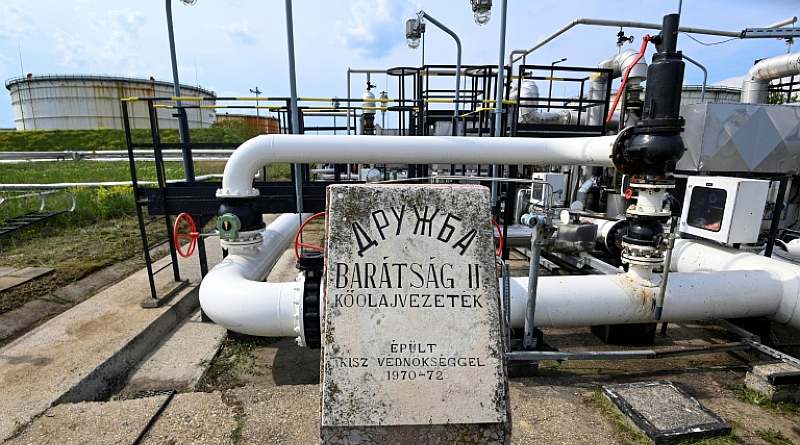
7. Hungary and Slovakia are blackmailing Ukraine with energy supplies after the “Druzhba” halt.
– Following the cessation of Russian oil transit through the southern branch of the “Druzhba” pipeline, Hungary and Slovakia threaten Ukraine with a halt in diesel fuel and electricity supplies. The formal reason was the stoppage of pumping from January 27, as reported by the Hungarian MOL Group on February 16.
– Hungarian Foreign Minister Péter Szijjártó stated that Budapest is suspending diesel supply to Ukraine and will not resume it until the transit of Russian oil is restored. The Hungarian authorities insist that the pipeline is technically sound, and the blockade supposedly has a “political” nature.
– Kyiv, on the other hand, links the disruptions to the consequences of Russian strikes on infrastructure. Slovak Prime Minister Robert Fico announced a crisis situation in the oil sector.
– The government allowed the release of up to 250,000 tons of oil from strategic reserves for the Slovnaft company, which operates the country’s only refinery. This volume should last about a month. Meanwhile, Slovnaft stops exporting diesel, particularly to Ukraine, redirecting it to the domestic market.
– Fico also allowed for a review of electricity exports to Ukraine if the transit is not restored. According to Slovak data, Slovakia accounts for about 21% of Ukraine’s electricity imports.
– Notably, both countries are already seeking alternative supply routes, including through the Croatian port of Omišalj and the Adria pipeline. This indicates that even governments traditionally advocating for maintaining energy ties with Moscow are forced to diversify supplies following disruptions in Russian logistics.
– The situation resulted from destabilization caused by Russia itself. However, Budapest and Bratislava are trying to use it as a tool to pressure Kyiv — despite the disruptions arising after Russian attacks on Ukrainian infrastructure.
8. Slovakia urgently refuses Russian oil.
– After the stoppage of oil pumping through the “Druzhba” pipeline, damaged due to a Russian strike on Ukrainian territory, Slovakia is forced to urgently replace Russian raw materials with alternative supplies.
– This essentially involves a forced break from a long-standing energy dependency on Russia. The largest Slovak refinery, Slovnaft, which was previously fully oriented towards Russian oil, ordered seven tankers simultaneously from Saudi Arabia, Norway, Kazakhstan, and Libya.
– The raw materials will be delivered to Croatia and further transported through the Adria pipeline — bypassing Russian infrastructure. Slovnaft is part of the Hungarian MOL Group, which has long advocated for maintaining access to Russian oil.
– Due to the cessation of supplies, the enterprise will temporarily reduce processing and use strategic reserves. EU rules require covering at least 90 days of consumption, allowing to avoid shortages and blackmail from Moscow. The European Commission stated there are no short-term threats to the energy security of Slovakia and Hungary.
– Brussels is coordinating actions with Ukraine to restore the damaged section, but at the same time, EU countries are increasingly diversifying supplies.
– The situation is indicative: even states that have maintained energy dependency on Russia for years and have slowed down the EU’s tough decisions are now forced to rapidly reorient.
– Consequently, Russia is losing another guaranteed sales channel and control over part of the Central European market.
