
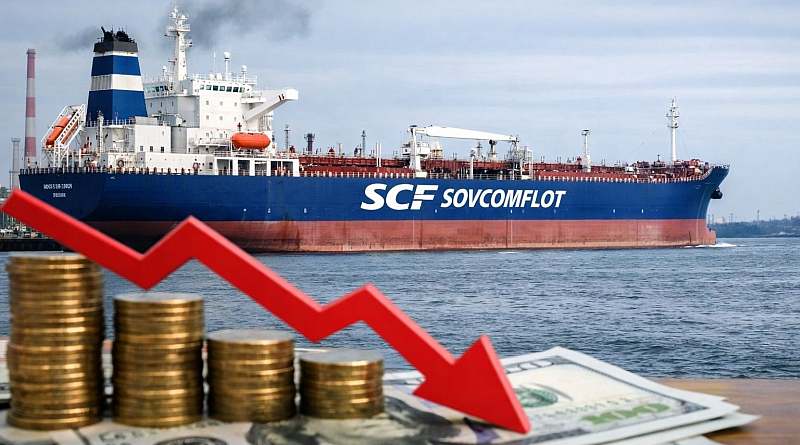

Information on the current losses of Russia due to sanctions as of 14.03.2026.
1. Ukraine attacked the Afipsky Oil Refinery and the port of “Kavkaz” in the Krasnodar Region.
– On the night of March 14, Ukrainian drones attacked the Afipsky Oil Refinery and the port of “Kavkaz” in the Krasnodar Region of Russia.
– As a result of the strike, technical installations caught fire at the Afipsky Oil Refinery. In the area of the port of “Kavkaz” in the Temryuk district, a technical vessel was damaged, and a fire broke out at the berth complex.
– The Afipsky Oil Refinery is one of the largest oil refining enterprises in the south of Russia. The plant produces gasoline, diesel fuel, gas condensate distillates, heavy oil residues, and sulfur. Since 2019, the main owner of the enterprise has been “Oil Technologies,” part of the “Safmar” group.
– This is not the first attack on the plant: the Afipsky Oil Refinery was previously struck in January 2026 and November 2025.
2. Investments in Russia’s economy have fallen to the highest level in 10 years.
– Investments in fixed capital in Russia fell by 2.3% in 2025, marking the largest decline in the past decade, according to Rosstat data.
– This is the first reduction in investments since 2020, when during the pandemic, their volume decreased by 0.1%. The last more significant decline was in 2015 — by 10.1%.
– Throughout the year, the situation gradually worsened. In the first quarter, investments still grew by 6.5% year-on-year. In the second quarter, they had already decreased by 1%. The decline accelerated to 4.3% in the third quarter and to 5.3% in the fourth quarter.
– A survey by the Russian Union of Industrialists and Entrepreneurs showed that only 19% of companies continued to invest in the usual way. Meanwhile, 33% of enterprises significantly reduced investments, another 33% reduced them slightly, and 15% completely froze all investment projects.
– The most substantial decrease in investment activity was recorded in transportation, construction, and extractive industries, particularly in coal and oil and gas industries. Among the reasons are the high key rate and worsening economic situation.
3. The largest operator of Russia’s “shadow fleet” became unprofitable after sanctions.
– The largest Russian shipping company “Sovcomflot,” a key tanker operator for oil exports, ended 2025 with significant losses amid Western sanctions. According to the company’s financial statements, the net loss amounted to $648 million, whereas the previous year the company earned a profit of $424 million.
– The financial indicators sharply deteriorated — revenue decreased by 30% to $1.31 billion, and EBITDA fell more than by half to $518 million.
– The main cause of the losses was the sanctions against the Russian tanker fleet. As a result, dozens of Sovcomflot’s ships were added to sanction lists, complicating their operations in the international market.
– The company also reported write-offs and asset devaluations amounting to $550 million. Additionally, the sanctions led to downtime for some tankers, increased insurance and logistics costs, and a reduction in fleet load.
– Before the full-scale war against Ukraine, “Sovcomflot” owned one of the largest fleets of Aframax class oil tankers in the world and played a key role in transporting Russian oil for export.
4. Losses in the Russian coal industry exceeded 400 billion rubles.
– Russian coal companies recorded a total loss of 408 billion rubles by the end of 2025, according to Rosstat data. Over the year, the country mined 429 million tons of coal, resulting in an average loss of nearly 951 rubles per ton.
– Only 33.9% of companies remained profitable, compared to 46.7% the previous year. The total profit of such enterprises amounted to 76.9 billion rubles, almost half of what it was in 2024. Meanwhile, the total losses of non-profitable companies nearly tripled — to 484.9 billion rubles.
– The coal sector showed the worst financial results among all sectors of the economy, as well as the highest share of loss-making enterprises — 66.1%.
– The industry’s problems began to worsen back in 2024, when coal mining became one of the few sectors where the number of loss-making companies exceeded the number of profitable ones. In 2025, the situation was exacerbated by Western sanctions, a drop in global coal prices, and the strengthening of the ruble. Almost half of Russian coal is exported, so the strengthening of the national currency by more than 20% significantly reduced the incomes of exporters.
– The Russian government was forced to implement emergency support measures several times — including providing tax deferrals, compensations for part of the railway transportation tariffs, and assistance in restructuring loans.
– The deterioration of the financial condition of coal companies is also affecting the banking sector. According to the Central Bank of Russia, the share of problem loans in the “metals and coal” sector grew from 2.8% to 7.6% over the year, one of the worst indicators among economic sectors.
5. Russia spent five times more on the war than the income of all poor citizens combined.
– In 2025, Russia spent about 10.9 trillion rubles on the war against Ukraine, which is approximately five times the combined income of all Russians living below the poverty line. This is evidenced by data from Rosstat and statements by Russian officials.
– According to Rosstat estimates, Russia’s GDP in 2025 was 213.5 trillion rubles. The Minister of Defense earlier stated that military expenditures accounted for 7.3% of GDP, of which 5.1% of GDP was directly related to combat operations. This corresponds to approximately 10.9 trillion rubles spent on the war.
– At the same time, Rosstat reported a decrease in the poverty rate. In 2025, the number of Russians with incomes below the poverty line fell below 10 million for the first time — to 9.8 million. Over the year, this number decreased by 0.5 million, and the share of the poor population dropped from 7.1% to 6.7%.
– The poverty line in Russia was 16,903 rubles per month, or 202.8 thousand rubles per year. Accordingly, the total annual income of all 9.8 million Russians living below the poverty line is less than 2 trillion rubles.
– Thus, even a fifth of the funds spent on the war could formally cover the income of all citizens living below the poverty line.
– At the same time, the official poverty line in Russia is underestimated because it is calculated based on the subsistence minimum of the fourth quarter of 2020, which is only indexed for inflation. Meanwhile, actual inflation for low-income households is usually higher than average.
6. U.S. policy and the escalation of global energy risks could further bring Russia and China closer.
– Such rapprochement could push Beijing to intensify energy projects with Moscow, including the construction of the “Power of Siberia-2” pipeline.
– After the start of the full-scale war against Ukraine, Russia has become increasingly dependent on China as a key economic partner. At the same time, Beijing also regards Russia as an additional source of stable energy supplies amid geopolitical instability. In 2025, trade between the countries decreased by 6.9% — to $228 billion after a record $245 billion in 2024. The reason was the fall in oil prices, which constitutes the main part of Russian exports, as well as a decrease in demand for Chinese goods in Russia due to economic problems.
– Despite this, Russia remains an important energy partner for China: in 2025, it accounted for 17.9% of Chinese oil imports and 27.8% of natural gas imports.
– Beijing was not in a hurry to further increase its dependence on Russian energy resources. However, Trump’s war in the Middle East and the maritime blockade of Venezuela by the U.S. may change this calculation. China included several pipeline projects with Russia in its new five-year development plan.
– The document states that over the next five years, Beijing plans to advance preparatory work on the central route of the China-Russia gas pipeline.
– It is believed that this specifically refers to the “Power of Siberia-2” project, which is planned to be laid through Mongolia and use fields that previously supplied gas to Europe.
– Meanwhile, the final parameters of the project have not yet been agreed upon, so the timing of its implementation remains uncertain.
Collage: Диалог.ua
