

Information on the current losses of the Russian Federation due to sanctions as of 23.03.2026.
1. Ukrainian drones attacked one of Russia’s key oil hubs, the port of Primorsk on the Baltic Sea, on the night of March 23.
– The strike damaged a fuel tank, causing a fire. Primorsk is a strategically important facility for the export of Russian oil and Euro-5 standard diesel fuel.
– The port’s capacities are estimated at about 1 million barrels of oil and up to 300,000 barrels of diesel per day, making it one of the key elements of Russia’s energy logistics.
– This is not the first attack: last September, strikes on the port led to infrastructure damage and delays in oil shipments.
– Attacks on such facilities are part of Ukraine’s strategy to reduce Russia’s export capabilities and pressure its oil revenues, which remain a key source of funding for the war.
2. Following drone attacks, Russia is forced to suspend oil exports through key Baltic ports.
– The ports of Primorsk and Ust-Luga — Russia’s largest western export hubs — have stopped shipping crude oil and oil products since Sunday. Officially, Russian authorities do not confirm this, but acknowledge infrastructure damage.
– Specifically, the governor of the Leningrad region reported on the ignition of fuel tanks in Primorsk after the drone attack. Meanwhile, the scale of the export suspension has not been officially announced.
– Primorsk is a crucial channel for exporting Russian Urals oil and diesel fuel — its capacity exceeds 1 million barrels per day. Ust-Luga, in turn, ensures the export of about 700,000 more barrels of oil daily and tens of millions of tons of oil products annually.
– The shutdown of these ports occurs against the backdrop of an existing deficit on the global market due to disruptions in the Strait of Hormuz, which additionally intensifies volatility in energy markets.
3. In Russia, the economic and business climate has sharply deteriorated, with all key indicators immediately showing negative dynamics.
– In February 2026, the decline was evident in survey indicators published by Rosstat and the Central Bank, as well as in more comprehensive assessments by the Center for Strategic Developments, which take into account actual macroeconomic data.
– This concerns not only the worsening business sentiment but also systemic problems in the economy: a decline in investments, a reduction in industrial production, and a slowdown in GDP growth are recorded. This indicates that the crisis phenomena exceed expectations and are already directly impacting the real sector.
– The current downturn can only be compared to the sharpest periods of recent years — the crisis during the 2020 pandemic and the beginning of the full-scale aggression against Ukraine. Such dynamics indicate an increase in structural imbalances and a loss of resilience in the economic model, which is increasingly dependent on military expenditures and a limited range of export revenues.
– The deterioration of the business climate does not appear to be a temporary deviation, but a sign of deeper problems exacerbated by sanctions pressure, investment outflows, and the degradation of the production base.
– This creates risks of further decline and limits opportunities for economic recovery in the medium term.
4. In Russia, an unprecedented volume of “frozen” funds of the population has emerged, with over 70 trillion rubles sitting in bank deposits.
– This indicates deep imbalances in the financial system and a loss of confidence in alternative investment instruments. According to estimates, this amount is equivalent to about 30% of the country’s GDP and is effectively removed from active economic circulation.
– The situation is causing concern among financial authorities and market participants. – On one side, the Ministry of Finance views these resources as a potential source to cover growing budget deficits, which are deepening amid military expenditures and sanctions constraints. On the other, the Central Bank is forced to restrain any sharp movements of these funds, as their mass exit into consumption or investments could trigger a new wave of inflationary pressure.
– The key factor in the accumulation of deposits has been abnormally high interest rates, offering double-digit returns and displacing interest in the stock market.
– As a result, the stock market segment is effectively losing liquidity, while the banking system concentrates resources without their effective redistribution into the economy.
– The concentration of such liquidity volumes in deposits essentially reflects stagnation in the investment environment, increased risks, and a lack of attractive tools for long-term capital investment.
– This exacerbates the structural problems of the Russian economy and creates prerequisites for new financial shocks in the event of changes in monetary policy.
5. The container market in Russia in 2026 will effectively halt in growth: transport volumes will remain at the level of 2025, which was already 5% lower than the 2024 figures.
– According to Fesco estimates, stagnation affects both foreign trade and transit transportation through ports and land crossings, as well as domestic rail and coastal shipping.
– The key reason is weak domestic demand. Consumer demand for goods transported in containers remains subdued, directly impacting imports. It is the reduction in import flows, rather than external factors, that determines market dynamics. At the same time, the impact of the conflict in the Middle East is not yet decisive for container transportation in Russia. The much more important factors remain internal economic weakness and declining business activity.
– Stagnation in the container segment is one of the indicators of a general economic slowdown, as such transportation is closely linked to trade, imports, and consumer demand.
6. Russia has intensified the use of space technologies to intercept data from European users, exploiting vulnerabilities in civil satellite infrastructure.
– Russian apparatuses can track other satellites and approach them at minimal distances, enabling possibilities for radio interception.
– This includes the satellite “Luch-2,” launched in March 2023. After entering orbit, it began maneuvering near European communication satellites, including Intelsat-39, changing trajectory and effectively “patrolling” alongside them.
– Such behavior raises concerns, as it potentially allows Russia to intercept signals transmitted between Earth and satellites, especially if they are not properly encrypted.
– The problem is compounded by the fact that even some European military structures partially use civilian communication channels. The use of Intelsat-39 by the Bundeswehr has been confirmed, creating data leakage risks.
– There have been previous incidents where the Russian side gained access to communications of German military personnel due to a failure to follow basic security protocols. Russian capabilities are not limited to passive interception.
– Theoretically, there are also attempts to interfere with satellite control by intercepting commands from ground stations, which can lead to loss of control over the devices or their deactivation. Moscow uses space as another tool of hybrid warfare, trying to compensate for technological lag with aggressive and risky methods.
– Such activity not only undermines trust in civilian space infrastructure but also creates additional security threats for European states, forcing them to urgently reassess approaches to protecting communications.
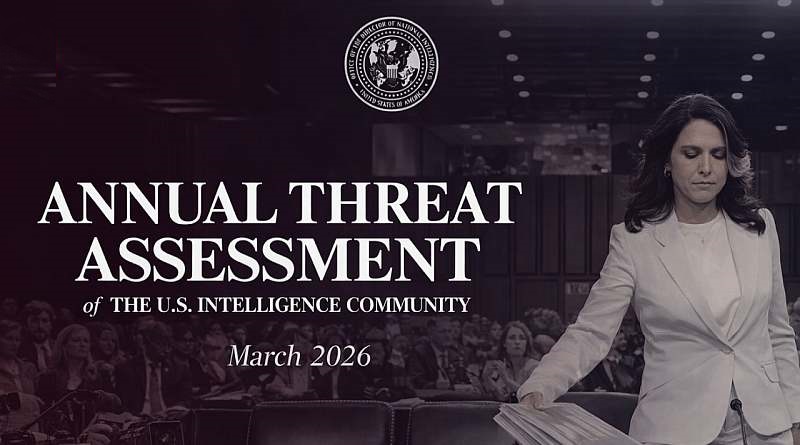
7. The USA has identified key state threats to national security, including Russia, China, Iran, North Korea, and Pakistan.
– This is stated in the annual report of the US intelligence community (Annual Threat Assessment 2026). The document notes that China, Russia, Iran, and North Korea view the US as a strategic competitor and potential adversary, attempting to weaken American influence through diplomatic, economic, and military means.
– Special attention is given to Pakistan, which is included for the first time on the list of significant nuclear threats. The reason is the active development of modern missile systems that, according to US intelligence estimates, could potentially reach US territory.
– The report also identifies a broader range of global challenges: missile threats, cybersecurity, migration processes, the development of advanced technologies, and instability in African countries.
– Washington emphasizes that constant monitoring of these factors is critically important for ensuring national security and strategic planning.
8. The European Union has begun restricting Hungary’s access to confidential negotiations due to concerns about possible information leaks to Russia.
– The reason is suspicions that representatives of Prime Minister Viktor Orban’s government are passing details of EU internal discussions to Moscow. According to European diplomats, bloc countries are increasingly holding sensitive consultations in narrow formats without Budapest’s participation to minimize the risk of information being passed to the Russian side.
– These negotiations concern security issues, sanction policies, and support for Ukraine. Additional tension was caused by reports that Hungarian Foreign Minister Peter Szijjarto communicated with Russian Foreign Minister Lavrov during breaks in meetings with European colleagues, passing information about the negotiations. Budapest denies these accusations, calling them “fake news.”
– Polish Prime Minister Donald Tusk stated that suspicions about information leaks have existed for a long time. According to him, this is precisely why some European leaders consciously limit the amount of information disclosed in the presence of Hungarian representatives.
– Diplomatic circles note that due to the risks of leaks, more strategic discussions are taking place in smaller groups of states, such as the Weimar Triangle or NB8 format, allowing for the avoidance of potential Russian access to EU internal discussions.
– Meanwhile, Viktor Orban’s government continues to block key EU decisions regarding support for Ukraine. Specifically, Budapest refused to support providing Kyiv with financial aid amounting to 90 billion euros. European diplomats note that the situation undermines trust within the EU and demonstrates how Russia attempts to use political allies in Europe to influence internal bloc processes and weaken its unity in countering Kremlin aggression.
9. Finnish customs officials uncovered a large-scale scheme to bypass EU sanctions, under which more than a hundred trucks and dozens of trailers were illegally exported to Russia.
– According to the investigation, one Finnish company exported equipment in 2022–2023, despite the European Union’s direct ban on supplying cargo transport to Russia, in effect since April 13, 2022.
– Preliminary findings indicate that this involves at least 135 trucks and 29 trailers with a total value of about 17 million euros.
– The exports were conducted through the Nuijamaa border crossing until the closure of Finland’s eastern border in December 2023. Formally, the equipment was declared as transit to third countries, including Kazakhstan or Turkey.
– However, the investigation revealed that virtually all the vehicles remained in Russia. The company’s documentation indicates a Turkish buyer, but the manager and owner of this entity is linked to Moscow, suggesting the use of shell schemes to circumvent sanctions.
– The discovered case underlines the systematic attempts by Russia to obtain sanctioned products through third countries and fictitious contracts.
– Despite official restrictions, the Russian market continues to be supplied with foreign-made equipment, casting doubt on the effectiveness of certain control mechanisms while demonstrating Russia’s dependence on imports even in basic segments of transport infrastructure.
