

The “greatness” and “self-sufficiency” of Russia’s military-industrial complex were the hallmarks of Putinism. However, four years of full-scale aggression against Ukraine revealed the reality: the “second army of the world” turned out to be critically dependent on one of the most isolated and repressive regimes on the planet.
The North Korean factor became not just a support for Moscow, but a fundamental condition for continuing the protracted war, turning Russia into a military-technical hostage of Pyongyang.
The latest investigation by “Important Stories,” published on March 16, 2026, reveals the scale and cynicism of the shadow supply schemes. Since June 2023, four Russian ships have made at least 112 trips to North Korea. Behind this dry number lies the supply volume of 8 to 11 million ammunition pieces delivered to support Russian artillery terror. On average, Pyongyang supplied Moscow at a rate of 350,000 shells per month.
Particular attention deserves the mechanics of circumventing sanctions. The supplies were carried out by companies “MG-Flot” and “Sovfracht,” and the final destination in the documents was listed as the South Korean port of Busan. Russian border guards and customs officers were practically involved in state fraud, processing documents for South Korea while the ships were unloaded in North Korea.
This is not just “parallel import”; it is the institutional merging of Russian state structures with methods of international smuggling.
The total value of the transferred weapons, from artillery kits to ballistic missiles and MLRS, amounts to between 2 billion and 10 billion U.S. dollars.
The formalization of the supplies was carried out according to the strategic partnership agreement of 2024. It de jure established the scheme: the Kremlin pays for the shells not only with money but also by transferring sensitive technologies, including missile and probably nuclear developments, as well as direct economic support to Kim Jong Un’s regime.
North Korea supplies Moscow not only with deadly metal but also bonds the alliance with the blood of its soldiers. The participation of 10,000-15,000 North Korean military personnel in battles in the Kursk region became a historical precedent. Today, closed memorial events are being held in North Korea in memory of the fallen “volunteers” in Ukraine.
These ceremonies represent a silent acknowledgment that Kim Jong Un successfully monetized the lives of his citizens, sending them to slaughter to support Putin’s ambitions. For the Kremlin, these Juche soldiers are merely a means to avoid another wave of internal mobilization, which could undermine the government’s rating.
However, by the beginning of 2026, the intensity of arms supplies sharply decreased: only one major trip was recorded. Experts see this as two scenarios, neither of which bodes well for the Kremlin.
Firstly, North Korea has been depleted, as even Pyongyang’s vast Soviet reserves are not bottomless. And the Kim regime cannot completely disarm itself in the face of South Korea. Secondly, Russia is trying to increase its own arms production but is doing so at the cost of turning the Russian economy into a “military camp,” where civilian sectors degrade in favor of shell production.
Ultimately, Putin’s dependence on the creators of Juche is a verdict on the myth of a “great power.” A country that claimed to be a global pole is today forced to disguise its ships as South Korean and beg for shells from Pyongyang. Such an alliance has turned Russia into a toxic pariah, whose military potential now directly depends on the whims and reserves of the most closed regime in the world.
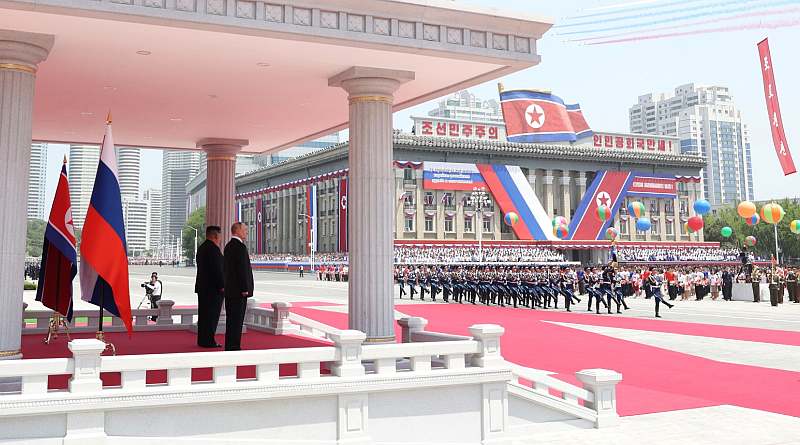
In the lead image: Putin arrived in Pyongyang on a friendly state visit at the invitation of Kim Jong Un. June 19, 2024.
