

Glory to Ukraine!
Glory to the defenders of Ukraine and all modern civilization!
In today’s issue:
- Why the trilateral talks in Geneva are not peace talks
- What could make Trump change his policy and be forced to resume aid to Ukraine
- Vitkoff and Kushner are trying to negotiate with Iran to return to the agreement that Trump broke in 2018
- By embracing Orban and Fico, Rubio demonstrates unity with Trump’s Europe and a lack of unity with Europe based on the values of liberal democracy
- The latest domestic events in the USA: forced withdrawal of immigration police and border patrol forces from Minnesota; and the grand jury’s refusal to approve absurd charges against six Democratic members of Congress
▶ Talks in Geneva. De facto collective Secretary of State, the president’s friend Vitkoff and the president’s son-in-law Kushner, are conducting negotiations in Geneva on three fronts at once.
They are conducting direct negotiations with the Russian and Ukrainian delegations (about what exactly, slightly below), indirect negotiations mediated by Oman with Iranian Foreign Minister Araghchi and with Putin’s emissary Dmitriev, who is not a member of the Russian negotiating group in the trilateral talks.
Can the trilateral talks in Geneva be called peace talks? No.
Because when they want to conduct peace talks, they cease fire. In all wars that ended not with the capitulation of one of the sides, but with peace treaties, the peace talks were preceded by a ceasefire by mutual agreement. Thus, when the fire ceases, if the warring parties strive for a permanent and lasting peace, they conduct peace talks. A classic example is the conclusion of the peace treaty between Israel and Egypt in 1978 after five years of negotiations that began after the ceasefire in the Yom Kippur War. Sometimes the fire ceases, and peace talks are not held. But in this case, frontal hostilities are not conducted for decades. Like between Israel and Syria or North and South Korea.
Therefore, the talks in Abu Dhabi and Geneva cannot be negotiations for peace. From the perspective of the 47th President of the United States, this is an attempt to pressure Ukraine into agreeing to cede the non-occupied part of Donbas to Russia. Since Trump, according to Vitkoff and Kushner, believes that in this case, Russia will agree to end the war (which is entirely impossible, as this would only provoke Russia into further aggression). From both Ukraine and Russia, it’s a diplomatic struggle to ensure the 47th President of the United States does not take actions that favor the opposing side. Russia’s goal is to buy time, simulate negotiations as the USSR did in the ’70s and ’80s, and continue the war as long as it has the resources to do so. They even managed to move the talks to their favorite place—Geneva, where they are willing to go just as their Soviet predecessors did.
People ask, what if Trump announces that he is “leaving the process” and will focus on something else. The answer is simple: he will not leave. For two reasons. He has promised so many times to end the war “in 24 hours,” “in two weeks,” “in four months,” that leaving the process would be a very serious political defeat for him. And he cannot lose at all. He always has to be the winner. And the “12 trillion” promised to him and his friends by Putin will not be a guiding star, but a mirage that in his virtual world is the most important part of his life’s purpose—personal enrichment and converting power into money in his pockets.
▶ What was much more interesting was what happened on Monday in Kyiv, where two Democratic senators—Whitehouse and Blumenthal—visited. And here’s what was interesting. Zelensky was explaining what weapons Ukraine needs, and they listened very attentively and took notes. They said that the U.S. should provide Ukraine with these weapons. How? The mechanism is clear. If the Democrats win even just the House of Representatives in the November elections (although with Trump and the Republican party’s current extreme unpopularity, they have a chance to win the Senate too), they will have the ability to shape the legislative agenda. This includes proposing a bill to renew American military aid to Ukraine, allocate funds for it, and oblige the administration to provide such assistance. There is no doubt that such a bill could be passed, and there is almost no doubt that enough Republicans could vote for it in the new Congress for the president to have no chance to veto it. Why is this scenario possible? Simply because after the congressional elections, if the Republicans suffer defeat even in just one of the chambers, they will stop looking back at Trump. This is inevitable because they will need to seek a new leader for their party by the 2028 elections.
This development could realistically force Trump to do something he very much wouldn’t want to—comply with such a law, if passed.
▶ On the U.S.-Iran negotiations. For about 6 years, from 2009-2015, the UN Security Council’s permanent member countries and Germany held discussions with Iran about halting its development of nuclear weapons. In 2015, an agreement known as the JCPOA was reached, under which Iran ceased enriching uranium to weapons-grade levels, exported all enriched uranium to Russia, and allowed IAEA inspectors access to its nuclear facilities. According to assessments by both the IAEA and U.S. intelligence (confirmed by intelligence in an open report to Congress in early 2018), Iran was complying with the agreement. Nevertheless, later in 2018, the then-45th President Trump announced the U.S. withdrawal from the agreement. Consequently, Iran stopped adhering to it, resumed uranium enrichment, shut its nuclear facilities off from inspections, and began rapidly progressing towards the development of a nuclear bomb.
Thus, the negotiations that Vitkoff and Kushner are conducting with Iran’s Foreign Minister Araghchi are discussions about concluding an agreement similar to the JCPOA. There are two questions here. Is it possible to step into the same river twice? And the second question, essentially stemming from the first: why withdraw seven years ago from a working agreement only to now attempt to negotiate a similar one? Except the American negotiating team that achieved the JCPOA agreement was led by a highly experienced professional diplomat – former U.S. Deputy Secretary of State Wendy Sherman. And now the negotiations on behalf of the U.S. are led by two businessmen – a friend of the president and the president’s son-in-law, acting on his behalf as a collective secretary of state, but lacking both diplomatic experience and corresponding professional knowledge.
▶ A small note in the margins. On Saturday, I wrote that the content of Secretary Rubio’s speech in Munich does not differ from the content of Vice President Vance’s speech a year ago. The tone is significantly different, but the essence, the meaning, coincide almost literally. And I added that with such an approach, it is impossible to be united with Europe, which is built on the values of liberal democracy – freedom, human rights, equal rights for all people, the rule of law. One can only be united with Orbán’s Hungary and Fico’s Slovakia.
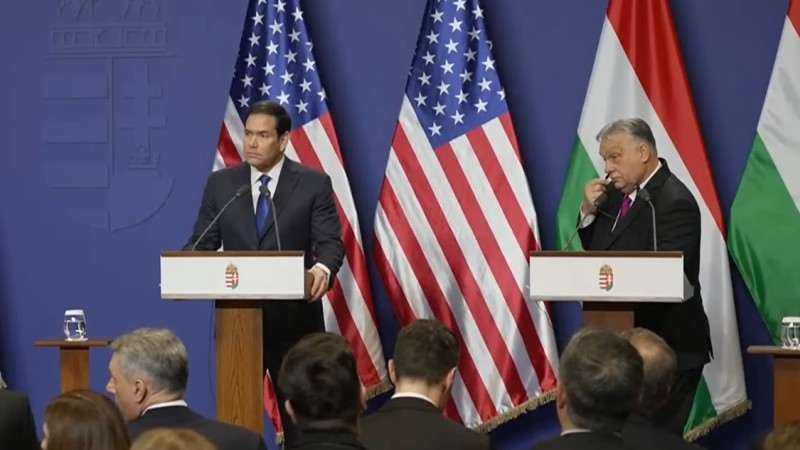
And what happened? Marco Rubio headed from Munich to Bratislava on Sunday, where he met with Fico, and on Monday, he was already embracing Orbán in Budapest, declaring that a “golden age” has now dawned in U.S.-Hungary relations.
This is the kind of unity with Europe demonstrated by the Secretary of State. Nothing else could be expected from him. In all the program documents of the Republicans and the administration of the 47th President—from the “Project 2025” to the National Security Strategy—it is proclaimed that the United States will have close relations only with those European countries where ultra-right parties are in power.
Notably, at the joint press conference with Orbán, Rubio avoided answering the question of whether the “golden age” in US-Hungary relations would continue if Orbán and his FIDES party were defeated in the April elections.
Rubio also stated at the same press conference that the First Amendment to the US Constitution, which guarantees complete and unrestricted freedom of speech from governmental interference, does not de facto apply to foreign citizens. Rubio declared that foreign citizens coming to the US and publicly speaking against the administration’s foreign policy could have their visas revoked, as they hinder the administration from conducting its foreign policy. He added that the courts cannot annul such visa revocations because foreign policy is the prerogative of the executive, not the judicial branch. However, it should be noted that the protection of freedom of speech for all people on US territory in accordance with the First Amendment to the Constitution is the duty of the judicial branch.
▶ On some of the domestic events in the US that occurred over the past week.
● Trump was effectively forced to acknowledge his complete defeat in the war he effectively declared on the city of Minneapolis and the state of Minnesota. His “border czar” Homan stated that immigration police units have completed their “operation” in Minneapolis and are being withdrawn from the state of Minnesota. The results and symbolic events of this punitive operation included the demonstratively brutal killing by an immigration police officer and a border patrol service officer of two US citizens—Renee Hood and Alex Pretty, the arrest and sending to an immigrant internment camp of a five-year-old boy and his father, whom the court ordered to be released and returned home.
The defeat of Trump in the war he declared against Minneapolis and Minnesota became possible because tens of thousands of people in Minneapolis and across the country protested daily against the punitive operation, demanding its end. Minneapolis took to the streets and won; the people showed that they are Citizens. Where people act as true Citizens, no authoritarianism can prevail.
In addition, Trump was also forced to cancel orders to federalize the National Guard and withdraw it from all the cities where he had sent it. He had to do this after the Supreme Court ruled that his order to deploy National Guardsmen in Chicago was illegal.
● Trump’s attempt to charge two Democratic senators (Kelly and Slotkin) and four Democrats – members of the House of Representatives – with conspiracy to incite rebellion turned into a very painful political and legal defeat. Six lawmakers – former military and intelligence officers – recorded a short video about two months ago, urging service members not to follow illegal orders, if given, and reminding them that the law allows them not to follow illegal orders.
The 47th president immediately accused the participants of the video call of treason, urging their arrest and execution.
And, apparently, instructed the federal prosecutor to press the corresponding charges against them. Federal prosecutor for the District of Columbia, Jeanine Pirro, who once worked in the prosecutor’s office but later spent many years as a host on Fox (where the president noticed her), undertook to execute the order. She prepared charges against all six for conspiracy to incite rebellion.
But such authoritarian tendencies hit a snag. In the United States, to charge someone with a criminal offense, the prosecution must go to a grand jury. A grand jury typically consists of 23 randomly selected citizens. Prosecutors must present the evidence collected to the grand jury and justify that it is sufficient to press charges. The grand jury decides by voting. If the majority is “in favor,” charges are pressed; if “against,” the prosecution cannot press charges. The grand jury in Washington unanimously rejected the attempt by the federal capital’s prosecutor to press completely absurd, ridiculous, and illegal charges against the six lawmakers.
There are 1068 days left until the end of the story called “Fear: Trump in the White House” © (the title of Bob Woodward’s book, published in 2018).
Thank you to everyone who read this. Take care of yourselves and your loved ones. Look after each other, help one another. Good health to all.
Ultimately, what happens in the world depends on us. Whether we fight evil, do Good, remain mere observers, wait passively and believe that someone somewhere will decide for us, or fight evil and do everything possible for Good to prevail.
We must not allow evil to triumph. The victory of evil would mean the end of the world in which we live. We cannot allow this. Especially now.
Ukrainian friends, I embrace and love you all. Please take care of each other.
Ukraine is and will always be.
And evil will be defeated and punished. And this is certain.
